That strange video inside an empty swimming pool was pretty cool. I always thought Bass VI would be awesome for solo live looping. Add an octave-up pedal and you have the full range at your disposal.

TalkBass has been independent since 1998. Add your voice.
Create a free account to reply to discussions, view embedded media, and browse with fewer display ads.
Join free Log in
Want zero display ads or expanded classifieds tools? Compare plans.
That strange video inside an empty swimming pool was pretty cool. I always thought Bass VI would be awesome for solo live looping. Add an octave-up pedal and you have the full range at your disposal.
It lacks the sort of low end authority that even a good shortscale bass delivers on.
Unless you play in a band that can handle a really thin sounding bass.
I didn’t say it wasn’t cool. Just a very niche instrument.I defy you to check out the Julie Slick vids posted by @Toptube (post #59) and me (post #71) and then say that again.
Oh, I totally agree with that. In fact, the ways in which Julie uses it illustrate your point: playing solo with a looper, and playing in a band with another bassist. Those are definitely "niches." When she's in a "traditional" bass role, as when she tours with Adrian Belew, she uses a "regular" 4- or 5-string.I didn’t say it wasn’t cool. Just a very niche instrument.
I'm not sure that there is a "rule" that "octave" attached to an instrument always means octave up. When we say "octave mandolin," it's an octave down. That's where my version of Bass VI terminology comes from, as the octave mandolin is a very common instrument that one is quite likely to encounter during a life as a musician. It's just a shorthand for "octave down guitar." I've never heard of one of the octave guitars you describe, till now. Seems to me like an octave up guitar should be called a soprano guitar. I'd love to play one, whatever it's called.
The common usage is that those are called octave guitars and VI's are called VI'S. Too late to change it now.
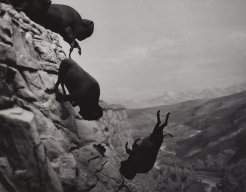
Lennon definitely played Fender VI on 3 rehearsal takes when the song was slow (before Paul got 'inspired' by Pete Townsend to make loudest dirtiest recording), Take 2 of this was released on Anthology in edited form and on 2017 White Album reissue in full. Throughout you can hear John playing one E note for 12 minutes.
For the released version, the outtakes from 2017 White Album (and more studio chat from Beatles Rock Band video game) point to the fact that it was Paul playing his Fender Jazz bass, which he used quite a lot on the White Album. Because during the chat when he says to have extra guitar bar in the first intro, then demonstrates the ending crash, he is "singing" all of that and also demonstrating it on the bass. And the bass sounds exactly like on the released version. Furthermore, reissue also includes short quick Baby, Let's Play House cover with the same bass sound as well.
Considering John's bass playing on Fixing a Hole, The Long and Winding Road, Let It Be (before Paul re-recorded bass track), he sucked on bass for some reason, so I don't think there was that one magic moment when he played that grinding Helter Skelter bass line for 20+ takes.
Anyway, it's all off-topic, the point is: yes, Beatles used Fender VI but only a couple times. It didn't become the mainstay and wasn't used often like in the case of The Cure.

[Invalid or Expired Link Removed]


Fender Bass VI - WikipediaI have the recent 30" scale Gretsch that they have shipped as both an E to E Bass VI style bass and a B-B baritone guitar (aside from the nut and the strings it's the same instrument).
I've flipped it back and forth between the two, and as much as I like the idea of a Bass VI, like most here it just doesn't do it for me in reality. The sweet spot for me is an A-A tuning, because I can do familiar bass-y stuff one the A-D-G strings, and also get chords without muddiness all over the neck. It's still a novelty for the most part though.
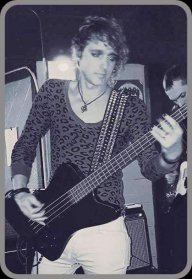
That's preeettyyyy

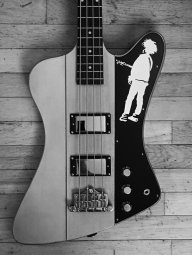
Not necessarily. It strongly depends on the strings.


I suppose. Two bassists have caught my eye using a VI in a jazz/fusion context. Sveinung Hovensjo used one with the Terje Rypdal Trio. This band are interesting as they, to some degree, capture the sound of Bitches Brew-era Miles Davis in a power trio format. This clip shows them playing the track 'Icing' and then a John McLaughlin composition. Sveinung uses the bass as a lead/texture instrument at times and as a conventional bass the rest of the time. On the Terje Rypdal album 'What Comes After' he is credited with electric bass while another bass plays upright bass.
And he still has the bass, and I'm not going to argue with a Viking elder on this one:
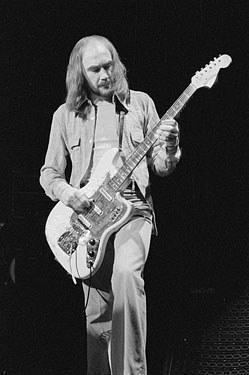
The other bassist is Roy Babbington, who replaced Hugh Hopper in Soft Machine. His example looks gorgeous in white, with a matching headstock.
Roy cut a slighter musical figure than Hugh Hopper, but again I think there are times in live performances where he cuts loose with the fuzz pedals.
In both cases it seems like the Bass VI was used to dart between conventional bass playing and easily accessing a sort of interesting 'middle' texture between guitar and bass. In The Soft Machine clip it compliments quite a dense mix of instruments.
7mm yes, but at the nut; it's 10.5mm (string centre to centre) at the bridge. Not saying it's not toight, I'd like it a smidgen wider myself, at both ends. But 7mm at the bridge would be like what, a toy guitar?This is exactly why I haven't got one of the Squier Bass Vi , I am 99.9% a fingerstyle player, I play a Hofner so I am used to narrow spacing but the Bass Vi is guitar spacing (7mm i believe) which is useless for fingerstyle playing, if they made one with 14mm spacing like a Hofner i would be all over it.
The first incarnation of Bond's project that I'm aware of was called the Graham Bond Quartet and featured John McLaughlin on guitar. You must have caught either the early days of the combo, before McLaughlin was in (I'm not sure Graham already played the Hammond live at the time though, he was mainly an alto player), or, more probably, a transition period after John was sacked (at Baker's behest), and before tenor saxophonist Dick Heckstall-Smith (an alumnus of Alexis Korner like the other three) was recruited, and the band redubbed the Graham Bond Organisation (back as a quartet, then). After two LPs, Jack was sacked (at Baker's behest - again) and the remaining three continued, bassless but with Graham playing organ pedals. Occasionally they were augmented with Mike Falana's trumpet. Then Baker left, joined Clapton who insisted on recruiting Bruce on bass (Jack had briefly subbed for John McVie in John Mayall's Bluesbreakers, and he'd also recorded with Clapton in the short-lived Powerhouse project), and Cream was born. Bond replaced Baker with Jon Hiseman. The Organisation's recordings of that era are dynamite, and sometimes feature Graham playing organ (pedals and left hand) and alto sax at the same time (as he surely did even before as you said), duetting with Heckstall-Smith. The latter was developing an "ensemble" technique of his own, similar to but independent of Rahsaan Roland Kirk's (two or even three saxes played at the same time by one player). Dick and Jon left Bond, played on the Bluesbreakers' album Bare Wires and founded Colosseum. Graham then put out solo albums and played with both Jack BruceJack Bruce played in a trio called Graham Bond Organization long before Cream.
Jack Bruce on Fender VI, Harmonica and vocals
Ginger Baker drums
Graham Bond Hammond Organ and Saxophone (often both at the same time) and vocals.
Must have seen them play weekly free of charge for over a year in a local pub in London Edmonton.
Shortly before Graham died (he fell under an underground train in Finsbury Park London) a young guitarist got on stage and jammed with the Organization, I've always believed that was Eric Clapton.
Shortly after Graham's sad death The Cream was born.