• TalkBass has been independent since 1998. Add your voice.
    Create a free account to reply to discussions, view embedded media, and browse with fewer display ads.
    Join freeLog in
    Want zero display ads or expanded classifieds tools? Compare plans.

Extended range bass amps..

That's the thing, I'm using the Carvin DCM2000L, and just using one channel, so 1,000 watts. I have the gain and everything set right, no clipping. And the sound was amazing! I'm more of a Mids and Highs guy anyways, so I tend to roll off on the Lows. I don't know if I should switch to a name brand head, something like Genz Benz, rather than finding the right cabinet for the amp I have.

What's wrong with Carvin cabs? I use their 4x10 and 1x18 with a Samson SX2800 for biamping. I use a crossover to send everything below 125 Hz to the 18. I also play with a low F# and tend to boost the bass frequencies. I've yet to experience any issues after 4 years.
 
That's the thing, I'm using the Carvin DCM2000L, and just using one channel, so 1,000 watts. I have the gain and everything set right, no clipping. And the sound was amazing! I'm more of a Mids and Highs guy anyways, so I tend to roll off on the Lows. I don't know if I should switch to a name brand head, something like Genz Benz, rather than finding the right cabinet for the amp I have.

If you like the sound you have but can't get loud enough without blowing speakers... then I think you need to use more speakers at once.

Kinda goes with the territory of even a bass tuned EADG that oftentimes to get good tone and get it loud, you're going to need some serious cabs. It's not as true for standard tuning as it used to be, but for low B and low F#, I think it still holds somewhat.

You might want to also experiment with some very detailed EQ's and start cutting out just the lowest frequencies. I've never played a bass with a low F# string, so I'm not sure at what frequency it would work best to start rolling off the lows. However, you really don't need much of the fundamental, even in EADG tuning, as tons of bass cabs don't even produce 41hz very well but still sound great. Most of your tone is going to be above the fundamental frequencies, as the harmonic frequencies are what give the instrument its timbre.
 
This is an interesting question - topic - and IMo is one that deserves a little more technical discussion about why it's not possible using a typical bass cabinet or two and what would be necessary to do this (and why).

First of alll, 23Hz is pretty low and may not be "heard" by most folks but perhaps felt.

All (MI) bass cabinets will not be suitable to reproduce 23Hz at any meaningful SPL and would likely tear themselves apart while attempting because the MECHANICAL power handling will end up being about 25-30% or the cabinet's rated capacity at 23Hz.

MI bass cabinets are designed to reproduce not just the very low but also to extend the response at higher frequencies too, and to do this at a reasonable efficiency. Part of the design equation trade-off is to avoid designing for the very low end. In practice this works well because MOST users are more concerned with material (fundamentals) starting almost 1 octave higher. Otherwise, bass cabinets would get much larger, heavier and less efficient PLUS they would need to be multi-way (not tweeters but mid bass and/or midrange) in order to maintain any midrange senstivity.

How would you accomplish this? Years ago, very long horns with large mouth areas would be the only practical way because of the cost of the power (ie. many thousands of watts) and the cost of the drivers necessary to do so in any front loaded (sealed or reflex) cabinet. BUT, things have changed... a suitable number of bass reflex cabinets equipped with drivers and cabinet volume/tuning could be used along with the now cheap power to get this done. The reason this would work is because of mutual coupling and active baffle extension that serves to lower the electro-mechanical rolloff point of the entire system. It could be done with quite a few of today's high performance bass cabinets but would likely take 50 or more drivers to extend low enough at adequate sensitivity. It also may not sound all that great in the midrange due to comb filtering BUT it may not be all that bad either depending on the application. It's probably not all that economical either.

Another method is to use fewer specialized larger subwoofer cabinets with driver components that have suitable properties to allow for low tunings in a reasonable (but still very large) box. I would suggest that 8 of the JBL SRX-718 cabinets in 1/2-space and with appropriate crossovers, LF lift eq, and protective high pass filtering would probably work. With both of these solutions, the power handling of the cabinets will need to be derated to maybe 1/2 or even 30% of nominal rating due to excursion limits of the drivers.

Why does it take so much speaker and power? A couple of reasons actually... the first being that the ear becomes LESS sensitive to very low frequencies and the second being that the speaker is less efficient at producing them. The combined effect is very significant.

Also, the bass amp must be capable of full power at 20Hz (ie. the system will need to have a ~20Hz, 4th order BW HPF) to allow full power at 20Hz and little below that in order to have hopes of surviving.

Hope this helps.
 
You mention a solid state Bmax. This thing will pass frequencies down to nearly DC.. I know.. pretty bad when the cones jump like mad just touching the strings.. Wastes too much power, and chasing tone is near impossible.. A high-pass filter is essential using this preamp.
 
That's the thing, I'm using the Carvin DCM2000L, and just using one channel, so 1,000 watts. I have the gain and everything set right, no clipping. And the sound was amazing! I'm more of a Mids and Highs guy anyways, so I tend to roll off on the Lows. I don't know if I should switch to a name brand head, something like Genz Benz, rather than finding the right cabinet for the amp I have.

The problem, such as it is, is not with your amp. Nearly any high-powered, pro-quality head or power amp will generate a full-range signal sufficient for your needs - depending on how loud you ultimately need/want to go.

The problem is that your cab(s) simply won't reproduce what your instrument and your amp puts into them. :eyebrow:

MM
 
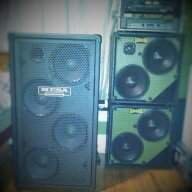
What are any ERB's on TB using for amp/cab? I have a hard time finding equipment that can handle the low F#0. I've blown two speakers in two different cabinets. It sounds amazing until that happens. I'm getting none to very, very limited clipping, power amp isn't getting hot. It seems okay then will crap out. I'm running out of cabinets, Haha! I have a Hartke HyDrive 8 10" and an Acme Low B 4 series ll that both need repairing. I've been using a rack compressor, power conditioner, BBE BMAX and a Carvin DCM 2000L. I can't get it right for some reason.

If you want bottom end maybe checkout theses ~

http://www.talkbass.com/forum/f15/mf-customers-rate-ampeg-svt-410hlf-speaker-1-a-830785/

Barefaced Bass - Dubster
 
AL!EN BASS, for your application you NEED a system with a mid driver. 4x10, 8x10, 2x12 are all going to give you problems.

If I understand correctly, you are using low tunings (F#) AND slap/pop play. This puts an immense amount of strain on your drivers. Think of it this way--you are putting a very low frequency signal and high frequencies (from slap) at virtually the same time. No woofer can handle this at high power and/or long periods of time. This is where crossovers really help. You can send lows to the woofer, mids to the midrange, and highs to the tweeter. A TRUE 3-way system like a fEARful will really help your cause.

Now, back to what dhomer was saying. A high pass filter could also help save your drivers and give you a little bit more efficiency. I don't think the Carvin has any DSP crossovers built in, but you may think of one in the future. At a minimum, HP at 23 Hz, but to really be out of the unloading zone, ~35 Hz would be better. This cuts into the fundamental frequencies that you are putting into the cab, but most of what you hear are harmonics anyway.

Unfortunately, much of this comes from the tradeoffs you make with a ported design. Yes, ported can go lower than sealed, but it is easier to blow a driver with a ported cab. Use drivers with high xmax, proper crossovers, and if available, limiters and you should be ok.

Another note: You say you are using a compressor. Compressors can also be dangerous. If you heavily compress and make up for it by cranking the power, this is another classic way to blow your cones.
 
Unfortunately, much of this comes from the tradeoffs you make with a ported design. Yes, ported can go lower than sealed
Not generally true for MI use if the player is trying to get a lot of sub 100 Hz output. The typical sealed cab is so many decibels down by 46 Hz (first overtone of F#0) that many attempt to make up for it by a lot of bass boost. That uses up excursion real fast, with not especially gratifying results.

Since the typical sealed cab isn't capable of making much down there to start with, it's just a recipe for toasted/broken drivers. People have a lot of misconceptions about sealed woofer cabs which in general find their greatest utility with tube heads. Not too many MI drivers are even developed for this application any more, though there are a few drivers that cross over decently between either ported or sealed use.
 
Lot's of good info here about what's happening down there electrically, mechchanically, how our ear hears it, etc. As far as tone and being practical, forget all about the 23hz thing. A cab that can honestly give good output into the 40's will give as big and full an F#0 as you're going to get. Aside from the fearful or similair diy designs, you're talking specific type cabs. Acme, the bigger Barefaced cabs, etc. It's going to have to be at least 2-way to have good representation of what needs representing, the tweeter may be optional. May want to consider a biamped system and possibly even a horn loaded dedicated sub on the lower half depending on what your overall volume needs are. That's deep stuff.

You say you're more of a mid/high guy, this may save you some as far as the huge lowend equipment goes. What you're really wanting to hear is more harmonics and less fundamental. Metal guys downtune to floppy string levels and play through common 610's all the time. I don't think it sounds all that great but that's an opinion. If you want to do that with clarity, slap, etc., you're going to have to beef up your bottom at least somewhat.

So, your answer may be what everybody else says all the time..."you need a fEARful".
 
"Everyone" is a sweeping generalization, you are correct sir.

lol, thanks Will - and you never know, maybe something like a fEARful 1515/66/1 might be just what the OP needs. ;)

I just got home from a gig - I’m beat!!! winding down (where's the yawn icon) :hmm:

BTW, +1 on Wills post - he always has good advice/ideas and the other suggestions posted here are worth looking into also.
 
WormtownBass said:
AL!EN BASS, for your application you NEED a system with a mid driver. 4x10, 8x10, 2x12 are all going to give you problems.

If I understand correctly, you are using low tunings (F#) AND slap/pop play. This puts an immense amount of strain on your drivers. Think of it this way--you are putting a very low frequency signal and high frequencies (from slap) at virtually the same time. No woofer can handle this at high power and/or long periods of time. This is where crossovers really help. You can send lows to the woofer, mids to the midrange, and highs to the tweeter. A TRUE 3-way system like a fEARful will really help your cause.

Now, back to what dhomer was saying. A high pass filter could also help save your drivers and give you a little bit more efficiency. I don't think the Carvin has any DSP crossovers built in, but you may think of one in the future. At a minimum, HP at 23 Hz, but to really be out of the unloading zone, ~35 Hz would be better. This cuts into the fundamental frequencies that you are putting into the cab, but most of what you hear are harmonics anyway.

Unfortunately, much of this comes from the tradeoffs you make with a ported design. Yes, ported can go lower than sealed, but it is easier to blow a driver with a ported cab. Use drivers with high xmax, proper crossovers, and if available, limiters and you should be ok.

Another note: You say you are using a compressor. Compressors can also be dangerous. If you heavily compress and make up for it by cranking the power, this is another classic way to blow your cones.


Well, I broke down and am having Don Berry build me a 15/6+Eminence tweet and hopefully after the holiday season get a 12/6 with a tweet on top. Getting rid of the Acme which is fixed btw.

So are you saying I shouldn't use a compressor but a high pass filter?! I do use a bit of compression but don't really have to crank my amp like crazy. I really don't like going above the halfway mark of I don't have to. I know next to nothing about a high pass filter.