• TalkBass has been independent since 1998. Add your voice.
    Create a free account to reply to discussions, view embedded media, and browse with fewer display ads.
    Join freeLog in
    Want zero display ads or expanded classifieds tools? Compare plans.

Fanned Fret Basses...why so few?

Link Removed

I have never owned or held a Rondo instrument so I neither endorse nor condemn them. From pictures the higher priced ones appear to be comparable to similarly priced instruments. There are plenty of owner comments here on TB, for and against. If you are new to Rondo do a search on them, read them, and form your own opinion.

As to non tension carrying mass affecting the frequency of a bass string, there is a simple experiment you can do yourself to demonstrate that this is true. I used solder wrapped around a C string, you could tape or clip whatever weights you have handy to a string to do the experiment on your own. Shown below is my C string with solder wrapped around it on the left and solder free on the right. I did not touch the tuner, I only wrapped and unwrapped the solder on the string. Adding mass to a string does indeed lower its frequency even though the mass is not carrying the tension.
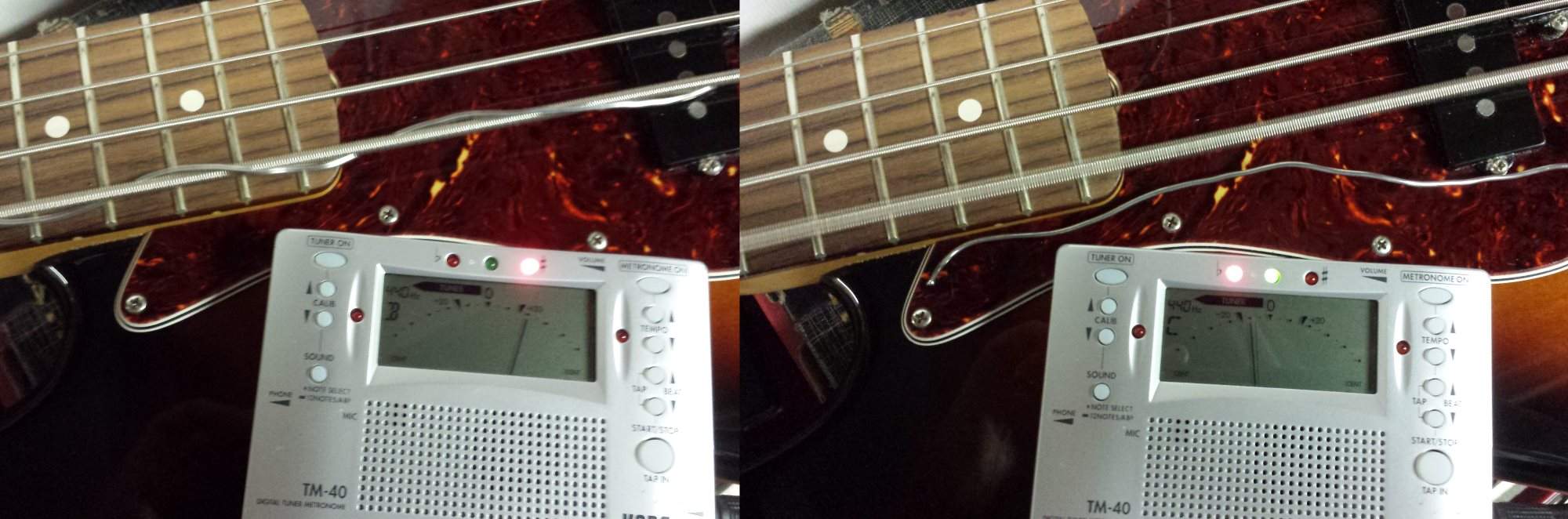

MassExperiment.jpg
 
So in your world, you find players that are happily making music with their inferior instruments, inform them of their ignorance, .

No, not at all. They wonder why I play other instruments, and point it out to them. You'd be sure of one thing. The first 10-12 years of my playing I definitely couldn't care less about any dead spots, or fan frets, or even 5 strung basses. Most people can't really tell why their basses suck, but they just trade them in for other ones, or sell them, because they have found this other bass that feels and sounds better, for whatever reason, but they can't pinpoint it. Just as with everything else. Working in music shop has been fruitful, informing all customers to be wary about. And watch out for. That they "hate" me is really that banter thing, I sort of "forced them" to look for basses without dead spots. And believe me, you don't have to change models out, from Fender J or P to find a bass without dead spots. There are plenty of P and J basses without dead spots everywhere. Just like you learn people what to look into a false diamond, what to look for.

A lot of people came into our shop, with their basses and asked (after a few years): "Hey look, what is this thing...the note stops right here"...
 
Last edited:
Link Removed
... Adding mass to a string does indeed lower its frequency even though the mass is not carrying the tension...

There you nailed it. "Even though the mass is not carrying the tension". Then why play a bass at 34 " or 33 " scale anyway? Just slam thick SOB gauge on an electric guitar at 25" inch scale or a Gibson Les Paul one, like 24 7/8 inch scale, change out nut, and bridge accordingly and leave it at that. Why should any bass be longer at all !? ;)

Of course I've never ever said that a thicker string will not have lower note at the same tension. But if it's only about that go consider my option, stated above. Why not use a mandolin with huge short wires on them thick as a AC/DC 110V cable?

You can't make strings of just lead (led) if you'd like. It has high density and mass don't you think? It aint enough having something real thick just wounded around the core of the string. Then, when plucked the string will swing (oscillate) too much and want's to contract and get shorter but the string can't due to its scale. Then it has to go somewhere and that is up in pitch. Not to say about how loud the inharmonics will turn.

- - - - -

Anyone remembers the old 80's Yamaha Electric Grand Pianos? Especially the CP80 with 88 keys. Them bass strings where too short, and that one was the only "grand piano" that I've managed to bang on the keys and the bass notes didn't stay in tune, the went up in pitch quite sharp and a lot when just hammering down like I would on an ordinary upright piano. They even went out of tune if you played too much on the bass notes, and actually stayed out of tune. They got stuck in that position. Because the string "thought" that someone turned on the tuning pegs, so they "thought" "well, let's stay there then". ;)

The oscillations turned the string to get shorter all of time, and soon enough, the strings stayed in that position. Got stuck. Just like when retuning any string on a bass or guitar. It stays at that retuned pitch for a while, but after 15 minutes it has slowly drifted towards the old pitch again, and you have to turn on the tuning pegs again to fine tune it. Especially when tuning down from high to low. Same principle. And boy where those bass strings thick...;)
 
Last edited:
Answer to OPs question if:

1. Why they arent that many who plays fanned frets? Why so few? A: There aren't that many around, simple as that. Not too many makes them.
2. Why they aren't that many brands who makes them? Why so few makers of them? A: They aren't that many players around who demands it. Or have asked for it. Because they don't even know such idea existed. Period.

Now close this thread.

There are plenty of manufacturers who make fanned fret instruments. Somebody posted a thread the other day and listed at least ten different manufacturers who all make fanned fret basses. The reason that these manufacturers offer it is due to the demand for such an option.

I agree this thread should be closed, however, it stopped being productive long ago.
 
  • Like
Reactions: Honch
And of course, once Ibanez fan frets has caught on, everybody else will get a "ME TOO" sense, and "also-ran" productions, and will see fan fretted instruments that has been made without any deeper thought to it. Here's one from MOSES graphite, guess what's wrong with this fanned fret graphite neck?

[Invalid or Expired Link Removed]
 
For the record, Strandberg are working on a bass which is the first non-Dingwall that might really spark my interest in a few years.
Their guitars are super light (~2-2.5kg) which is something I value. Ola Strandberg mentionned he's aiming for a Wal ballpark tone.

Screenshot-2015-02-22-17.17.30.png
 
  • Like
Reactions: Honch
Then why play a bass at 34 " or 33 " scale anyway? Just slam thick SOB gauge on an electric guitar at 25" inch scale or a Gibson Les Paul one, like 24 7/8 inch scale, change out nut, and bridge accordingly and leave it at that. Why should any bass be longer at all !? ;)

As a matter of fact there are people here who do that and are very happy with the results. I might as well ask you why you stop at 37 and don't go up to 43 like a double bass?? We are all different, we have different goals, and different things feel right to us. We are lucky to live in a time when string technology and instrument designs accommodate our wide variety of tastes. I don't care how pure and beautiful your Dingwall sounds to you because the mix I play in drowns out all those subtleties. And that is before I turn on the fuzz box! One answer does not fit us all. That 17th century instrument had fanned frets not because they sounded beautiful but because string technology of the day did not allow it to be made with a single scale for all strings. Modern metallurgy and string building techniques allow you to make a bass with almost any scale length you might like and there are people who push the limits of that at both ends, for different reasons, and they get the results they had hoped for. Life is good.

I listened to people here blather on and on and on about five string basses for about a year before one of them finally gave a good answer to the question "why do I want five strings?". The only really telling answer is that it gives you more range from any given hand position. That is the fundamental feature of a fiver that makes them worth owning. I am still waiting for that reason from the fanned fret community. I have yet to hear a "must have" feature of the fanned fret approach.
 
I don't understand. What justification is needed? Was I wrong in buying a fanned fret bass? Can you elaborate?

I don't know, is life all about you?? ;)

I am not saying that any of you need to justify to me why you do what you do. That would be silly. All I am saying is that if some bass builder wants to sell me their fanned fret bass then they have to give me a reason to want one. I don't see that reason in anything that was said above. If it does not solve a problem that I am having or let me do something that I cannot do right now, then I don't see any reason to buy one, just as I did not buy a fiver until someone pointed out the real advantage of having the fifth string. If the bass builders cannot give me a reason and the community of fanned fret users cannot give me a reason then it is safe to assume that I don't need one!

Clear enough now?
 
I don't know, is life all about you?? ;)

Considering I live my own life, yes it is. Maybe your life is all about you but that's your own deal.

I am not saying that any of you need to justify to me why you do what you do. That would be silly. All I am saying is that if some bass builder wants to sell me their fanned fret bass then they have to give me a reason to want one. I don't see that reason in anything that was said above. If it does not solve a problem that I am having or let me do something that I cannot do right now, then I don't see any reason to buy one, just as I did not buy a fiver until someone pointed out the real advantage of having the fifth string. If the bass builders cannot give me a reason and the community of fanned fret users cannot give me a reason then it is safe to assume that I don't need one!

Clear enough now?

No. If I don't want to buy something, I just don't buy it. If you already know all the reasons you don't like fanned fret basses, I don't see why you have to point that out to the people that do like fanned fret basses. I'm glad they don't work for you. Happy bass hunting.
 
You can't make strings of just lead (led) if you'd like. It has high density and mass don't you think?

Just a bit of trivia but in spite of its reputation lead is not all that heavy at 11.3 g/cm^3. It is just the heaviest of the metals we encounter most often, some others being iron, copper, and aluminum. The following are all nearly twice as heavy ranging from 22.6 g/cm^3 at the top to 19.1 g/cm^3 at the bottom:

Osmium
Iridium
Platinum
Rhenium
Neptunium
Plutonium
Tungsten
Gold
Uranium

I know for sure that at least two of these are radioactive and I don't know if any of them are a practical choice for affordable bass guitar strings! Tungsten or a tungsten alloy maybe.
 
No. If I don't want to buy something, I just don't buy it. If you already know all the reasons you don't like fanned fret basses, I don't see why you have to point that out to the people that do like fanned fret basses. I'm glad they don't work for you. Happy bass hunting.

You seem to be missing the point of this thread. This is not a club thread for Dingwall or fanned fret bass owners. This is a thread that ultimately asked the question why doesn't everyone buy fanned fret basses? I don't hang out in fanned fret owners threads and rain on your parade. I came here to offer my opinion on the OP's question and to hear what you all have to say about why you think I should own one. This thread is supposed to be the place where both camps can talk about what they like and dislike in a bass with the ultimate goal of shedding some light on the OP's question and the secondary goal/opportunity for you fannedboys (pun intended) to convince some of us to join you and thereby strengthen the market for the basses that you love.
 
This is a thread that ultimately asked the question why doesn't everyone buy fanned fret basses?

I don't even think that's a legitimate question. Everyone? Really?

the secondary goal/opportunity for you fannedboys (pun intended) to convince some of us to join you and thereby strengthen the market for the basses that you love.

My goal in playing a fanned fret bass is to have fun. I don't care about the fanned fret market and I certainly don't need or want to convince anyone to get one. Like I said, it'd be nice if people that were actually interested in them would ask questions instead of pointing out how they don't meet some personal need I don't care about.
 
  • Like
Reactions: arrowsun
... This is a thread that ultimately asked the question why doesn't everyone buy fanned fret basses? ...

No it bloody hell wasn't! If you read scores and charts as bad as this thread, I don't want you in any of my bands, besides all this, I have no use for two bass players. If you can't read/see the difference between "why so few" and "why doesn't everyone" then you shouldn't be able to arguing on anything on any thread at all. If you have the preferential right of interpretation to feel that the wording "why so few" EXACTLY MEANS "why doesn't everyone.." then I know more english than you do, and believe me, this is a first for me as a non-native english speaker. In rhetoric this is an argumentation error due to the ad hoc and ad hominem reasoning. Just like this logic flaw:

- You know everyone is a child to their parents right?
- Yeah, they shure are!
- But according to UN laws, child labor is banned and forbidden.
- Yes is sure is.
- But then no one is allowed to work then.

Get it? Just the same. And if we should be really nit picking, the word BUY wasn't in the OPs original question at all. It was PLAY. If you do that "lost in translation" or really "lost in interpretation" again, that PLAY = BUY is kind of beyond loopy. Or do you think people buy fanned frets basses and not play them? Why there's so many just buying them but not playing them? I dunno... in your world it is all up to interpretation.
 
We are lucky to live in a time when string technology and instrument designs accommodate our wide variety of tastes.
Instrument designs accomodate our wide variety of tastes. YES! You nailed it, and answered it yourself without actually knowing it. On variety of tastes are - say - fanned frets, graphite necks, headless, flatwound strings, roundwound strings. Every flavor you can think of.

That 17th century instrument had fanned frets not because they sounded beautiful but because string technology of the day did not allow it to be made with a single scale for all strings.
Oh, dear! This is laughable. So they started to make pianos with equal single scale when the string manufacturers upped the ante a century on? ;)

I have yet to hear a "must have" feature of the fanned fret approach.

Just as the story with the dead spot I told you about. Someone doesn't get it until demonstrated by someone else. And THEN makes the choice by themselves like in "If I can't hear/see it, then it's not for me". Simple as that. Doesn't need to be more to it than that. Same with graphite necks, or headless. As I said, if I was just 10 years into my bass playing, I couldn't care less of dead spots, graphite necks, 5 strings (any). It's a thing that takes time. It slowly evolves and dawns on you. Like, if I should require that a beginner buy a fanned fret just when starting out...jeez. And scold him. Not everyone likes a Porsche or Ferrari, no matter how much money they own. It's just like sort of "why should you buy a car going that fast, when the speed limits it's a third of that?" thing. Fanned frets doesn't need to be a Dingwall mind you. I think we should all get rid of that misconception by now, as Ibanez has entered that scene. It's like mathematics at school. You think it's boring as h*ll. You have to "find da'thang" by yourself. I don't scold people if they don't get the explanations. It's when they themselves comes up with "not even wrong" arguments that I am ready to take the verbal fight.

I do not listen or laud bassists just because they're playing fanned frets. They can be just as bad or good as anyone else. I don't say hi to people just because their gig bag shows the Dingwall logo, or something else, when passing them on the street. I couldn't care less what people plays.

You should read NOVAX site, instead, where he explains it in more academic terms. Don't skip that part on "CLANG TONE"! That's really over the top A Retentive. That's the most interesting part.