
Enjoy the benefits of a premium membership!
Upgrade Account
-
TalkBass has been independent since 1998. Add your voice.
Create a free account to reply to discussions, view embedded media, and browse with fewer display ads.
Join free Log in
Want zero display ads or expanded classifieds tools? Compare plans.
You are using an out of date browser. It may not display this or other websites correctly.
You should upgrade or use an alternative browser.
You should upgrade or use an alternative browser.
Fanned Fret Basses...why so few?
- Thread starter Bassheart365
- Start date
More options
Who Replied?
I was trying to find a way to tie in fanned fret instruments with the fine furniture built in Scandinavia (of which I have bought a fair amount over the years) and this is the best I could come up with!...here in Scandinavia...

I think that the demand is higher for multi-scale instruments than it was a decade ago, but it seems apparent that the majority of the bass-buying public prefer mono-scaled instruments. I really don't see multi-scales ever outselling mono-scales. As always, this is simply my humble opinion.
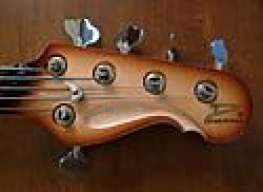
I was trying to find a way to tie in fanned fret instruments with the fine furniture built in Scandinavia (of which I have bought a fair amount over the years) and this is the best I could come up with!
View attachment 706613
Fanned fretless table - how is the tone?
..but I am just commenting on the OP's question: why do so few people use fanned fret basses?
Well, I've interpreted the OP's question differently. Totally. That wasn't what was asked. Why are they so few around, i e not many makers making them? I interpreted it as that. If it was "why do so few people.." the question would've been easy: They're too bloody expensive, and just a few makes them, since Dingwall (and other handmade boutiques like Conklin,Novax et al) are the only ones making them... until now. Rondo (Brice) has one at 500 USD, and Ibanez has finally got one, and just wait until they try them Ibbys out. They're at least not "bloody expensive" and made in small numbers.
Whatever you say, there's more of them READILY AVAILABLE AT DECENT PRICES, than there was even a few years ago.
The question should really be: why?

Very airy.....................Fanned fretless table - how is the tone?

Let's turn the question around then:
Why are there more manufacturers these days making fanned frets basses than a few years ago?
Could it be .... demand? Hell, noooooooooooo...
Could it be .... it has DAWNED on some people? Hell, noooooooooo
Could it be... some new music genre requires instruments to be tuned down way low? Hell, noooooooooo
Could it be .... marketing hype, they just have to come up with something new to sell? Hell, nooooooooo
All of the above? Hell, yeeeeeeeah....!
Why are there more manufacturers these days making fanned frets basses than a few years ago?
Could it be .... demand? Hell, noooooooooooo...
Could it be .... it has DAWNED on some people? Hell, noooooooooo
Could it be... some new music genre requires instruments to be tuned down way low? Hell, noooooooooo
Could it be .... marketing hype, they just have to come up with something new to sell? Hell, nooooooooo
All of the above? Hell, yeeeeeeeah....!
But I agree - as I said earlier about strutting about "these ones goes to 37" - that there are quite a few just showing off. Me myself would never ever scold or patronize anyone for playing any 5er that is not fanned. Because a) they can't afford a Dingwall b) They're not too many around. It's 95% to 5 of regular pararell frets. c) They simply not get it no matter how much you try to explain to them. Why should you force upon those people to try a Dingwall or a cheap Rondo (Brice) even?
Simple as that.
Simple as that.
My Wishnevsky Fanned Fret Hyper doesn't have slanted pickups. Dingwall AB1 for comparison.
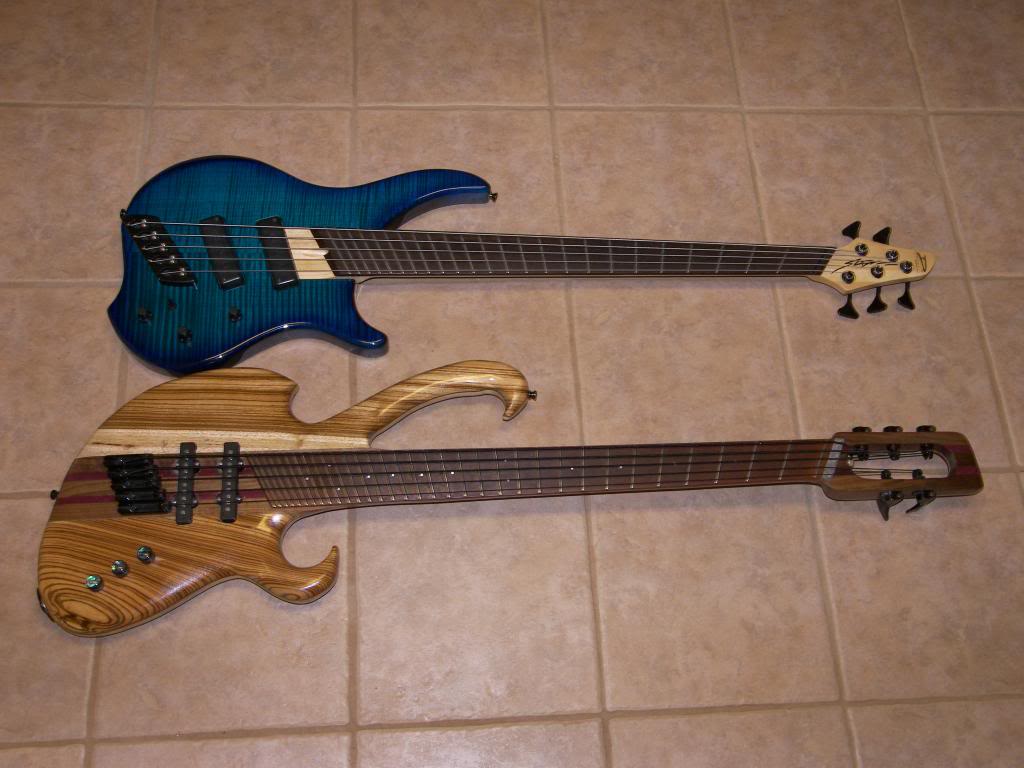
Nice pair, but I think it should be the other way around. I don't know about Dingwalls pickups. They offer different options, to suit every flavor, but you can't see on the DIngwalls if they're single coild pickups or humbucker pickups, neither if the Dingwall has pole pieces or rails in them. Probably the "single coils" on your Wish bass that is not slanted in any way is due to that the pole pieces wouldn't align up perfectly under the strings. If you had rails it wouldn't matter. People often thinks that it doesn't matter but it really does. Otherwise you wouldn't see different staggered pole pieces on certain electric guitar pickups like strats for example. They are staggered due to fingerboard radius and needs to get closer and further away from the string accordingly. If it is important that way - underneath the string - it sure as hell is equally importan to the side of the string, i e that the string is aligned right under the string, and not slightly off the right or left.

Let's turn the question around then:
Why are there more manufacturers these days making fanned frets basses than a few years ago?
Could it be .... demand? Hell, noooooooooooo...
Could it be .... it has DAWNED on some people? Hell, noooooooooo
Could it be... some new music genre requires instruments to be tuned down way low? Hell, noooooooooo
Could it be .... marketing hype, they just have to come up with something new to sell? Hell, nooooooooo
All of the above? Hell, yeeeeeeeah....!
I vote for door # 4....they're desperately looking for "something new" to sell in an ever-increasingly competitive market....minus the "new" aspect. In like fashion there are guitar makers dredging up old funky designs from the distant past, ones that failed miserably when they were first marketed, but with some modern-day improvements, have a certain "kitsch" appeal. Most won't sell very well, but it's still not cost prohibitive to make a limited test run, so why not try.
CNC programing has made limited run models much more practical to test the waters for demand these days. Bigger manufacturers with sleek, efficient production facilities are in position to carve out a slice of Dingwall's (or anyone's) market share for themselves, even if overall sales of that market are relatively small. They see the high cost of a Dingwall combined with a long wait time....bingo....opportunity knocks. They're not dependent on sales from any singular "niche" item (ala fanned fretted guitars), so a "hit and run" approach is warranted. When sales drop off, they just move on.
That said, I'd bet that Ibanez will have an impact on fanned fret interest, at least temporarily. The Curiosity Factor, if for no other reason. It won't be the first time, either. One is reminded of previous "revolutionary designs" like the Steinberger, graphite necks, etc., all of which delivered on their promises of improved performance, and still exist to some extent, but have mostly faded into obscurity due to the "payoff" not being equal to the investment of effort.

There is one reason for low demand that I have not seen mentioned here (though it's possible I've missed a comment or three). From what I've seen in my friend's store, most people do not even know that fanned fret basses exist. I've seen the look of surprise and heard "what is that?" from many customers when they first see the Dingwall hanging on the wall. TB is populated with many players who keep up on gear, but I would guess that most players don't.
Last edited:
...It won't be the first time, either. One is reminded of previous "revolutionary designs" like the Steinberger, graphite necks, etc., all of which delivered on their promises of improved performance, and still exist to some extent, but have mostly faded into obscurity due to the "payoff" not being equal to the investment of effort...
Well first, the "revolutionary" designs of Steinberger actually went and came back. Same with the graphite necks. You could as well go back and figure out why Fender had to probe deep into the dreaded DEAD SPOT that showed up on Fender P and J basses during the late 60's. To some people it wasn't a problem that needed to be solved. To some it was both heard and in the end they simply couldn't stand it, only because they tried OTHER BASSES that didn't had that dreaded dead spot at 5-6 fret on a Fender bass, both P and J. So Gene Fields, the head technical of Fender started to experiment and investigate the ins and outs of WHY the dead spot occured, just at that fret, and not the same notes up the neck on another string. This is a classical example of:
Just because it isn't a problem with some, and some hasn't detected it, or even bothered to check out, doesn't mean that it doesn't exist.
Now, you might think that graphite necks would kill that dead spot once and for good, and couldn't be "killed" with any wood neck?
Now read on and weep. Nothing but .... making it headless... killed that dead spot. Still the same wood. Chopped off.... a thorough read for you.
Fender Headless Bass |
Recommend reading it all through. And think about "what is a problem for one person ain't anothers persons problem". Most people I show dead spots to, hasn't got a clue UNTIL I SHOW IT TO THEM. Then it starts to bother the f* out of them. They hate me for bringing it up. Then and only then they're detecting it too...and is of annoyance to them. Big time. Same with my Dingwall fanned frets. Only I don't need to explain it to them, they figure it out themselves while trying it out. They hear it. And as another person here already stated with his different possesions of both Dingwall fan frets, and other 5 fret, is that when he went back to ordinary frets, it annoyed the f* out of him, because the "problems" showed up and was blatantly "in your face" detectable. The problems solved by fanned frets, seemed even quite minor to him, UNTIL HE WENT BACK. Then all drawbacks with pararell frets came up again but bit him in the butt.
The main reason headless, graphite, and fanned frets basses has somewhat INCREASED in manufacturers, even Ibanez, is just thanks to the Internet. Headless double ball end strings can be ordered throughout the internet sites, and you don't need to have your local shops stack them. Graphite necks too. Replacement necks. Everything else. And thus, including fanned frets basses. So I think on the contrary, while they've been in small numbers, they've steadily increasing otherwise Ibanez wouldn't have made the plunge. Second factor is just the same with expanded range instruments, such as 7 or 8 string guitars, which really doesn't solve "a problem". It's an instrument for those who wish to have more strings. No problems to be solved, just added versatility, and extended tone/note range. And on those guitars you really have to stretch the scale of the lowest strings. In these "djent" metal days, these musicians may find fanned frets just as worthwhile as as they can't play 6 strings, but just need to have 7 or 8 strings.
I wonder if there ever been a shootout between Ibanez new fanned fret, and a Dignwall Combustion, and the Rondo (Brice) fan fret cheapest of them, basses?
Comparison? For real? I do think you can't compare a 37 " to a "just 35.5" scale. It will be a slightly skewed comparison. Not even oranges to apples. But anyway. Say if the Rondo (BRICE) exists in abundance, chances are that people are trying that bass, and makes the verdict that fanned frets basses sucks big tome, just because of that single one, and they wont even touch a Dingwall, or Ibanez with a ten foot pole.
Comparison? For real? I do think you can't compare a 37 " to a "just 35.5" scale. It will be a slightly skewed comparison. Not even oranges to apples. But anyway. Say if the Rondo (BRICE) exists in abundance, chances are that people are trying that bass, and makes the verdict that fanned frets basses sucks big tome, just because of that single one, and they wont even touch a Dingwall, or Ibanez with a ten foot pole.
Answer to OPs question if:
1. Why they arent that many who plays fanned frets? Why so few? A: There aren't that many around, simple as that. Not too many makes them.
2. Why they aren't that many brands who makes them? Why so few makers of them? A: They aren't that many players around who demands it. Or have asked for it. Because they don't even know such idea existed. Period.
Now close this thread.
1. Why they arent that many who plays fanned frets? Why so few? A: There aren't that many around, simple as that. Not too many makes them.
2. Why they aren't that many brands who makes them? Why so few makers of them? A: They aren't that many players around who demands it. Or have asked for it. Because they don't even know such idea existed. Period.
Now close this thread.
And think about "what is a problem for one person ain't anothers persons problem". Most people I show dead spots to, hasn't got a clue UNTIL I SHOW IT TO THEM. Then it starts to bother the f* out of them. They hate me for bringing it up. Then and only then they're detecting it too...and is of annoyance to them. Big time. Same with my Dingwall fanned frets. Only I don't need to explain it to them, they figure it out themselves while trying it out. They hear it. And as another person here already stated with his different possesions of both Dingwall fan frets, and other 5 fret, is that when he went back to ordinary frets, it annoyed the f* out of him, because the "problems" showed up and was blatantly "in your face" detectable. The problems solved by fanned frets, seemed even quite minor to him, UNTIL HE WENT BACK. Then all drawbacks with pararell frets came up again but bit him in the butt.
So in your world, you find players that are happily making music with their inferior instruments, inform them of their ignorance, then make gear recommendations to help them become better artists? Riiiight....I'm sure that's why they "hate you". lol
Anyway good luck with your Crusade. Don't give up, you know the old saying....if it doesn't catch on in the first 25 years....wait 25 more.
I wonder if there ever been a shootout between Ibanez new fanned fret, and a Dignwall Combustion, and the Rondo (Brice) fan fret cheapest of them, basses?
Comparison? For real? I do think you can't compare a 37 " to a "just 35.5" scale. It will be a slightly skewed comparison. Not even oranges to apples. But anyway. Say if the Rondo (BRICE) exists in abundance, chances are that people are trying that bass, and makes the verdict that fanned frets basses sucks big tome, just because of that single one, and they wont even touch a Dingwall, or Ibanez with a ten foot pole.
Yeah. Hey, does Dingwall have an Ambassador Program or something?
Well, I've interpreted the OP's question differently. Totally. That wasn't what was asked. Why are they so few around, i e not many makers making them? I interpreted it as that. If it was "why do so few people.." the question would've been easy: They're too bloody expensive, and just a few makes them, since Dingwall (and other handmade boutiques like Conklin,Novax et al) are the only ones making them... until now. Rondo (Brice) has one at 500 USD, and Ibanez has finally got one, and just wait until they try them Ibbys out. They're at least not "bloody expensive" and made in small numbers.
Whatever you say, there's more of them READILY AVAILABLE AT DECENT PRICES, than there was even a few years ago.
The question should really be: why?
They are really the same question. In a demand driven market if few people want something then few people will make it.
Undoubtedly the market penetration will rise with the availability of cheaper options to try out fanned frets. If they have any traction for the typical bassist then the sales numbers over the next few years will show that and more options will become available. Both Rondo and Ibanez have shown a willingness to offer things that are a little outside the norm in a significant way to see if there is a market for them or not. Over the last few years Fender, for example, has not been willing to do this at all. They have offered variations on their four, five, and even six (as in Bass VI) string products but these have been cosmetic rather than fundamental design variations. For example they offered a couple of medium scale (which is fairly out there for Fender!) basses with Telecaster shaped bodies and headstocks in the Squier line. They were a nice variation from the norm but certainly not groundbreaking technologically and you will note that in the most recent round of cost control moves Fender has pulled these and most other things that don't closely resemble a classic P, J, Jag, or now Dimension bass from both the Fender and Squier lines. But if fanned frets have a future as a mainstream bass design then Ibanez and Rondo should be enough of a platform for that future to launched from.
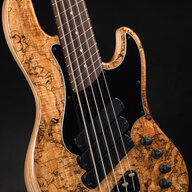
First time I've heard of a "Rondo" bass/ So here is what they are offering with a retail price of $799 - the scale goes from 35" down to 32" - exactly the same 3" scale difference as the "medium scale" Dingwall ( Super J or P 35" to 32") and the "long scale" Dingwall (Combustion, AB, etc - 37" to 34"). So Rondo didn't "water down" the scale difference like Ibanez did (35.5" down to 34"), which is a plus IMO.
Link Removed
Link Removed


