• TalkBass has been independent since 1998. Add your voice.
    Create a free account to reply to discussions, view embedded media, and browse with fewer display ads.
    Join freeLog in
    Want zero display ads or expanded classifieds tools? Compare plans.

Faulty new string?

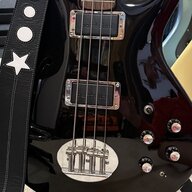
Changed out the strings on my Ric last week and ran into an issue I've not encountered before. There was some definite rattling and string noise that seemed to be coming from around the bridge. It went away once I loosened and reseated the string (maybe it got all twisted up?). The weird thing is that the first 5 or 6 frets on the E string are REALLY flat. It's very noticeable in that when I took it to rehearsal it noticeably sounded strange when playing F and G in a band setting. The guitarist would be on a G chord and my Ric was so flat that it sounded off/bad.

I put an old string on there of a different kind and it was fine, so I ended up just ordering a single string to replace what I think is a bad one. I'm hoping this fixes the issue. Anyone else had a similar problem? I don't think it's the nut as the old strings didn't do this (at least not that I remember) and a different string seemed to be ok.
 
Do you set witness points when you fit strings?

This is probably sacrilegious to at least half of TB, but no. I've always just strung my basses and started playing. Really this is the first time I've had a problem other than one time a string was just outright dead right out of the package.

It’s really easy to twist a string. I’m surprised it doesn’t happen more often.
That was my guess for the rattling and/or string noise.
 
I have had it happen once. Pretty much exactly what you said here (rattling noise). For me it was the E string on a set of DR Nickel Lo-Riders. I asked a guitar tech, who I have used for years, and he indicated it is more common than you would think. He also mentioned that issue rates vary across brands. He noted several that he pretty much never had issues with and a few that he sees a bad string at least once every month or two. I will not mention brands that he mentioned here (so do not ask), since I would just be passing along what I heard rather than providing a first hand account. I will also note that someone doing setup work all day every day sees issues but not all that often (so quality control is in general quite good).
 
  • Like
Reactions: Yahboy
Changed out the strings on my Ric last week and ran into an issue I've not encountered before. There was some definite rattling and string noise that seemed to be coming from around the bridge. It went away once I loosened and reseated the string (maybe it got all twisted up?). The weird thing is that the first 5 or 6 frets on the E string are REALLY flat. It's very noticeable in that when I took it to rehearsal it noticeably sounded strange when playing F and G in a band setting. The guitarist would be on a G chord and my Ric was so flat that it sounded off/bad.

I put an old string on there of a different kind and it was fine, so I ended up just ordering a single string to replace what I think is a bad one. I'm hoping this fixes the issue. Anyone else had a similar problem? I don't think it's the nut as the old strings didn't do this (at least not that I remember) and a different string seemed to be ok.

After I string up, I just loosen my strings one by one, and pull them back out of the bridge a little so they can straighten themselves out before re tightening and setting my points. I've had twisted strings a few times. It's the curse of high mass bridges with ball slots. They hold the ball at one end so the string ends up twisting when wrapping the post. I love my bridges though, so I've learned how to counter it. I've never had a twisting problem with a standard bent plate bridge.
 
I once had a new string do this major "warbling" thing. Really seemed like there was something very wrong with the string. I tired everything I could think of - nothing helped. I contacted the manufacturer to see if I could buy a single to replace it. To their credit, they sent a new string for free and when I put it on, everything was better.
So, yeah; bad strings do happen.
 
I've had a few do this to me. Some brand's cores seem to really not like extreme angles over bridges, which makes some sense. D'Addario tapewounds I've been through a few B and E string core breaks. I've had a Ernie Ball Cobalt flatwound B string do it to me too. D'Addario were cool about it when I reached out and replaced the strings. I didn't bother with Ernie Ball I was swapping the strings anyway.
 
I've posted this before, and I know it sounds like voodoo, but what I have been doing for the last 7 years or so is letting the string be as loose on the bass as I am turning the post, making sure to NOT seat the ball end at the bridge until the very last couple of turns up to pitch. The thought being that the string won't be twisted as it has been allowed to turn to it's most comfortable position before getting to the last couple of turns up to pitch. I used to seat the ball end and then hold the string at a mild tension to tune up the bass, and every now and then I would get a thudder. But since changing to this method, I have had no string issues at all... but that maybe is just a bit of luck, I didn't have a lot of problems with strings ever, just every now and then.
 
I`ve been playing for years and this is the first I`ve ever heard of "witness point". Maybe I know it by another name, but I`d like to know what this is.

After the strings are installed and tuned up to pitch, you should press on the string just in front of the saddle, gently with your thumb but firmly, to make sure the part that passes over the saddle is straight and flat with a well-defined break angle just behind it. When the string casually arches over the saddle, it can affect tuning stability as well as intonation.

Witness Point.jpg
 
This is probably sacrilegious to at least half of TB, but no. I've always just strung my basses and started playing. Really this is the first time I've had a problem other than one time a string was just outright dead right out of the package.

It's the wrong way to string. You need a break angle otherwise the string curves over and has a higher action, until it finally sits after stretching over time. While it's doing that, everything is changing slightly. This is basic stuff.
 
Over the last 30 years I have had dead/bad strings many times...more so with Rotosounds years ago, which led me to start looking for a new stainless roundwound brand that was more consistent...back in the 80's and 90's I was limited in my choices to whatever the local music stores carried. I ultimately landed on Dean Markley SR2000's and stuck with those for many years. Over the last couple of years I now am having trouble finding consistent sets of the DM SR2000's as well :rollno:...I have had to return 5 or 6 packages to them, and some of those replacement sets have still had dead strings....so I have moved on once again to D'Addarios and DR's,etc. I have definitely run into the twisted string problem, and had to set better witness points as well, especially with B strings...so yeah, it does happen.


 
I've posted this before, and I know it sounds like voodoo, but what I have been doing for the last 7 years or so is letting the string be as loose on the bass as I am turning the post, making sure to NOT seat the ball end at the bridge until the very last couple of turns up to pitch. The thought being that the string won't be twisted as it has been allowed to turn to it's most comfortable position before getting to the last couple of turns up to pitch.


Doesn't sound like voodoo to me! I've been doing exactly that for quite a while. And when it's almost time to seat the ball end, I wiggle the long part of the string to see if there's any pent-up twist in it, before taking it home.