Had trouble getting this to display in the previous post.

Enjoy the benefits of a premium membership!
Upgrade Account
-
TalkBass has been independent since 1998. Add your voice.
Create a free account to reply to discussions, view embedded media, and browse with fewer display ads.
Join free Log in
Want zero display ads or expanded classifieds tools? Compare plans.
You are using an out of date browser. It may not display this or other websites correctly.
You should upgrade or use an alternative browser.
You should upgrade or use an alternative browser.
fdecks HPF, Part II
- Thread starter Chef
- Start date
More options
Who Replied?
I know this is an older post and I can't help with what's "optimum for most piezos" but my understanding is that it varies with the pickup and, to some degree, with preference. Folks on the DB side (maybe you've already tried there) might have opinions as to what they like to see with different pickups.I'm double posting this from the DB side as I'm not sure where the best place to ask is.
So, I've recently come across a few comments on TB regarding the input impedance of various devices actually being above optimal. A few comments claim that something like 3-4MOhm is optimal for most piezos. One TBer (I forget who and where, can't seem to find it now) even mentioned DIYing a simple adapter with a resistor in parallel with the input jack in order to lower the impedance. Has anyone here actually tried this with the fdeck? Does anyone here think that the fdeck 10MOhm impedance is higher than optimal?
I'm really just asking out of curiosity. I don't think I've ever actually used a device with rating anywhere in between 1MOhm and 10MOhm. The fdeck with my copper Realist pickup seems to work very well, and definitely sounds better than going directly into the various amps I've used with 1MOhm inputs, although I have no way of knowing how much of that improvement is due to the HPF and how much, if any, is due to the higher impedance.
A number of BG players seem to prefer the fdeck in the effects loop. Perhaps such an adapter would be useful to BG players when using amps without an effects loop?
Sorry if this question has already been addressed. I tried searching, but I wasn't really sure what search terms to use.

I'll just update that old post to say that all of my gear seems perfectly happy with my HPF-Pre v.2. That goes for my upright piezos (copper Realist and Vic's bridge wing pickup) as well as my electric basses, active as well as passive. Likewise, both of my piezo's seems perfectly happy with every amp and device I've tried that was rated for 1 M-Ohm. The Realist has never been any good with anything rated below 1 M-Ohm, where as the Vic's has enough output to be usable with even low impedance devices.I know this is an older post and I can't help with what's "optimum for most piezos" but my understanding is that it varies with the pickup and, to some degree, with preference. Folks on the DB side (maybe you've already tried there) might have opinions as to what they like to see with different pickups.
I'd love to see the same thing for the v.2, even though I've spent enough of my life reading graphs that I guess already know what it would look like based on the math and my confidence in Mr. Deck's engineering abilities.

I’ll have to check this program out! I’ve been looking for a free program that can do this on a MacThis is a duplicate post from the HPF/LPF megathread, but I figured it belonged here, too:
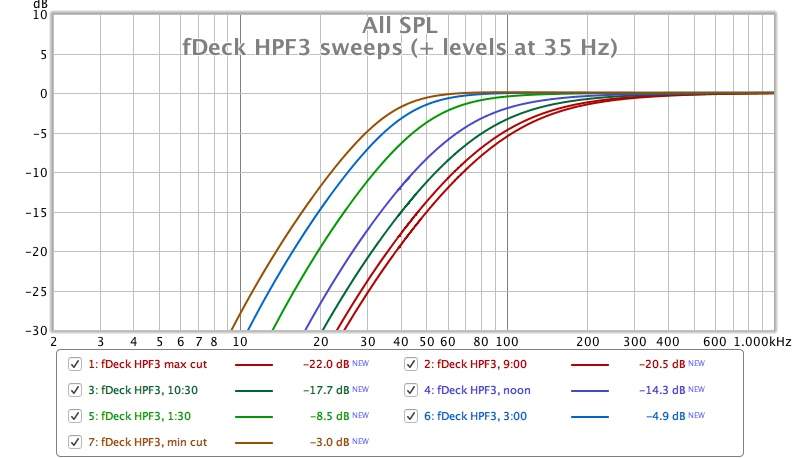
I recently figured out how to do some frequency sweeps with my audio interface (Focusrite Scarlett 2i4 - nothing spectacular) and the program Room EQ Wizard. I tried this with a couple of preamps and with the HPF3. So far, I am mainly looking at SPL vs. frequency, though the program measures myriad other things (like phase relationships and distortion) that I haven't really gotten into. (To be clear, I'm not measuring anything acoustically -- signal is generated from the program and looped from the interface, through the device being measured, and back into the interface.)
I learned that it's easy to make errors that can skew your results (like using inappropriate signal levels or not disengaging the direct-monitor function on the interface, which can feed-back through the device you're scoping and give you skewed results and weird resonances -- which, since you're not monitoring, you don't hear). I'll come back and elaborate (here or elsewhere) on my methodology (not that there's much to it) at some point -- the last thing I want to do is misrepresent someone's work and, if I'm making a mistake somewhere, I want to know.
Meanwhile, though, after several trial runs, checking my results, and running them by @fdeck before posting here, I think that I've got things reasonably sorted.
I measured the response of my interface beforehand and used that as a calibration file in REW.
At any rate, this is the measured response of my HPF3. The title indicates that the numeric SPL levels given are at 35 Hz (the HPF3's minimum adjustment) but they are actually at 34.9 Hz -- couldn't get the cursor exactly on 35 Hz. It was exactly -3 dB there, though, and the -3 dB at max was exactly at 140 Hz (top of the adjustment range), too. Impressive correlation (at least to me) with the nominal specs.
I ran the sweep from 2 Hz to 21 KHz (my interface tops out around 22 KHz), using the response at 1 KHz as my "0 dB" reference. I've zoomed-in on the are of interest for an HPF, but the response from 1 KHz on up is pretty much ruler flat.
I know that we've seen several visualizations of what an HPF is supposed to do, but I thought you might all be interested in an actual, measured response.
View attachment 3933980

I am using an eight-year-old Macbook, for what that's worth. The program is pretty cool -- I certainly haven't scratched the surface (in execution or understanding) of what it can do and, at this point, am not using any of the room-measuring capabilities.I’ll have to check this program out! I’ve been looking for a free program that can do this on a Mac
There is a paid program, called Fuzz Measure, that got some nice reviews for ease-of-use and prettiness of graphs. REW is free-with-optional-donation.
You know- it turned out I had already downloaded REW at some point and gave up on it because I couldn't get it to recognize my interface input. Turns out you have to give it access to the Mic when that pop-up comes up (even when I am not using internal mic). The simplest things sometimes! HahaI am using an eight-year-old Macbook, for what that's worth. The program is pretty cool -- I certainly haven't scratched the surface (in execution or understanding) of what it can do and, at this point, am not using any of the room-measuring capabilities.
There is a paid program, called Fuzz Measure, that got some nice reviews for ease-of-use and prettiness of graphs. REW is free-with-optional-donation.
I remember downloading it hoping it would be able to do these kinds of measurements like I used to use TruRTA for on my old PC, and very happy to see that it is! Thanks!!

that looks like a set of curves for the knee frequency knob.
Yep, exactly. Re-reading my OP, I didn't make that clear.that looks like a set of curves for the knee frequency knob.
Dialed the knob from max cut (-3 dB at 140 Hz, very audible) to minimum cut (-3 dB point slides down to 35 Hz). For each adjustment along the way (indicated by knob "clock" position) the level at 35 Hz is given.
Hoping someone can help me out here. Starting up with a new group and we practice in a small concrete dungeon. The studio owner & drummer has this place setup with lots of acoustic foam and moving pads to tame acoustics. My problem is my cab gets real boomy when I play a low G. Doesn't matter if played on the E string or A string. It's the only not that booms. Wondering if the HPF is the tool for this or if I just need to raise the cab off the ground or something. Cab is not located is a corner.

How small is a small dungeon? (And how does one play a low G on the A string?)
I doubt the HPF is the solution to your problem, but it sure couldn't hurt. What amp and cab are you playing on?
I wasn't kidding about how small is small, in this context? (Most dungeons are pretty spacious, from what I've read. )
)
Also, maybe consider starting a new thread with a more specific title -- that might elicit more and better responses than here in this HPF-specific thread.
I doubt the HPF is the solution to your problem, but it sure couldn't hurt. What amp and cab are you playing on?
I wasn't kidding about how small is small, in this context? (Most dungeons are pretty spacious, from what I've read.
)Also, maybe consider starting a new thread with a more specific title -- that might elicit more and better responses than here in this HPF-specific thread.

Hoping someone can help me out here. Starting up with a new group and we practice in a small concrete dungeon. The studio owner & drummer has this place setup with lots of acoustic foam and moving pads to tame acoustics. My problem is my cab gets real boomy when I play a low G. Doesn't matter if played on the E string or A string. It's the only not that booms. Wondering if the HPF is the tool for this or if I just need to raise the cab off the ground or something. Cab is not located is a corner.
Get one of the Auralex Acoustics GRAMMA floor pads and use a HPF. Those two tremendously helped tame my B string boominess.
Jazzdogg
Less barking, more wagging!
Get one of the Auralex Acoustics GRAMMA floor pads and use a HPF. Those two tremendously helped tame my B string boominess.
And pay a lot of attention to where cabinets are placed within the space.
How small is a small dungeon? (And how does one play a low G on the A string?)
I doubt the HPF is the solution to your problem, but it sure couldn't hurt. What amp and cab are you playing on?
I wasn't kidding about how small is small, in this context? (Most dungeons are pretty spacious, from what I've read.
Also, maybe consider starting a new thread with a more specific title -- that might elicit more and better responses than here in this HPF-specific thread.
My bad.... it's a C, not G.

The room is probably 10 x 12 with ceiling about 6 1/2 high.
I have a Traynor YBA100 and play into a BFM Jack12. The Traynor has a high pass filter built in rolling off at 35hz.
Get one of the Auralex Acoustics GRAMMA floor pads and use a HPF. Those two tremendously helped tame my B string boominess.
At next session I will definitely put the cab on an acoustic pad. My amp has a HPF built in but its not as extensive as the Fdeck 3.
weird thing is only the C booms. Everything below it is tight and clear.
Jazzdogg
Less barking, more wagging!
If you can, play the C repeatedly while someone else slowly moves your cabinet around the room; sometimes this will do the trick.
A variable high-pass filter, like the one made by Mr. Deck (I have two of his), is my secret weapon - way more effective in tuning a cab to a venue than a fixed HPF.
A variable high-pass filter, like the one made by Mr. Deck (I have two of his), is my secret weapon - way more effective in tuning a cab to a venue than a fixed HPF.
In a room that size, it won't matter where the source is placed if it's exciting a room resonance node. Likewise, you can put it on a stack of isolating pads 3-feet high and it won't matter -- it's acoustic resonance, not mechanical.
If it's basically that one note and everything below that is fine, I doubt a HPF is going to help any -- if a filter is operational high enough to have much effect on that resonant C, notes lower than that will suffer.
The wavelength of that 65 Hz C note is about 18 feet -- I don't suppose one of your dungeon dimensions is about 9 feet -- 1/2-wavelength -- is it?
Edit: BTW, I'm not convinced it actually IS a room resonance...I'm just saying if it is, it won't help to schelp the amp around trying to find a spot where it doesn't excite that node.
If it's basically that one note and everything below that is fine, I doubt a HPF is going to help any -- if a filter is operational high enough to have much effect on that resonant C, notes lower than that will suffer.
The wavelength of that 65 Hz C note is about 18 feet -- I don't suppose one of your dungeon dimensions is about 9 feet -- 1/2-wavelength -- is it?
Edit: BTW, I'm not convinced it actually IS a room resonance...I'm just saying if it is, it won't help to schelp the amp around trying to find a spot where it doesn't excite that node.
Last edited:


