• TalkBass has been independent since 1998. Add your voice.
    Create a free account to reply to discussions, view embedded media, and browse with fewer display ads.
    Join freeLog in
    Want zero display ads or expanded classifieds tools? Compare plans.

fEARful™ Part Ten (10)

Status
Not open for further replies.
fEarful156tube.gif

Nice grill treatment. Is that from Reliable Hardware? Do those stand-offs keep the grills' edge rollover just a hair off the front wood surface?
 
Usspeakers has the 3015lf for 180 bucks, don't know if that is still the actual price. In this price range there are two non-neo's that comes close, the B&C 15 PS76 and the RCF L15P540.

The 3015LF costs 185euro's over here.
One non-neo driver that has the same linear excursion(well, we never know exactly) is the Oberton 15xb700. This driver cost 223euro's, it's a bit more expensive but it has a higher thermal rating, 1000watts instead of 450watts. So power compression will be slightly better.

6.5mm xmax and 7.5mm xmax are enough less than 9.6 that I wouldn't call them drop-ins - that basically halves the peak excursion limits IIRC. Also, the RCF's fs of 50 might be on the high side.

The oberton drivers, I still don't know if we can get those over here :) Can we?
 
6.5mm xmax and 7.5mm xmax are enough less than 9.6 that I wouldn't call them drop-ins - that basically halves the peak excursion limits IIRC.
The xmax figures of Eminence and B&C are based upon the distortion figures measured according to AES2-1984 and not on the voice coil overhang.

B&C says this:
Constant advances in research provide more and more precise methods to measure the performance of loudspeakers, and describe their features. Thiele – Small parameters have become the universal language for describing loudspeaker behaviour in the small signal domain. Nevertheless, they comment little on the working limits of loudspeakers in the large signal regime. These limits are customarily indicated by Xmax, the maximumlinear excursion. This value, measured in our catalogue according to AES2-1984 standard, corresponds to a maximum of 10% total harmonic distortion (THD) with a sinusoidal signal. Recent research shows that this method can yield ambiguous results, and even different numerical values for the same loudspeaker. The main limit of this measurement is that it looks at the output signal instead of the physical features of the driver itself. On the contrary, the most up-to-date instruments for distortion analysis can measure the variations in loudspeaker parameters when they are fed with high-level signals. In this way, an excursion limit can be fixed, beyond which the parameter’s variation becomes excessive. The “Xvar” value reported in our data (generally after the traditional “Xmax” value) is measured this way. Beyond this excursion limit, the magnetic field seen by the voice coil, or the total suspension compliance, or both, drops to less than 50% of their small signal value, producing high distortion levels, strong variations from small signal behaviour and power compression. The new technique yields different results from the standard measurement based on THD.

I stated before that manufacturers need to show distortion measuremnts at different SPL levels so one can see how the driver behaves at higher spl level.
I had these Deltalite 2510 II which according to eminence have an xmax of 4.2mm and I have the Oberton 10B200 which have a (calculated) xmax of 5.25. Not much of a difference one might think. In the real world though the Deltalite start to distort very very fast after xmax is reached. The Oberton doesn't do that.
I believe that these B&C and RCF drivers can compete with the 3015lf they make some very solid PA stuff.
 
Nice grill treatment. Is that from Reliable Hardware? Do those stand-offs keep the grills' edge rollover just a hair off the front wood surface?

Yah, it's a Reliable Hardware grill, square hole pattern. There's a full 1'' bend on all 4 sides so it's bomb-proof, making full contact on the inside edges. Obviously that option is more $ but I figured less grill components = less rattle.

I previously had the standoffs in the far corners, which looked great aesthetically, but all that open metal had ring/resonance with the knuckle test.. not that I could hear it when actually playing.. but I still knew it was there lol.

Truth be told I was really going for the old Mesa/Boogie Diesel waffle grill look.. but the Reliable grill is a smaller hole pattern.. looks more like GK than M/B :hmm:

Next build:
How about a pair of fEarful 1515/66 masquerading as Emperor cabs?
insert: clever pun re "Emperor's new clothes"
 
Hey Burning Skies, I have a question for you. I remember you talking long ago about wanting to get that Peavey IPR, and now you have it, you like it. But is there any difference between that and the Crown or Mackie class D amps? Cause I am thinking about going the pedal pre/power amp for my 15/6 and soon to be 12/6/1 cube(picked up a Beach Audio 3012lf through Amazon for $176 earlier this week BTW) particularly the Crown XLS 1000.
 
I need to get one.. or make one......
What to do if the Neo goes through the roof?

Pay the man.

After living with a fearful for a while, I really can't think of any reason I'd drag anything else around. They are that good. Thank you greenboy.

Things aren't that bad. Things were really good and now are being adjusted to good.

I paid $300 for my first gigging rig back in the early '70's. What is that today - $1200 - $1500 in today's currency?

That rig was 150 pounds and barely kept up with a Twin Reverb.

My current rig is on the order of 1/3 the weight, can deal with a five string and is much louder. And, it can be put together today for less than $300 in early '70's loot.
 
The xmax figures of Eminence and B&C are based upon the distortion figures measured according to AES2-1984 and not on the voice coil overhang.

B&C says this:
Constant advances in research provide more and more precise methods to measure the performance of loudspeakers, and describe their features. Thiele – Small parameters have become the universal language for describing loudspeaker behaviour in the small signal domain. Nevertheless, they comment little on the working limits of loudspeakers in the large signal regime. These limits are customarily indicated by Xmax, the maximumlinear excursion. This value, measured in our catalogue according to AES2-1984 standard, corresponds to a maximum of 10% total harmonic distortion (THD) with a sinusoidal signal. Recent research shows that this method can yield ambiguous results, and even different numerical values for the same loudspeaker. The main limit of this measurement is that it looks at the output signal instead of the physical features of the driver itself. On the contrary, the most up-to-date instruments for distortion analysis can measure the variations in loudspeaker parameters when they are fed with high-level signals. In this way, an excursion limit can be fixed, beyond which the parameter’s variation becomes excessive. The “Xvar” value reported in our data (generally after the traditional “Xmax” value) is measured this way. Beyond this excursion limit, the magnetic field seen by the voice coil, or the total suspension compliance, or both, drops to less than 50% of their small signal value, producing high distortion levels, strong variations from small signal behaviour and power compression. The new technique yields different results from the standard measurement based on THD.

I stated before that manufacturers need to show distortion measuremnts at different SPL levels so one can see how the driver behaves at higher spl level.
I had these Deltalite 2510 II which according to eminence have an xmax of 4.2mm and I have the Oberton 10B200 which have a (calculated) xmax of 5.25. Not much of a difference one might think. In the real world though the Deltalite start to distort very very fast after xmax is reached. The Oberton doesn't do that.

I believe that these B&C and RCF drivers can compete with the 3015lf they make some very solid PA stuff.

I am sure I don't need to tell you, but excursion is not linear, so the difference in power handling from 4.2mm xmax to 5.25mm xmax is not a 25% increase in power handling, it's more like 50% IIRC.

Combine that with the significant difference in Fs, and differences in the midrange response curve (e.g. the deltalite is much peakier in the upper mids) I wouldn't be surprised that they perform a lot differently as bass drivers.

One big point is that the Oberton is around 2db (or a little more) less sensitive, so while the Oberton might take more power and go lower, it won't be as loud.

Bottom line, they are not a direct A/B comparison in any way.
 
Yeah, but if the xmax is huge to begin with, one might never even reach xmax making the distortion issue after exceeding it...moot.

Ok, lets explain this a little different.
There are methods so that the magnetic field not suddenly drops after the voice coil (partially)leaves the air gap. Which means you can have a smooth transition when you go beyond xmax. In my experience the 2510 II (and other eminence drivers I had!!!) this was not the case. With the Oberton the transistion is very smooth. Even when pushed way beyond xmax you do not hear very audible distortion.
There are some other people who share my thoughts, they had the same experience with several eminence drivers. These guys didn't have this with B&C or other big PA guys.
I don't know how often I have to explain all this.

I am sure I don't need to tell you, but excursion is not linear, so the difference in power handling from 4.2mm xmax to 5.25mm xmax is not a 25% increase in power handling, it's more like 50% IIRC.

Why do you think that? when the suspension is (sort of )linear and the magnetfield in the air gap is linear too, the excursion will double when the power is doubled. It should be pretty linear (up to the point where the voice coil leaves the air gap or better stated, the magnetic field)

Combine that with the significant difference in Fs, and differences in the midrange response curve (e.g. the deltalite is much peakier in the upper mids) I wouldn't be surprised that they perform a lot differently as bass drivers.

I'm talking about xmax and distortion in the lowest two octaves so mid response is moot. The difference in Fs is just slightly in this case, no reason for them performing so differently

One big point is that the Oberton is around 2db (or a little more) less sensitive, so while the Oberton might take more power and go lower, it won't be as loud.

In the midband perhaps but NOT in the bass region.

Bottom line, they are not a direct A/B comparison in any way.

Really? :eyebrow:
 
I'm late the the party here, but has anyone here tried building the speakerhardware cut kit yet?

I've been itching to build one of these guys for a while, but my inadequacy with a saw had been holding me back.

This may be a stupid question, but what would be the resulting dimensions and weight of building a 15/6/1 out of these kits?

 
Ok, lets explain this a little different.
There are methods so that the magnetic field not suddenly drops after the voice coil (partially)leaves the air gap. Which means you can have a smooth transition when you go beyond xmax. In my experience the 2510 II (and other eminence drivers I had!!!) this was not the case. With the Oberton the transistion is very smooth. Even when pushed way beyond xmax you do not hear very audible distortion.
There are some other people who share my thoughts, they had the same experience with several eminence drivers. These guys didn't have this with B&C or other big PA guys.
I don't know how often I have to explain all this.


Why do you think that? when the suspension is (sort of )linear and the magnetfield in the air gap is linear too, the excursion will double when the power is doubled. It should be pretty linear (up to the point where the voice coil leaves the air gap or better stated, the magnetic field)


I'm talking about xmax and distortion in the lowest two octaves so mid response is moot. The difference in Fs is just slightly in this case, no reason for them performing so differently


In the midband perhaps but NOT in the bass region.


Really? :eyebrow:


1. going to let the transition past xmax stuff go, but the point I was getting at is that the oberton can take 50% more power before even hitting xmax...so unless you were measuring very carefully (using the exact same wattage) it would be hard to compare "distortion characteristics past xmax"

2. Go simulate some stuff in winisd. doubling wattage does NOT double excursion.

A deltalite 2510 II in a standard alignment (2.26 cf, 49hz tuning) reaches 2.21 mm excursion at 70hz with 15 watts.

Doubling the wattage to 30 watts increases excursion to 3.13mm.

Double the wattage again to 60 watts, increases excursion to 4.43mm.

With your supposed model going from 15 watts to 60 watts would result in a 4x increase in excursion from 2.21mm to 8.84mm...which is not the case.

3. A speaker that is louder in the mids stands to have louder distortion -- maybe I'm wrong about that but it does seem the huge mid spike of the 2510II might give it louder distortion modes. I'm no expert there so that's just cojecture.

4. The 2510II is >2db more sensitive at 100hz than the Oberton driver you reference. Have you compared them modeled in cabinets? My guess is that this sensitivity advantage will extend on down to the -3db point of the Deltalite -- about 45hz in the alignment i mentioned earlier.


The only sensitivity chart for the 10b200 is in a 30l box tuned to 60hz. Modeled like that the deltalite bitchslaps the Oberton by 3db or better.

Did you measure them against each other or compare with the ear test?
 
I'm late the the party here, but has anyone here tried building the speakerhardware cut kit yet?

I've been itching to build one of these guys for a while, but my inadequacy with a saw had been holding me back.

This may be a stupid question, but what would be the resulting dimensions and weight of building a 15/6/1 out of these kits?

There is a thread about wcriley building the 12/6 cutkit.
 
Next build:
How about a pair of fEarful 1515/66 masquerading as Emperor cabs?

Here's my treatment of Bill Fitzmaurice Omni 212's. I did the Fender tweed covering with multi-coats of shellac, custom powder coated the corner handles and handles to a bronze hammer tone finish, did some inlay and edge banding, etc. Took a long time. They're full range cabs, so I can use them elsewhere.

My fearful 15/6's need to have simpler finishing. Tolex, stock black handles and corners, and a metal grill. I may do a deep tint stain or garnet shellac on the face panel.
 

Attachments

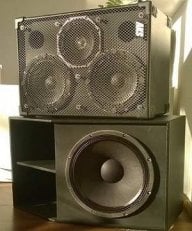
  • FullStack.jpg
    FullStack.jpg
    49.3 KB · Views: 98
Status
Not open for further replies.

Latest posts