• TalkBass has been independent since 1998. Add your voice.
    Create a free account to reply to discussions, view embedded media, and browse with fewer display ads.
    Join freeLog in
    Want zero display ads or expanded classifieds tools? Compare plans.

Fearful Part 14: one better than 13!

Status
Not open for further replies.
BFunk said:
For those that ordered the 15/6, do you ever find you regret not getting the horn? I mostly play finger style rock/blue/reggae/r&b. I can't see needing it. What are you thoughts?

Glad you asked this. I have a 15/6 I'm currently building and I'm wondering the same thing. Right now I'm leaning toward getting a horn and if I don't need it or like it I figure I can always turn it down or off. But if I want it and font have it then I'm S.O.L.
 
I went with horns on both of my 15/6/1s. I have them turned to 3 or 1 most of the time. I wanted the horns for when I play MP3s through the amp for practicing.

If all I ever played was dub than I would go hornless.... but the extra cost was worth it for me.
 
I'm definitely glad that I put a HF driver in my 12/6/1cube. I usually end up playing along with music or a drum machine while practicing. When I have it turned off, the cymbals completely disappear and music sounds lifeless. If you're only interested in pumping your bass through it then save the $50 and 3lbs. If you ever want to play along with music or drum tracks then you will most likely wish you had it.
 
I went with horns on both of my 15/6/1s. I have them turned to 3 or 1 most of the time. I wanted the horns for when I play MP3s through the amp for practicing.

If all I ever played was dub than I would go hornless.... but the extra cost was worth it for me.

This.

The horn might not be neccessary for just bass, but if there's any chance of ever needing a full range cab, it is a must.


Piping in some audio to practice to is just a start. I got the tweet so I could use it for drums or keys if I had to. But in the band I'm playing in now, I'm playing some full range samples/phrases from a looper. Have all my tone shaping for the bass come in before it, so those "extras" are pretty clean/clear when they hit the cab.

Works great, nice to not have to rely on PA support for that stuff, especially when PA is carrying little/none of the bass.
 
I put the horns in both 15/6/1's. I didn't do the last highpass stage on the crossover. Instead, I run the horns off my GK 1001 rb 2's high section. 5K and up, the control is on the amp. The horns can add a nice breathy top end. I think they would be even better if they crossed over at a lower frequency.

I think this was addressed in the latest version of the high pass. The first versions crossed at 6K or something and the horns were pretty subtle. The ASD 1001 goes down to 1K, so the lower crossover point would make the horn more pronounced

My problem is that this set up is dependent on the GK, and now that I'm moving towards a new setup I'll need to get in and add the high pass. No bid deal, it's only a few bucks in parts.

When I use the 12/6 cube without a horn, I really don't miss it at all. If I run the 12/6 and the 15/6/1 with the GK I turn up some horn.

The horns are pretty cheap, like $30 for the ASD1001 and $7 for the wave guide, IIRC, and easy to install. I use a hole saw. You could add a horn later without too much muss and fuss.

Now that I'm using the 15/6/1's more like PA cabs, with a mixer into a Carvin HD 1500 power amp, I can see adding the highpass to run the horns. Or I could start using an active crossover to really dial things in.
 
No horn for me, thanks. For me, there's nothing a horn can bring to my job as the bass guy but trouble... round-wound string squeak, electronic hiss, and the metallic ticks and tacks of my own bad finger technique. There's nothing up in those frequencies that I want to be hearing.
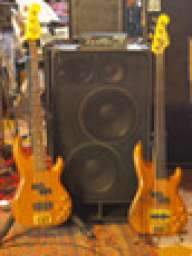
fEARfulstack.jpg


My current case of Tinnitus provides all the hiss I need.
 
For my current 15/6 build, I bought the 7$ Dayton wave guide and am installing it now despite not having bought the driver or crossover yet. I'll plug it for now and worry about adding the tweeter later. I figure it'll be way easier now than once the baffle is recessed in the box.

I'm building it in arauco from Lowes, mostly to save weight (and it's only $33 a sheet). But the wacked-out on- again / off-again winter we're having in Georgia means extra fun (read: none at all) dealing with warping. I've been tempted to scrap it and go BB, but haven't given up yet.
 
For my current 15/6 build, I bought the 7$ Dayton wave guide and am installing it now despite not having bought the driver or crossover yet. I'll plug it for now and worry about adding the tweeter later. I figure it'll be way easier now than once the baffle is recessed in the box.

If you think you might want a horn then fit it as it is far easier to fit at build time than retro fit.

If you know you will never need one leave it out. (I left it out.)

To be hedge your bets and be on the safe side do what JdoubleH has done for 7$.
 
I put the 18sound HF in my 1212/6/1, but realized that I didn't need it at all for my use as a bass cabinet. So when I built my 12/6, I skipped the HF. However, there's no real downside other than weight and cost to having it. I have no regrets about either cab, but if your main use is as a bass cabinet, it's doubtful that you need the horn.
 
I've never liked piezo tweeters...a good horn, properly eq'd is another thing altogether :)

I prolly wouldn't care on electric, but for upright bass, that little bit of air and finger noise goes a long way toward creating a great amplified acoustic tone.
 
The whole methodology of tweeter implementation between the typical bass cab and the fEARfuls is quite a bit different. Most bass cabs have a huge gap between where the woofer rolls off and the tweeter begins to come on. The fEARful midrange driver, since it extends up quite a bit further and closes that gap, integrates the output from the tweeter more directly. The tweeter does not start at 3.5K Hz or so since it does not need to, but begins more in the 6K Hz + region.

Thus, if you want a "Marcus" sounding tweeter response, you actually need to EQ a gap into the response below the tweeter. If you are using it for keyboards or drum monitoring where a more continuous integrated tweeter is desired you don't want that gap.

Other than for certain slap tones, generally no bass players are really generating content in the range that a tweeter handles anyway, but understanding what you are after and what each component is doing to the general FR is key if you do use the tweet.
 
I sold this whole thing to my wife based on the fact that they could double as PA speakers for all the stuff she does (singer, choirs, plays, directing). We're using them later this month for an elementary school play she is directing. I put tweeters in both cabs. :)
 
Status
Not open for further replies.