• TalkBass has been independent since 1998. Add your voice.
    Create a free account to reply to discussions, view embedded media, and browse with fewer display ads.
    Join freeLog in
    Want zero display ads or expanded classifieds tools? Compare plans.

Fender American Original Series Successor?

I feel the originals I've played don't have the same warmth of the old models. Something about them they feel more like toys/plastic is the best way I can describe them. Thats obviously just my opinion. I would like to see a more authentic nitro finish come back as they did change that
Did they really change the finish? The late AVS ones have a very thin nitro finish. Hard for Fender to do it right: players complained about the imprints of the pre-installed ashtrays etc. on the AVS instruments.
This is my '64 Jazz (detail) after 4 years of playing:
R0009152daphne.JPG

On the other hand: The AOs are made of the same materials, using the same Pure Vintage pick-ups and have a nitro finish just like the AVS ones. How should this make them feel like plastic toys?
 
Why not build the best quality American Fender bass ever made? And for under $1,500?

They have the specs because they've built it before. Why else is everyone looking back? I love bass. But we are talking about an instrument that can fall off the back of a pickup and still be in tune.
Oops, that would stunt sales eventually. Imagine having the best model after all the mutations out there by Fender. That could possibly be the collapse of the new/used bass market.

I second this. I feel like the American Geddys were essentially what you described before prices went up.
 
They will be called the American Standard New Originals.

I will mail a $10 prize to anyone who honestly recognized that as a Spinal Tap reference :)

I think we were typing our posts at the same time. I not only recognize the reference, I was making the same joke, along with one with another reference. Keep the $10
 
You can buy decent instruments for less than 1.000,-. This is my resumé after playing bass for 4 decades and owning a lot. The biggest advantage of owning basses that are 2.000,- and more is that you become aware that good pick-ups, a good setup and most of all: the strings that fit your sound are the important issues. And you no longer think: if only I could afford this 2.000,- and more bass, I would sound like I want to sound. You own it, now it is up to you!

Basses are not rocket science, they are pretty simple objects.
Even Fender uses myths like resonating bodies, nitro finishes letting the body breath etc. to sell their more expensive instruments. The truth is: what you get in an expensive bass is far more about looks and attention to detail than about sound or playabiltiy. Just think about the 200,- or more you pay for this wonderfull case that you might never use, 'cause it is far more convenient to use a gig-bag. Or if you go on a world tour, you might use a flight case, but not that fancy vintage accurate case. But they are so beautifull.

I have to admit, I love the way nitro finishes look and age. But I would sound as good with any 800,- mexican Fender or even a Squier after changing the pickups (if at all), putting the strings on it I like and getting a good setup. And checking that the body weight is <= 9 lbd. and the fret work is good.
 
I don't know but I'm sure the answer depends on Fender's specs for whatever given year of production and whether the AVRI P is a '57, '58, '62, or '63.

I guess you're more likely interested in AVRI '57 or '58 vs AO '50s?

If it's a fat '50s P bass neck you're seeking then I suggest a 1-pc C width neck from Musikraft with a fat C 1" 1" profile or maybe the soft V to C .88" .95".

Yeah, I prefer the rosewood fingerboard versions of things, so it does seem like aftermarket parts are probably the way to go to really get what I want but I'm not great at building stuff myself so.... :D

My preference is to get the most baseball-batty neck on a production Fender as I can (with rosewood fingerboard).
 
Hard to foretell. They let the American Vintage Series unchanged for 4 decades (1982-2012). A 62 P, a 57 P, a 62 Jazz. The only change made was a '75 Jazz Bass added during the 90s.
It was very popular. You would hardly see any pro with a contemporary Fender Bass, at least far more - if they didn't use real vintage stuff - with one of these vintage reissues.

Then they changed to the Pure Vintage Series in 2012 or 2013. A 63 P, a 58 P, a 64 Jazz and a '74 Jazz. This was a bit more expensive and vintage correct than the previous series, the most noticable change: the clay dots. My favorite US Fender basses.

Then after just about 4 or 5 years, the American Originals superseded the American Vintage Series.

There is a whole lot of bad info in here.

They did not leave the American Vintage Series unchanged for four decades.

First of all, you meant "for three decades," not four, in the range of years that you listed ("1982-2012").

And secondly, there WERE changes in that period, including to the names of the lines.

The first U.S. made reissue series was called the Vintage Series, or U.S. Vintage Series. Circa 1982–1997. It was NOT called the American Vintage Series.

Some specs changes were made (making them more vintage accurate, mostly), and it was renamed the American Vintage Series for 1998.

In late 2012, a major specs re-vamp swept through the line, but the American Vintage Series name remained. It was NOT called the "Pure Vintage Series."

Pure Vintage is the name of the new vintage reissue parts line that was introduced alongside the re-vamped AV Series (the parts that were used on the re-vamped AV Series, that continue to be used on the AO Series, and which are available separately). "Pure vintage" is also a phrase used in the advertising for the re-vamped AVs – but NOT the name of the line.

The American Original Series replaced the AV Series for 2018.

There was never any official distinction between "AVRI" and "AV." "Reissue" was never actually part of the name for ANY U.S. made reissue line. It was called the AV Series from 1998 through late 2012, even though there were two versions of it. And, again, the AV Series did not exist until 1998. It was called the Vintage Series or U.S. Vintage Series before that.
 
Last edited:
My preference is to get the most baseball-batty neck on a production Fender as I can

Seems Ive got ya'll thinking. My CV70's neck is the nearest production neck thats ever been produced to a 70's P bass. For me a P bass with a modern skinny neck doesnt feel right. That thickness also contributes to tone. My old 71 P bass had a deep woody tone which Ive never heard on a modern Bass.
 
Even Fender uses myths like resonating bodies, nitro finishes letting the body breath etc.
Spent years thinking bout this but you know its hocum really even tho from an asthetic point of view worn nitro is beautiful, however my CV,70's P has a super hard urethane finish and don't resonate too much but it sounds really good, and feels real good too.
 
I don't see these as being a step forward or back issues. They're preference pertaining essentially to playability and they're rather minor at that.
Maybe those are minor things for you. For me the neck and fretboard details are of paramount importance and they are what makes a vintage bass feel vintage, especially a P bass.

Changing the fretboard radius for the American Originals was a low blow, Fender :)
 
Yeah, I prefer the rosewood fingerboard versions of things, so it does seem like aftermarket parts are probably the way to go to really get what I want but I'm not great at building stuff myself so.... :D

My preference is to get the most baseball-batty neck on a production Fender as I can (with rosewood fingerboard).
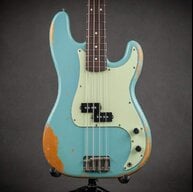
I think the American Original Precision has a thick C shape that is almost like a baseball bat.

The Am Pro I and II have the 63 profile C. Not sure if that is only slightly less thinner.
 
  • Like
Reactions: Bassist30