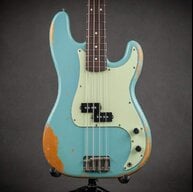
What's it doing? Curious to know.
Not wearing down..... Still Looks new. Not that that is driving me crazy.But I am not the type to bang it around. But I though Nitro would wear faster.

TalkBass has been independent since 1998. Add your voice.
Create a free account to reply to discussions, view embedded media, and browse with fewer display ads.
Join free Log in
Want zero display ads or expanded classifieds tools? Compare plans.
What's it doing? Curious to know.
I think the American Original Precision has a thick C shape that is almost like a baseball bat.
The Am Pro I and II have the 63 profile C. Not sure if that is only slightly less thinner.
Well back in the 60s it was a thinner finish I believe so not sure if they do it any different now and it takes longer to wear. That's why I bought a classic 60s jazz (MIM) in road worn already but it's a rush job and doesn't seem authentic to me. I have a worn Sandberg and think the poly finish (that they turned road worn) looks a lot better than nitro. Nitro tends to go matte or flake.

There is a whole lot of bad info in here.
They did not leave the American Vintage Series unchanged for four decades.
First of all, you meant "for three decades," not four, in the range of years that you listed ("1982-2012").
And secondly, there WERE changes in that period, including to the names of the lines.
The first U.S. made reissue series was called the Vintage Series, or U.S. Vintage Series. Circa 1982–1997. It was NOT called the American Vintage Series.
Some specs changes were made (making them more vintage accurate, mostly), and it was renamed the American Vintage Series for 1998.
In late 2012, a major specs re-vamp swept through the line, but the American Vintage Series name remained. It was NOT called the "Pure Vintage Series."
Pure Vintage is the name of the new vintage reissue parts line that was introduced alongside the re-vamped AV Series (the parts that were used on the re-vamped AV Series, that continue to be used on the AO Series, and which are available separately). "Pure vintage" is also a phrase used in the advertising for the re-vamped AVs – but NOT the name of the line.
The American Original Series replaced the AV Series for 2018.
There was never any official distinction between "AVRI" and "AV." "Reissue" was never actually part of the name for ANY U.S. made reissue line. It was called the AV Series from 1998 through late 2012, even though there were two versions of it. And, again, the AV Series did not exist until 1998. It was called the Vintage Series or U.S. Vintage Series before that.

Corrected : U.S. American Original Vintage Professional Player Performer Elite III Series (insert Deluxe wherever you want).
There was nothing better than the AVRI Series, except the Custom Shop.

I think the American Original Precision has a thick C shape that is almost like a baseball bat.
The Am Pro I and II have the 63 profile C. Not sure if that is only slightly less thinner.

On the AO '50s the neck is .82" @1st to 1.00" @12th. Thicknesses at the 1st fret of classic "baseball-bate" Fender P bass necks from the 1950s reside more in the range of 1.00" to .90".
The necks were thickest front to back at the beginning, 1951, and they were U shaped. Progressing through the decade general thicknesses gradually diminished to where it could be closer to .90" to .88" @1st fret circa '58-'59. Profiles evolved and varied along the same timeline from U to V to soft V to C. The evolution flowed toward less girthy C shape P necks in the early '60s.
Profiles of produced necks were less precisely consistent those days because more hand controlled work by individual people went into shaping the necks.
Sooo I was considering two basses in my area:
- American Vintage 74 (maple) Jazz Bass;
- American Original 70s (also maple) Jazz Bass;
And lads and ladies (and others) this was the same bass. I think they only changed:
Considering that most of us romanticize past, I think we did it with old AV vs the new one AO.
- Radius;
- Pickups (74 had awfull pups tbh);
- Maybe polyurethane tint on neck (74 have that slightly darker tint, no "boiled chicken meat - white").
Also, to consider: If AO have drop in quality, why for example AO 70's JB is so popular choice (even with touring musician ie. in Europe)?
I kind of disagree. I think the Classic series (which became the Vintera line) was great too. Have a road worn classic 60s jazz. Could be a custom shop almost."There was nothing better than the AVRI Series, except the Custom Shop."
I totally agree! The 2013-2017 AVRI series was as good as good can get with the exception of the Custom Shop stuff. BRING IT BACK!
Did someone claimed there was a drop in quality? l didn't. I think the quality is equal, what changed is that the production was kind of streamlined and Fender doesn't claim anymore that the models are accurate reproductions of specific year models. But who cares, if you like the instrument? Some players even prefer the more contemporary neck shapes.I own two AO necks for a J and P ('50s) FSO parts builds.
I don't see any drop or issues in quality on the necks I've seen and the hardware is all the same so I'm a bit skeptical about claims of drop in quality. Consistency in quality from Fender has never been world class anyway.
Did someone claimed there was a drop in quality? l didn't. I think the quality is equal, what changed is that the production was kind of streamlined and Fender doesn't claim anymore that the models are accurate reproductions of specific year models. But who cares, if you like the instrument? Some players even prefer the more contemporary neck shapes.
Maybe the 70s Jazz Basses are very similar. They don't have nitro finishes anyway. The 3-bolt neck was already abandoned in the last AVS series (they changed from a '75 Bass to a '74). And they had to produce special necks anyway, because of the block inlays.

Sooo I was considering two basses in my area:
- American Vintage 74 (maple) Jazz Bass;
- American Original 70s (also maple) Jazz Bass;
And lads and ladies (and others) this was the same bass. I think they only changed:
Considering that most of us romanticize past, I think we did it with old AV vs the new one AO.
- Radius;
- Pickups (74 had awfull pups tbh);
- Maybe polyurethane tint on neck (74 have that slightly darker tint, no "boiled chicken meat - white").
Also, to consider: If AO have drop in quality, why for example AO 70's JB is so popular choice (even with touring musician ie. in Europe)?
Probably because the AOs have a flatter fretboard so guitarists can bend more easily whereas bass players don't bend as much and might actually prefer the rounder vintage radius. Fender changing the one spec that makes the neck feel vintage and having the gall to call it Original was a low blow. You wanna change something? Put the truss rod adjustment in the headstock so I don't have to jump through hoops when the weather starts acting up. leave the neck specs alone please.I find it strange why so many dislike the AO range. In the guitar world the AO seem a lot more celebrated. In time I think the AO will be seen in a better light with the bass community.

Then we wouldn't talk about 60s or 70s or 90s Fender basses. We would start a sub-forum for every month of production with all the pros and cons and how every Fender produced on a monday is an absolute no-go for every player who takes herself seriously.(...) I wonder what the forum whould read like if there was just a Precision or Jazz to pick as it was.