• TalkBass has been independent since 1998. Add your voice.
    Create a free account to reply to discussions, view embedded media, and browse with fewer display ads.
    Join freeLog in
    Want zero display ads or expanded classifieds tools? Compare plans.

Fender Custom Shop Club

You are very welcome.
Even better than the COA, you can see the Shop Floor Traveler; it lists all the specs of your bass. Newer CS instruments have it printed in a leather booklet. Otherwise you can email Fender requesting it based on your serial number.


Nice, Lush Closet Classic indeed.
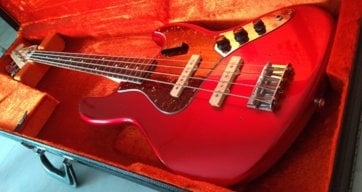
Your bass must be a 2017 NAMM piece.
Thanks again for that info. It didn't come with a leather booklet..unless the original owner kept that by accident. I will send an email off to Fender to request. It's nice to keep all the paperwork together. I will take a couple other pics in a few. Moment of silence for vets at the moment. Thanks to all those who we remember who fought for us, and for those who lost their lives for us. God bless those
 
20181111_111200.jpg
20181111_111253.jpg
20181111_111433.jpg
Pics as promised. Cheers guys
 
The forearm wear is quite minimal, I think it is indeed at the boundaries of the Journeyman Relic finish offerings.
But the "catalog" Postmodern Bass version with maple fretboard should be featuring a Lush Closet Classic finish.

I would agree with you that it was minimal. It’s certainly not a heavy relic. However, I have never seen another postmodern bass with forearm wear, nor have I ever seen a Closet Classic finish that included forearm wear. However minimal.
 
I would agree with you that it was minimal. It’s certainly not a heavy relic. However, I have never seen another postmodern bass with forearm wear, nor have I ever seen a Closet Classic finish that included forearm wear. However minimal.

Once the finish has chipped or worn to the wood on the arm contour, the lacquer wears away pretty easily, depending on how thick the paint is.
 
I’m not sure I understand your point?
Just commenting on how arm wear occurs on an older nitro finished bass. I know because I have a few. As long as the finish hasn't opened, wear proceeds more slowly.
 
  • Like
Reactions: Ace Of Bass
I'm sorry if my comment was felt to be inappropriate, and apologize if I have caused any offense. That was not my intent.

My only intention was, as I stated, to comment on how arm wear occurs. IME, CS nitro finish basses will show arm contour wear eventually, if they are played as much as mine. :D

The context was the discussion of the CS instrument in post #1443.
 
Last edited:
  • Like
Reactions: graphics1988
I'm sorry if my comment was felt to be inappropriate, and apologize if I have caused any offense. That was not my intent.

My only intention was, as I stated, to comment on how arm wear occurs. IME, CS nitro finish basses will show arm contour wear eventually, if they are played as much as mine. :D

No offense at all. :) My apologies if my responses sounded otherwise. Not my intent. I was not sure why you were bringing it up, as it had nothing to do, IMO, to the point I was trying to make. I was just trying to figure out what the idea was behind your question. I know that in time, these nitro finishes will eventually end up with forearm wear if played long and hard enough, but it does not address why there is forearm wear on a Lush Closet Classic finish, which in every example does not have one.

The point I was trying to make with graphics1988's bass was in regards to it's finish inconstancy with other Post Modern basses with the Lush Closet Classic finishes. I have not seen another Post Modern Lush Closet Classic finish with forearm wear. Again, nothing wrong with forearm wear. My comment has to do with the inconsistency with other Post Modern relic finishes and further with Fender's products in general.

If there is another Lush Closet Classic finish with forearm wear, it would be great to see a photo, because I have yet to find one. That doesn't mean another doesn't exist but it would only be the second one I know of, and I have seen about every post modern bass on the internet.

Yes I know, I need to get a life. :D

So, about inconsistency in product line - which this forearm wear is for a Lush Closet Classic finish. I have seen FCS 59 RI's with 70's style logos, 59's with black anodized guards and 2TSB finishes that would not have been on a 59, we see grounding strips on AVRI 64 jazz basses while the Custom Shop 64's do not, jazz basses listed as a 62 with block inlays, among other things. There is in general a loose interpretation of models across the board with Fender products, IMO.

As far as the Fender Custom Shop relic models go, the Time Machine Series was an attempt to make an authentic and consistent product line intended to be a replica of the years model using the same die and tooling as the basses made from said era. Prior to the Time Machine series, the FCS was not so consistent with the CS instruments. For example you could have two 64 jazz basses, one with a slab fretboard and The other veneer. There was no standardization.

Recently there have been more loose interpretations of their product lines. This is not a good or bad thing, just that you can't describe one of their products without finding an example that defies its definition. Case in point graphics1988's bass with the forearm wear, or finding a Fender AVRI 63 Precision with a factory jazz neck which is supposed to be a spot on exact replica of a 63 P bass.

Now, the Pro series line according to Mike Eldred, meant that it was a prototype. It was intended to be a base from which anything could happen. There could be a maple blocked and bound neck with a Inca Silver finish, etc. The model was just supposed to be a base from which a dealer or customer could pick and choose what they wanted on that base model. This idea seems to have migrated beyond the Pro series, and can be seen in other models.
 
Last edited:
So, about inconsistency in product line. I have seen FCS 59 RI's with 70's style logos, 59's with black anodized guards and 2TSB finishes that would not have been on a 59, grounding strips on AVRI 64 jazz basses while the Custom Shop 64's do not, 62 jazz basses with block inlays, among other things. There is in general a loose interpretation of models across the board with Fender products, IMO.

Now, the Pro series line according to Mike Eldred, meant that it was a prototype. It was intended to be a base from which anything could happen. There could be a maple blocked and bound neck with a Inca Silver finish, etc. The model was just supposed to be a base from which a dealer or customer could pick and choose what they wanted on that base model. This idea seems to have migrated beyond the Pro series, and can be seen in other models.
The idea of the Pro series extends to the Time Machine line, as well. Even the CS Design Guide states it: "Select a Custom Shop Base Model". That's the whole essence of Fender CS, in my humble opinion. One can have a stock 1962 Jazz, or a 1962 Jazz with binding, lollipop tuners, ebony fingerboard and 7.25" to 12" radius. Even though the latter would not fit the 1962 year tag based on specs, it can be seen as a "custom" 1962. That's how I see it anyway. :)
 
  • Like
Reactions: sneha1965
The idea of the Pro series extends to the Time Machine line, as well. Even the CS Design Guide states it: "Select a Custom Shop Base Model". That's the whole essence of Fender CS, in my humble opinion. One can have a stock 1962 Jazz, or a 1962 Jazz with binding, lollipop tuners, ebony fingerboard and 7.25" to 12" radius. Even though the latter would not fit the 1962 year tag based on specs, it can be seen as a "custom" 1962. That's how I see it anyway. :)

It may be the case now, but if I’m not mistaken, once you wanted to change a bridge design, standard model colors, tuners, pickups or neck, you were getting into a Master Built bass. You could do it, but it was going to be at a Masterbuilt price.

On a side note, it appears that FCS dealers have something different going with the Custom Shop then what is available to customers. I’m seeing dealers with hybrids that take a 64 jazz bass base, combined with a slab body with binding similar to a Custom telecaster, yet is not called a Masterbuilt bass. It appears this level of customization is only available to dealers at non Masterbuilt prices.

Anyway, regardless of whatever direction Fender CS is going now, I’m still a huge fan of their products and if it becomes difficult explaining why a Lush Closet Classic has a clean pick guard and forearm wear, it will be a small price to pay in light of the wonderful basses we all get to play and enjoy. :)
 
Last edited:
  • Like
Reactions: Midak
No offense at all. :) My apologies if my responses sounded otherwise. Not my intent. I was not sure why you were bringing it up, as it had nothing to do, IMO, to the point I was trying to make. I was just trying to figure out what the idea was behind your question. I know that in time, these nitro finishes will eventually end up with forearm wear if played hard or long enough. So let me just state for the record, I think the arm wear looks great and I like relic basses in general.

The point I was trying to make with graphics1988's bass was in regards to it's finish inconstancy with other Post Modern Relic basses with Lush Closet Classic finishes. I have not seen another Post Modern Lush Closet Classic finish with forearm wear. Again, nothing wrong with forearm wear. My comment has to do with the inconsistency with other Post Modern relic finishes and Fender's products in general. If there is another Lush Closet Classic finish out there with forearm wear, it would be great to see a photo, because I have yet to see one. That doesn't mean another doesn't exist, but it would be only the second one I know of, and I have seen about every post modern bass on the internet. :D Yes I know, I need to get a life.

So, about inconsistency in product line. I have seen FCS 59 RI's with 70's style logos, 59's with black anodized guards and 2TSB finishes that would not have been on a 59, grounding strips on AVRI 64 jazz basses while the Custom Shop 64's do not, 62 jazz basses with block inlays, among other things. There is in general a loose interpretation of models across the board with Fender products, IMO.

As far as the Fender Custom Shop relic models go, the Time Machine Series was an attempt to make an authentic and consistent product line that was intended to be a replica of the years model using the same tooling as the basses made from said era. Prior to the Time Machine series, the FCS was not so consistent with the CS instruments. However, recently there have been more loose interpretations of their product lines. This is not a good or bad thing, just that you can't describe one of their products without being wrong. Case in point graphics1988's bass with the forearm wear, or finding a Fender AVRI 63 Precision with a factory jazz neck which is supposed to be a spot on exact replica of a 63 P bass.

Now, the Pro series line according to Mike Eldred, meant that it was a prototype. It was intended to be a base from which anything could happen. There could be a maple blocked and bound neck with a Inca Silver finish, etc. The model was just supposed to be a base from which a dealer or customer could pick and choose what they wanted on that base model. This idea seems to have migrated beyond the Pro series, and can be seen in other models.
I started worrying that the original owner lightly sanded the forearm area ....cuz it has some scratch areas below it (on the black) BUT I just put it under my magnifying glass and light..and the bare wood has actually been clear coated as well. So..I will assume it was all done right from the CS factory. Regardless I just finished playing it and it is SO soooo sweet...i would almost say I like it a bit more than my 1970... the jazz width neck a welcoming treat at times. :)
 
  • Like
Reactions: sneha1965
I started worrying that the original owner lightly sanded the forearm area ....cuz it has some scratch areas below it (on the black) BUT I just put it under my magnifying glass and light..and the bare wood has actually been clear coated as well. So..I will assume it was all done right from the CS factory. Regardless I just finished playing it and it is SO soooo sweet...i would almost say I like it a bit more than my 1970... the jazz width neck a welcoming treat at times. :)

I love a jazz neck on a P bass. It’s the neck I learned to play bass on so it feels like home.
 
It may be the case now, but if I’m not mistaken, once you wanted to change a bridge design, standard model colors, tuners, pickups or neck, you were getting into a Master Built bass. You could do it, but it was going to be at a Masterbuilt price.

On a side note, it appears that FCS dealers have something different going with the Custom Shop then what is available to customers. I’m seeing dealers with hybrids that take a 64 jazz bass base, combined with a slab body with binding similar to a Custom telecaster, yet is not called a Masterbuilt bass. It appears this level of customization is only available to dealers at non Masterbuilt prices.

Anyway, regardless of whatever direction Fender CS is going now, I’m still a huge fan of their products and if it becomes difficult explaining why a Lush Closet Classic has a clean pick guard and forearm wear, it will be a small price to pay in light of the wonderful basses we all get to play and enjoy. :)
No, I definitely don't think that ordinary changes like the ones you mention will get you into Masterbuilt territory. The non-contour, double-bound Jazz you mentioned is an example of that; if you want to be sure what can be done Teambuilt-wise, the safe road is always to ask.

100% with you on the lovely CS offerings. :)
 
Here's a link to Fender's current design catalog. Second to last page lists the items that puts the order into Masterbuilt range. Fender changes what it calls its "base" models fairly frequently. The idea is the base model dictates what style instrument you want, then the customization starts from there. So technically, you can order a 1964 Jazz with stack knob or VVT setup, or go one step further at add a S-1 series / parallel switch to the VVT. You can also take that same 1964 Jazz model and outfit it with a fat P bass neck or '75 jazz pickups. The amount of customization Fender offers is truly remarkable.

Invalid Link Removed
 
  • Like
Reactions: Midak