There are several nitrocellulose lacquers available, each with distinctive characteristics. Some are softer and "breathe" as the wood swells and contracts with the changes in atmosphere so it is less likely to check. Others are hard and brittle(-ish). Behlen Nitrocellulose Stringed Instrument Lacquer is of the flexible variety but it still dries pretty hard and can be polished to infinity. They also make a "regular" lacquer which is harder. A very popular but almost twice as expensive brand is McFadden (now marketed by Seagrave.)
One of the cool things about cellulose is that it is made out of the same stuff as your bass, pretty much. Tree sap. As such, natural lacquers have an affinity for wood and soak up into the pores completely and bond in a way the water-borne and catalyzed plastics can't quite do. But... reality check!
One word: "Fullerplast."
Since what? Day 1? Fenders have had the raw wood dipped or sprayed with a catalyzed plastic. Whatever imagined or real tone-enhancing which is attributed to natural lacquers is completely cancelled by isolating it from the wood with Fullerplast. Whatever is applied over the Fullerplast is pretty much cosmetic only (and protection--catalyzed automotive urethanes are TOUGH!) Why do prized violins sound so special? The wood is dried-out and brittle. Why do some electric basses sound so special? Playing technique, set-up, and electronics--pretty much in that order. The underlying wood (or whatever) of the body and neck contribute some but not nearly as much as we musicians tend to believe.
I was checking out the pedal rack of one of my favorite bassists (a local guy, Ronnie Sanchez.) He has a Ibanez AW7 Auto Wah/Envelope filter and a Boss OC3 Super Octave but he says he really doesn't use them much. Then he demonstrated half a dozen very different tones by changing his attack, where he was hitting the strings, and some damping. Minimal knob-twisting.
Now there is no denying that some guitars and basses have some special mojo that sets them apart in tone and playability and this is real. But people who have studied this in far more detail than myself generally conclude that original build quality (neck-to-body joint is a biggie) and set-up count for more than all of the lore about woods, finishes, etc. For example, I picked up an Invalid Link Removed off Craig's List and was upset at the dull, lifeless sound. I played around with the tone knobs, then I started looking at pick-up height and other set-up things. Then I noticed slight movement at the neck/body joint. The screws were barely hand-tight. When I tightened that up, the bass's tone sprang to life.
There you have it folks--my treatise (rant) on guitar finishes. Enjoy whatever you like but understand that what you're really hearing is well-dried wood encapsulated in Fullerplast.
P.S. does it show that I'm a techie?
Good post ! Thanks !
Boy oh boy, start a thread titled Fullerplast over on tdpri forum and visualize knocking a hornet's nest out of a tree on a hot summer day

Talk about who Let The Dogs Out !
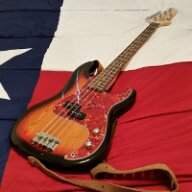
Anyhow, does my Bass have the Fullerplast on it ? It looks very similar to the Gibson 2007 Melody Maker I had. That no wood filler under the Nitro look.






 Wait just a dog gone minute! I almost forgot it is