• TalkBass has been independent since 1998. Add your voice.
    Create a free account to reply to discussions, view embedded media, and browse with fewer display ads.
    Join freeLog in
    Want zero display ads or expanded classifieds tools? Compare plans.

Fender Studio Bass Club!

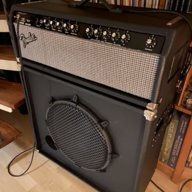
F3A7447D-1885-4DEC-8244-771ADF5D0209.jpeg

Finished head & cab. Recap & retube. Power stage rebuilt with larger screen resistors, new grid stoppers & 1R bias kathode resistors, variable bias, first pre amp stage revoiced as silver face bassman (500pF treble cap, 100K slope resistor), snubber cap removed. Great, open sound now! Very loud & very silent too. I’m happy!
 
View attachment 4049452
Finished head & cab. Recap & retube. Power stage rebuilt with larger screen resistors, new grid stoppers & 1R bias kathode resistors, variable bias, first pre amp stage revoiced as silver face bassman (500pF treble cap, 100K slope resistor), snubber cap removed. Great, open sound now! Very loud & very silent too. I’m happy!
That’s awesome!
The Silverface tone circuit is interesting. I was using a Silverface Bassman 100 yesterday and dang it sounded nice!
 
View attachment 4049452
Finished head & cab. Recap & retube. Power stage rebuilt with larger screen resistors, new grid stoppers & 1R bias kathode resistors, variable bias, first pre amp stage revoiced as silver face bassman (500pF treble cap, 100K slope resistor), snubber cap removed. Great, open sound now! Very loud & very silent too. I’m happy!
cool refinish/mod project. Just out of curiosity, is that the only change required (500pF treble cap, 100K slope resistor), to mod the Studio Bass to a Silver face bassman ? How does that mod change the nature of the original Studio Bass pre amp and how does that really work when you have the additional SB rotary EQ section ?

I like my Studio Bass just as it is, but am always curious about modifications.
 
cool refinish/mod project. Just out of curiosity, is that the only change required (500pF treble cap, 100K slope resistor), to mod the Studio Bass to a Silver face bassman ? How does that mod change the nature of the original Studio Bass pre amp and how does that really work when you have the additional SB rotary EQ section ?

I like my Studio Bass just as it is, but am always curious about modifications.
Yes, I just changed the tonestack. I left the 750µF kathode bypass cap and removed the anode to ground snubber cap. I liked the change even with all 3 tone controls at 5. The 5 band active EQ works as usual.
 
  • Like
Reactions: jumbodbassman
What's the function of the snubber caps in this case? I only know them to limit voltage spikes in power supplies, but in this case they seem to attenuate higher frequencies, like a low pass filter. did you notice the difference?
 
What's the function of the snubber caps in this case? I only know them to limit voltage spikes in power supplies, but in this case they seem to attenuate higher frequencies, like a low pass filter. did you notice the difference?
Fender started to use them late ‘70’s when they started with the ultralineair power stages on the solid state rectifier diodes and than also on the preamp stages to prohibit HF oscillations. Fender 75, super twin (reverb) and studio bass have them as well as more later fender amps. They do effect tone considerably. They are necessary when you crank the distortion circuit on a SuperTwin or Fender 75, but the Studio Bass has far less gain. So I guess it’s safe to remove them. I just removed the one on V1a and left the one on V1B. Made surely a difference. Enough to open the tone a bit.
 
If anyone is looking, I have a Super Twin I may be willing to sell or even possibly trade. It’s already been converted to a head with a really nice cabinet and a NOS faceplate, so it’s plug and play. New JJ tubes throughout. I put a fan inside that plugs into the back outlet for hot days or extended playing times.

9C54C3CC-A984-4C1A-A81B-3CD52A16FAF7.jpeg
 
Colleagues -

I'm about to receive a chopped-head Studio Bass and I was wondering about the 8 ohm impedance. In reading the impressively-detailed 30 pages of this string, many folks don't seem one bit concerned - some of the most popular paired cabs (Berg NV412 and NV610, pairs of Fender 115 Neo, etc.) run 4 ohms. Should I worry at all or run 4 ohm cabs at will? Has anyone thought of swapping in the Mercury Magnetics output transformer that allows both 4 and 8 ohm output? For the tech savvy out there, could you use one of these and make the 8/4 ohm output switchable?
 
Colleagues -

I'm about to receive a chopped-head Studio Bass and I was wondering about the 8 ohm impedance. In reading the impressively-detailed 30 pages of this string, many folks don't seem one bit concerned - some of the most popular paired cabs (Berg NV412 and NV610, pairs of Fender 115 Neo, etc.) run 4 ohms. Should I worry at all or run 4 ohm cabs at will? Has anyone thought of swapping in the Mercury Magnetics output transformer that allows both 4 and 8 ohm output? For the tech savvy out there, could you use one of these and make the 8/4 ohm output switchable?
When you have the head, look at wires that come out of the OT: on the primary side there are 5 wires that go to the output tubes. On the secondary side are 2 wires (older models) OR 3 wires (later models). At some point they started to use the same OT on the super twin and the studio bass. That later OT has wires for 8 and for 4 Ohms. The unused wire is the 8 Ohm lead. You could solder that to the recording output socket, to have both options.
But if you have the 8 Ohms only model you could run it on 4 Ohm cabs, but that stresses the output tube, so I wouldn't do so on a 2 hour non stop full power gig.
 
  • Like
Reactions: Ace Of Bass
When you have the head, look at wires that come out of the OT: on the primary side there are 5 wires that go to the output tubes. On the secondary side are 2 wires (older models) OR 3 wires (later models). At some point they started to use the same OT on the super twin and the studio bass. That later OT has wires for 8 and for 4 Ohms. The unused wire is the 8 Ohm lead. You could solder that to the recording output socket, to have both options.
But if you have the 8 Ohms only model you could run it on 4 Ohm cabs, but that stresses the output tube, so I wouldn't do so on a 2 hour non stop full power gig.
The Studio Bass is 8ohm already, so is the spare lead in this instance a 4ohm?
I’m getting my SB head serviced soon so this could be useful.
 
Happy new year, everybody,

reading this thread from the beginning (!) during the last days, I was ensured to buy a Fender Studio Bass Amp (Blackface, have to check the Serial number, think it's 1980), still as a Combo. Speaker has been changed into a newer EV. The seller said that the Output/power tubes had been changed a few years ago, but not the pre-amp tubes. So, when I tried it in the rehearsal-room of my band, I noticed some crackling noises now and then, increasing when I turned the Output Control higher than "2". I left the amp in the room, went home and read the "Fender Studio Bass Club-Wiki", where a Tube diagram is shown; this - and all other Sources I found in WWW - said that there are usually 3x 7035, 1x 12AT7 and 1x 12AU7A. So, I ordered them online, today they will arrive.
But: when I went to the rehearsal room yesterday, I was surprised to find a different Tube diagram in my Amp!
It has 2x 7025, 1x 12AT7, 1x 6CX8 and 1x 6C10 (see photo). And: my amp does not have a "Ground switch".
I send the diagram to the "tube amp doctor" where I had ordered the tubes; he said (the technician of the shop) that I'd have to order the correct tubes as shown in the diagram, so I did - but not the 6C10, I ordered the 6AC10 instead. The Technician mentioned also, that the photo of the diagram showed some of the power tubes, and that they were "not correct" - Russian 6P3S - not constructed for a Voltage up to 500 V. So I decided to order a matched Sextett of 6L6GC, too…
My Question: does anyone here know about the "anusual" tube diagram? I found that it was nearly similar to the Fender Super Twin Reverb ? An what About the "missing" Ground switch?
And: what about the russian 6P3S - should I really change them out?
Sorry - many questions, medium english…
Thanks!
 

Attachments

  • Tubes 3 Studio Bass.jpg
    Tubes 3 Studio Bass.jpg
    430.2 KB · Views: 46
Interesting! The pentode part of the 6CX8 is used in the Super Twin Reverb as reverb tank driver and the tri-triode 6C10 is used as reverb recovery, distortion circuit and reverb/dry signal mixer. The Studio bass has reverb nor distortion channel..... very strange indeed.
My best guess is that you may have a very rare Studio Bass unit. Fender may at some time have run out of SB chassis sets and just put a SB face plate on a STR chassis, omitting the reverb tank & pot and disabling the distortion circuit. Both circuits are (apart from reverb and dist.) very much alike and there’s been a lot of bass played through Super Twin heads. Too bad for you that the 6C10 is extremely rare & expensive to get..... you could leave it alone.
It would be interesting if you could post a close up pic of the guts of this beast!
 
I could order a 6C10 for 99 Euro in the same Online Shop. But they told me a 6AC10 could be used instead. When I'm going to change the tubes the next Weekend, I'll take some photos. And maybe, there's another surprise inside and the tubes are the usual ones, and someone put the wrong sticker with the Twin diagram on it
 
  • Like
Reactions: Joost Overmars