Fuel cells are really where it's at IMO, once they're developed a bit more. Place a few inexpensive batteries between it and the drive to handle transient current demand and you're there.

TalkBass has been independent since 1998. Add your voice.
Create a free account to reply to discussions, view embedded media, and browse with fewer display ads.
Join free Log in
Want zero display ads or expanded classifieds tools? Compare plans.

The question posed was about size, cost, AND RANGE. So, if you reduce the size and cost of the battery, you will gain no range. So, no, your "solution" doesn't fit all of the requirements listed in the question. Sure, it would cost less and be smaller, but it wouldn't go any further than the big ones.
You are absolutely correct. Yet, making the car very much smaller and lighter does, indirectly, solve the problem because you can more easily justify having a proportionately larger battery in a small car than in a large car because the absolute size is still much smaller. Again, this means greater range, faster charging, less cost and smaller environmental footprint.
The bottom line is, if you're trying to maximize your overall ecomony then you should only make the vehicle large enough to do the job and no larger. Electric vehicles are best suited to the individual urban/suburban commuter (the target market) so it makes sense to limit the vehicle's size to a single passenger plus a small space for light cargo.

Meh. It is still not yet ready for prime time. Still way short range. Who wants to buy a $100K car that won't get you across a state? That's utterly ridiculous.


What is needed is a supercompact 1 seater commuter vehicle that weighs under 1400 lbs.

What is needed is a supercompact 1 seater commuter vehicle that weighs under 1400 lbs. This would make possible a greater range at a price under $40,000. If someone made this they would sell in numbers more like a "real" car.

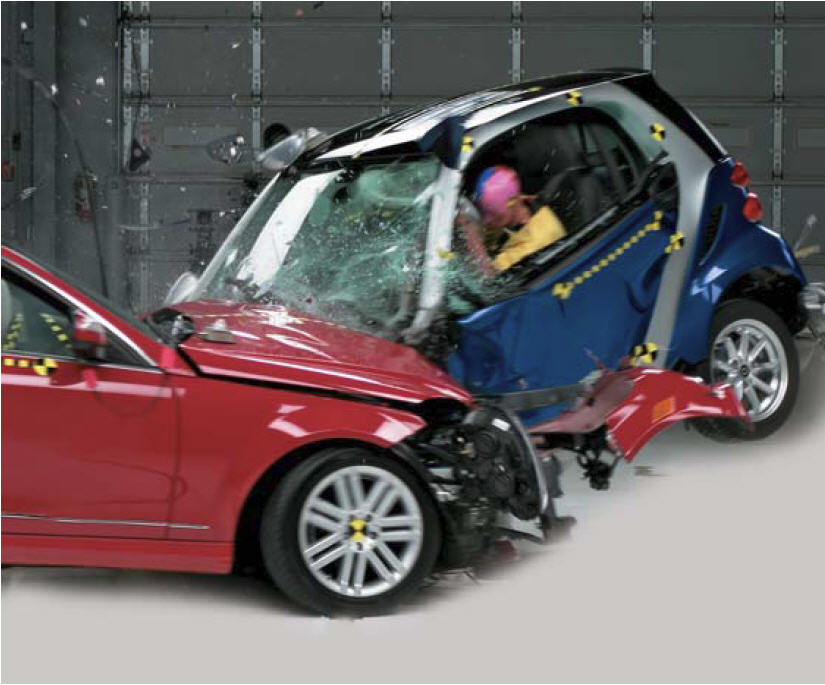
Would never pass crash safety tests...imagine a 4000lb pick up truck hitting it?

Imagine that truck hitting a motorcycle. Those pass safety tests somehow.......
You can buy a smart car that weighs 1600 pounds. They pass all the safety tests with flying colors.
The problem with that idea is that most bike owners want a noisy bike. They can make bikes as quiet as cars, but there's no market.


For me sadly they just don't work, but I agree that for others they may. For instance, on Monday I'm visiting a facility that is 157 miles each way. On Thursday I'll be driving 99 miles each way for another.
For some it works, others I don't know. I wonder if AAA is going to create emergency charging tow trucks for cars that get stuck in accident traffic. How does an electric car do in a Sig Alert - 10 miles crawling along bumper to bumper for 3 hours? That can happen a lot in SoCal.

I think I take my chances on a full size car.....[/IMG]
The pic you posted? Wouldn't matter what you were driving. I can find lots of similar pics featuring SUV's, pickups, whatever.
As much as we love our gasoline/diesel powered vehicles, its a fact that the petroleum resources throughout the world are being depleted and when we run out, we run out.
The question is when that will happen. At the current rate of consumption, its estimated the world's oil supply will be completely depleted by 2049.
Ill be dead by then, but many of you younger TBers will be faced with that hard reality. But no worries, by then, if people are still driving cars, Im sure they will be electric or fuel-cell powered.
The only remaining gasoline/diesel powered vehicles will be owned by a handful of collectors and they can simply convert the gasoline/diesel engines for methanol operation.
I predict Tesla is is going to one of those companies where in 20 years, folks are going to be kicking their own @sses for not buying stock when they had a chance.

Better!?...think ill take the red car