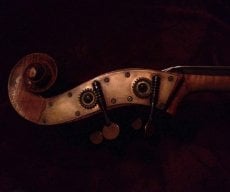
Well, darn it, I just dropped my bass while getting it out of the bag, and it hit on its back, and the fingerboard popped off the neck. As far as I can tell there's no other damage, so I've (immediately) taken all the tension off the strings and tomorrow will start getting it into a shop. So no real worries there.
But - there just doesn't hardly seem to be any glue residue to speak of on the back of the board or the front of the neck. There's a little very shallow groove all the way down the center of the back of the board, and maybe there's a little glue residue visible there, and a little squeeze-out down where the neck ends and the board continues, but the rest of the back side of the fingerboard, and the front surface of the neck, seem really smooth.
Is this the normal way the joint would look, due to clamping and forcing glue out, or is it possible that not enough glue was used? It was a pretty hard drop, so I am not surprised something gave way, and I think I should be happy it's an easily reglued joint. Just wondering whether this was possibly a dry joint. Of course when I get it to the repair shop I'll ask the guy.
But - there just doesn't hardly seem to be any glue residue to speak of on the back of the board or the front of the neck. There's a little very shallow groove all the way down the center of the back of the board, and maybe there's a little glue residue visible there, and a little squeeze-out down where the neck ends and the board continues, but the rest of the back side of the fingerboard, and the front surface of the neck, seem really smooth.
Is this the normal way the joint would look, due to clamping and forcing glue out, or is it possible that not enough glue was used? It was a pretty hard drop, so I am not surprised something gave way, and I think I should be happy it's an easily reglued joint. Just wondering whether this was possibly a dry joint. Of course when I get it to the repair shop I'll ask the guy.