• TalkBass has been independent since 1998. Add your voice.
    Create a free account to reply to discussions, view embedded media, and browse with fewer display ads.
    Join freeLog in
    Want zero display ads or expanded classifieds tools? Compare plans.

Fingering on a fretless

Use a headstock tuner to tune the strings and then to check your intonation as you get accustomed to the instrument. My first fretless (a Guild) had no markers and was so tough to play in tune. My current Rob Allen fretless is a dream to play and playing in tune is like a fun game. Enjoy

I'm gonna see if I can find a small chromatic tuner for that - great suggestion!
 
I don't think the previous poster meant that you should play a harmonic at position X and then finger a normal note at that same point on the same string, I think they meant that you can use various harmonics at various locations as reference pitches for comparison purposes.

You can get harmonics in lots of places, but the ones that are very easy to get consistently are the ones at frets 12, 7, 5, and 4. If you're actually aiming for one of those you're not likely to get one of the in between ones by mistake.

You're right - harmonics don't lie! Thanks for reminding me.
 
With Fretless it is very important to utilize your ears and forget about your eyes. There are many variables with fretless instruments one of them being that no two are exactly alike. The frets are not going to be exactly where you might expect them to be, if it sounds in tune, then that is the correct place to be despite what your eyes are telling you. Start with one neck position and practice not looking at your hands while you’re playing.

Start slow. Practice long tones (whole notes and greater) with a tuner and with drone notes (easy to find on YouTube,, just look up C cello drone for example). Octaves are a great place to start, especially notes utilizing the open string. Don’t get bummed out if your not in tune, just adjust your finger until your in tune. That’s the key with fretless, we’re all out of tune sometimes but we can adjust so quickly you don’t notice.

Any time your playing constantly check your intonation where you can using octaves, harmonics, and open strings.

Good Luck!

That seems to be a recurring trend among the comments. I like to think I have a good ear. So not only listening to myself, but to anyone else I might be making music with is important. Thanks for reminding me!
 
James I think you mean you put your finger in the "space" between, just BEHIND the fret, not directly ON the fret, which of course is a metal bar.

Edit: now seeing all the other posts about finger DIRECTLY ON TOP OF THE FRET, I'm prompted to be less diplomatic: that technique is simply crazy.

I agree. No matter the fretted instrument, one should place their finger as close BEHIND the fret as possible - never on top. Agreed.
 
  • Like
Reactions: DJ Bebop
Yes, you are "supposed to" finger a little bit behind the dots (and/or lines) on a fretless bass.

The dots on the side of a fretless electric bass neck are not placed for good fretless intonation. They are simply placed where frets would go...on a fretted bass. They don't work for good intonation on fretless...unless your fingertips are shaped like triangles. But they aren't. They're imperfect ovals, with a flat side, therefore the string does not ring all the way to the middle of your finger, but from the edge of your finger. Bottom line: You finger right on the dots, you are sharp.

The point where the string starts ringing, i.e. the edge of your finger, is what is supposed to be on position – not the center of your finger.

Using a tuner to find proper position is pointless, aside from calibrating your octave position. It will become second nature to squeeze, ease up on, and perhaps roll, slide, or shimmy your fingers a bit during a song, to tune your notes to be harmonious within the composition that you are playing at any given moment.

The goal isn't to be perfectly in tune, but to be harmonious with the other instruments – because perfect tune in the technical sense rarely sounds "correct" to the ear. If you play fretless, this tuning happens near instantaneously (as long as you can hear yourself well enough for your unconscious brain to take over for you).

I agree with everything right up to "using a tuner is pointless". I agree with those who suggested using one, at least while learning. A chromatic tuner, that is. And I'm going to take those suggestions. But thanks for your comments.
 
  • Like
Reactions: DJ Bebop
No, Ed played a fretted bass and so did I at the time - a very workmanlike Ernie Ball MM S.U.B. Sterling. Which unfortunately, they no longer make in San Luis Obispo. And since Ed and I would occasionally break out in a Beach Boys song (I love them!) he would have a six string electric close at hand. Quite a talented fellow. He was in England jamming with Hendrix when he got the call from his childhood friend Al Jardine to play bass for the Boys as part of their touring company. Ed was actually invited to play guitar for the band previously, but opted for England instead, as that was the happening music scene at the time. He tours with a bunch of ex-Boys sidemen now called "California, Incorporated"
 
  • Like
Reactions: DJ Bebop
Yeah I know there's more harmonics, but 12 is the only one that rings true to pitch regardless of intonation, directly over the fret.

There's is literally 5 harmonics in between just the 3rd and 5th fret. That's why your statement is inaccurate. You can get a harmonic directly over the line, as well before and after it, on various spots, meaning that deciding where your finger gets placed based off a harmonic ringing doesn't make sense unless it's the 12th.

I use harmonics probably more than 75% of players and understand them extremely well but thank you.

Jaco used harmonics extensively- both natural and induced. I'm going to try them next time I pick it up - which will be in like 2 minutes! My poor customized Squier Affinity PJ is feeling awfully neglected lately...
 
  • Like
Reactions: DJ Bebop
With Fretless it is very important to utilize your ears and forget about your eyes. There are many variables with fretless instruments one of them being that no two are exactly alike. The frets are not going to be exactly where you might expect them to be, if it sounds in tune, then that is the correct place to be despite what your eyes are telling you. Start with one neck position and practice not looking at your hands while you’re playing.

Start slow. Practice long tones (whole notes and greater) with a tuner and with drone notes (easy to find on YouTube,, just look up C cello drone for example). Octaves are a great place to start, especially notes utilizing the open string. Don’t get bummed out if your not in tune, just adjust your finger until your in tune. That’s the key with fretless, we’re all out of tune sometimes but we can adjust so quickly you don’t notice.

Any time your playing constantly check your intonation where you can using octaves, harmonics, and open strings.

Good Luck!

Good suggestions all - thanks for the encouragement!
 
Jaco used harmonics extensively- both natural and induced. I'm going to try them next time I pick it up - which will be in like 2 minutes! My poor customized Squier Affinity PJ is feeling awfully neglected lately...

Harmonics are great and there's more than you could count and keep track of tbh.

Try sliding your harmonics once you get good at ringing them, so fun!
 
With proper intonation setup my SRF705 is in tune right above the markers, but I don't look over them anyway :laugh:

BTW.. I recommend you to look at this video, Rich is an awesome musician and a great teacher:


Thanks for posting this.
When I first watched it, I was skeptical.
But after a few days working on the exercise, I really like it.
 
  • Like
Reactions: etnoo
...

BTW.. I recommend you to look at this video, Rich is an awesome musician and a great teacher:


There is nothing in that 'lesson' which explains how that exercise is better for intonation than any other exercise. Intonation is not improved by playing this or that note or interval sequence or pattern. It comes from rigorous development of handshape/posture, accurate shifting (without loss of hand-shape) and knowing what 'in tune' sounds like. And those things can and should be worked on universally across the board at all times, no matter what is being played. Yet they don't get a mention. He should explain what, if anything, about the fingering, shifting and positioning makes it good for intonation, or better than other choices.

On a lighter note did you notice how he says "with no vibrato" and then goes on to play with vibrato? It is also interesting that he chose not to deomonstrate the entire sequence - some of the string-crossings and shift requirements get quite 'interesting' if you want to maintain hand-shape and avoid fingering 'cul-de-sacs'.
 
  • Like
Reactions: MonetBass
Tuners are helpful, but they easily become a crutch to lean on. Trusting one's ear is most helpful. I play unlined as I feel the lines are not very useful - I don't wanna stare at the fingerboard all day, and, when reading music, they do no good at all. Setup is pretty important as mentioned earlier - stinks having string to string differences in intonation on a fretless. One thing worth mentioning that I haven't read in this thread is playing with the lights out to music that is familiar. Really pushes the muscle memory and ear training. Side dots are really nice for reference points. As mentioned earlier, one's finger build/geometry and fingering hand technique will greatly influence where one feels they actually put their finger to get proper intonation. One other thing worth noting is scale length. If most playing has been done on particular scale on fretted basses with good left hand technique, the muscle memory transfers well to a fretless bass of the same scale. All of my basses are 34" scale. (no complaints about the "b" string w/ TI jazz flats on a 34" scale bass).

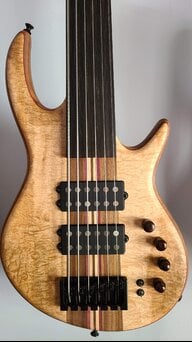
View attachment 4637536

Your killin' me with all that eye candy and no names/brands... ! Care to share? I feel like I should know just by the body shape, but I cant place the brands... Carvin keeps coming to mind... but...
 
There is nothing in that 'lesson' which explains how that exercise is better for intonation than any other exercise. Intonation is not improved by playing this or that note or interval sequence or pattern. It comes from rigorous development of handshape/posture, accurate shifting (without loss of hand-shape) and knowing what 'in tune' sounds like. And those things can and should be worked on universally across the board at all times, no matter what is being played. Yet they don't get a mention. He should explain what, if anything, about the fingering, shifting and positioning makes it good for intonation, or better than other choices.

On a lighter note did you notice how he says "with no vibrato" and then goes on to play with vibrato? It is also interesting that he chose not to deomonstrate the entire sequence - some of the string-crossings and shift requirements get quite 'interesting' if you want to maintain hand-shape and avoid fingering 'cul-de-sacs'.

If you play it in the dark and over three octaves instead of two it is a good exercise. As is any other pattern. But you have to use a drone or backing track.
 
Your killin' me with all that eye candy and no names/brands... ! Care to share? I feel like I should know just by the body shape, but I cant place the brands... Carvin keeps coming to mind... but...

Sure thing. From left to right
1) Carvin Icon 6 (Claro walnut top, maple walnut neck & coated fingerboard, humbuckers &piezo bridge)
2) Kiesel Icon 6 ( chocolate maple top, 7pc neck, 3pc body (walnut, purple heart, maple top))
3) Carvin lb76 (solid Koa body, maple Koa neck, single coils & piezo bridge)

20220114_121231.jpg
 
To those who suggest to use a tuner: this is useless. There is no point trying to play "more in-tune" than what your ear can detect (please note that your audience will also not "listen" to you by looking at a tuner, but with their ears).

Does this mean we should be satisfied if our ears do not detect any intonation issue? Of course not. We should work hard on sharpening and improving our pitch and interval detection skills. It is a lifelong battle.

The way to work on this is to use a keyboard and practice hearing - and singing - intervals. You should particularly work on the most consonant intervals (and their inversions): octaves, 5ths, then majors and minor 3rds, then major and minor 2nds, and finally tritons (all other intervals are inversions of those).

On your instrument, start by practicing playing octaves and 5ths. There are 2 reasons for this:
1. they are the most consonant intervals and therefore those for which our pitch detection is the sharpest.
2. they can be played in position (without shifting) with a very relaxed hand shape; (I personnaly prefer playing them with 1 and 4, à la Simandl, but if you go for 1-2-3-4 technique, play them with 1 and 3 consistently). This will help you establishing a rigorous hade shape and enable the so-called "muscle memory" (of course muscles have no memory, and memory takes place entirely in our brain, but this is a convenient way of talking about proprioception).
Practice with closed eyes, focussing your attention on what your ears tell you. Sing the interval before playing it (you cannot play in tune what you cannot ear and sing in tune).
Then practice other intervals you can play in-position.
Then practice shifting, starting with small shifts.

Do all this with closed eyes (at least for part of your practice). Of course, when performing music, you will open your eyes and also watch your fingerboard (to use all visual cues available there), as well as all other things you need to watch (sheet music, band mates, chicks in the audience, etc.), but closing your eyes while practicing will help sharpening your ears and train your muscle memory.
 
There is nothing in that 'lesson' which explains how that exercise is better for intonation than any other exercise. Intonation is not improved by playing this or that note or interval sequence or pattern. It comes from rigorous development of handshape/posture, accurate shifting (without loss of hand-shape) and knowing what 'in tune' sounds like. And those things can and should be worked on universally across the board at all times, no matter what is being played. Yet they don't get a mention. He should explain what, if anything, about the fingering, shifting and positioning makes it good for intonation, or better than other choices.

On a lighter note did you notice how he says "with no vibrato" and then goes on to play with vibrato? It is also interesting that he chose not to deomonstrate the entire sequence - some of the string-crossings and shift requirements get quite 'interesting' if you want to maintain hand-shape and avoid fingering 'cul-de-sacs'.

Thank you for your contribution but I think you misunderstood the idea of this short sample excercise. For me it is only first step and a part of more advanced training. Personally, as a beginner fretless player I found this exercise very effective. Stretching it on entire fretboard, playing scales in different positions, with drones in background and using my ears rather than eyes helped me improve my left hand technique and develop muscle memory.
Maybe there is a "better" and more complex training video showing more methods and techniques, If so link it please instead wasting time on unconstructive criticism.

On a lighter note I don’t know why you picking on fact he uses vibrato twice at the end of example, it doesn’t matter at all in my opinion, but it’s only me :)
 
  • Like
Reactions: Les Fret
Steve,
I think the benefit of the exercise is, as Papageno suggested, starting with octaves as they are the most consonant interval.
But instead of practicing just one octave pair, practice three at a time based our ability to recognize adjacent intervals.
I think most of us can recognize adjacent intervals much better than any other order, thanks to Julie Andrews of course. ;)
 
Personally, as a beginner fretless player

Perhaps as a beginner you should learn to.listen to those with more experience.

...

On a lighter note I don’t know why you picking on fact he uses vibrato twice at the end of example, it doesn’t matter at all in my opinion, but it’s only me

He said that one of the things to do when focussing on intonation, and which I would endorse, is not applying vibrato. Then he does it. Twice.

please instead wasting time on unconstructive criticism.
...

If you take the time to read any of my posts you will see that I am not unconstructive. I have posted extensively on intonation and the right ways to develop and improve it. Just presenting a series of notes with no instruction on hand-shape or fingering is npt one of them.
 
  • Like
Reactions: LeeNunn