
Enjoy the benefits of a premium membership!
Upgrade Account
-
TalkBass has been independent since 1998. Add your voice.
Create a free account to reply to discussions, view embedded media, and browse with fewer display ads.
Join free Log in
Want zero display ads or expanded classifieds tools? Compare plans.
You are using an out of date browser. It may not display this or other websites correctly.
You should upgrade or use an alternative browser.
You should upgrade or use an alternative browser.
Finished my FearFul 15/6 build
- Thread starter homeby5
- Start date
More options
Who Replied?

- Apr 3, 2003
- 35,518
- 19,954
- Disclosures
- Editor-in-Chief, Bass Gear Magazine


After talking to some other 15/6 builders, I think I described my switch function wrong at first. Here is the wiring diagram I followed.
I believe the upper position enables the current to go through the 2.5 and the direct shunt going to the Mid +. The middle position removes the parallel shunt and the current goes only through the 2.5. The bottom position sends the current through the 2.5 but also provides another return path (shunt) of 20 ohms that current goes through without going through the mid.
properly implemented - there is no middle position.

There is a free phone app called TruTone that's pretty handy for testing this type of stuff. Just rig up a 1/8" to Speakon cable to connect phone to cab.
Start with a 200hz tone. That should be coming pretty much exclusively from the woofer. Around 1khz you should be hearing it from both drivers and around 3-4khz it should be coming pretty much exclusively from the mid. If it does that, your crossover is functioning. If not, there is a problem.
To test your pad switch, pass a 3 or 4khz tone and move the switch back and forth. You should hear a small but noticable difference in loudness. If you don't hear a difference or if there is a switch position that cuts out the sound, there is a problem.
That little test will help isolate your issue......that is, if you have an issue.
Start with a 200hz tone. That should be coming pretty much exclusively from the woofer. Around 1khz you should be hearing it from both drivers and around 3-4khz it should be coming pretty much exclusively from the mid. If it does that, your crossover is functioning. If not, there is a problem.
To test your pad switch, pass a 3 or 4khz tone and move the switch back and forth. You should hear a small but noticable difference in loudness. If you don't hear a difference or if there is a switch position that cuts out the sound, there is a problem.
That little test will help isolate your issue......that is, if you have an issue.

There is a free phone app called TruTone that's pretty handy for testing this type of stuff. Just rig up a 1/8" to Speakon cable to connect phone to cab.
Start with a 200hz tone. That should be coming pretty much exclusively from the woofer. Around 1khz you should be hearing it from both drivers and around 3-4khz it should be coming pretty much exclusively from the mid. If it does that, your crossover is functioning. If not, there is a problem.
To test your pad switch, pass a 3 or 4khz tone and move the switch back and forth. You should hear a small but noticable difference in loudness. If you don't hear a difference or if there is a switch position that cuts out the sound, there is a problem.
That little test will help isolate your issue......that is, if you have an issue.
Good idea EXCEPT IMO you would do better with an 1/8"to 1/4" adapter and run through your amp.
Use the adapter and your smart phone in place of your bass.
Good idea EXCEPT IMO you would do better with an 1/8"to 1/4" adapter and run through your amp.
Use the adapter and your smart phone in place of your bass.
You can do it that way too, but, just the phone output will make enough noise to tell what's going on....and annoy everyone else in the house.

Even 90 db worth of sinewave is enough to make people say, "please stop that".
If you do use an amp, watch the loudness. The sinewave will be putting full constant power to the whole system and getting over 50 watts in the highe frequencies can start endangering tweeters, though your ears should've told you to turn it down by then.
You can do it that way too, but, just the phone output will make enough noise to tell what's going on....and annoy everyone else in the house.
Even 90 db worth of sinewave is enough to make people say, "please stop that".
If you do use an amp, watch the loudness. The sinewave will be putting full constant power to the whole system and getting over 50 watts in the highe frequencies can start endangering tweeters, though your ears should've told you to turn it down by then.
Yes good point about volume, I generally expect the annoyance to take care of that, but never hurts to mention. I'm a fan of using premade cables and adapters when an obvious electrical fault is at hand. No need to start introducing extra variables in troubleshooting.
On his cab, 2.83 volts on the input would equal 1 watt and would be at 96db or better. If the phone can make just 1/4 watt, he'd still be hitting 90db worth of test tones. That's already louder than most noise you'll find in a typical residential home.

On his cab, 2.83 volts on the input would equal 1 watt and would be at 96db or better. If the phone can make just 1/4 watt, he'd still be hitting 90db worth of test tones. That's already louder than most noise you'll find in a typical residential home.
Again you miss my point about the reliability of a testing method.
Sure that will work fine and have plenty of volume. How about we meet in the middle?
He could use a speakon to 1/4" adapter and a store made 1/8" to 1/4" adapter?
Sure he can hand make a cable, but if there are any problems with that, then IT has to be troubleshooted.
The last thing I want when something doesn't work is a new problem keeping me from fixing the first.

Again you miss my point about the reliability of a testing method.
Sure that will work fine and have plenty of volume. How about we meet in the middle?
He could use a speakon to 1/4" adapter and a store made 1/8" to 1/4" adapter?
Sure he can hand make a cable, but if there are any problems with that, then IT has to be troubleshooted.
The last thing I want when something doesn't work is a new problem keeping me from fixing the first.
Ahh...now I see.
Didn't think rigging a cable + to + and - to - should present much of a problem.
Also where did you get the lettering for your logo?
That's the nicest logo I've seen. Just big and brawny, like a Mack truck...like how it plays.
Picked up a bag of letters from Michaels for about $4.00.
Can't find a TruTone app...
It's at the Google Play store for Android phones, along with a few other tone generators and RTA's and things. Maybe called something else for iphone's? Maybe spelled "true" with an "e"?
Any app that will make sinewaves/test tones over the general range of human hearing will work, should be a few different free ones to choose from.

BurningSkies
CRAZY BALDHEAD
- Feb 20, 2005
- 27,956
- 20,350
- Disclosures
- Endorsing artist: Dingwall Guitars


After talking to some other 15/6 builders, I think I described my switch function wrong at first. Here is the wiring diagram I followed.
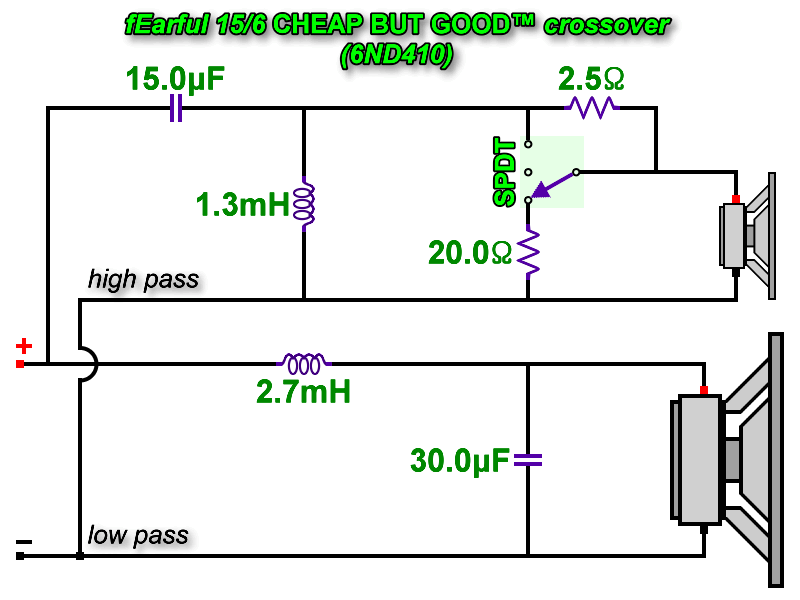
I believe the upper position enables the current to go through the 2.5 and the direct shunt going to the Mid +. The middle position removes the parallel shunt and the current goes only through the 2.5. The bottom position sends the current through the 2.5 but also provides another return path (shunt) of 20 ohms that current goes through without going through the mid.
Not exactly. In the upper position the 2.5Ω resistor is shunted around and the 20Ω resistor is bypassed. In other words, that is the midrange driver only.
In the middle position the 2.5Ω resistor is in series with the midrange driver and the 20Ω resistor is bypassed again.
In the lower position the 2.5Ω resistor is in series with the combination of the mid and the 20Ω resistor in parallel.


