• TalkBass has been independent since 1998. Add your voice.
    Create a free account to reply to discussions, view embedded media, and browse with fewer display ads.
    Join freeLog in
    Want zero display ads or expanded classifieds tools? Compare plans.

First Build - "Lucifer"

Well, ya never know... I used to buy some kind of animal horn for my dog. Never thought to use it for a nut. :vomit: Especially when black tusq is available :whistle:
Yeah, I couldn't find a tusq blank long enough. that was my first choice, but all of the blanks were too short because of it being a multiscale and the nut being at an angle (which makes it longer). Then I saw Chris at Highline say "just go to the pet store, it's like four dollars for enough to do like 10 guitars!" and I went "Bingo!"

Why can't you use brass like a regular person?
:roflmao: :laugh: :roflmao: Now you sound like my wife. "Why can't you be a normal husband and just look at porn?!?!?" :roflmao: :laugh: :roflmao:
 
Well, according to the interwebs, bone can be dyed no problem, with aniline or even clothing dye. The issue is that it does not go deep so it seems best to dye it after its completely shaped and slotted.

Side note, searching for "bone nut" in secret mode produced some... er... colorful results. :whistle:
 
  • Like
Reactions: TerribleTim68
Yeah, I couldn't find a tusq blank long enough. that was my first choice, but all of the blanks were too short because of it being a multiscale and the nut being at an angle (which makes it longer).

It is true about a multiscale being longer, but how long do you need it to be? My 5 string multiscale uses a zero fret, but that fret will be only 55 mm long. You would need fairly wide string spacing for a 63.5 mm (2.5") nut blank to be too short:

Black TUSQ XL Slab 1/4
 
Last edited:
Templates: A Luthier's Map
Okay, I agonized over this way too much, so I decided to take some advice from my friend Scott over at Bone head Guitars. Scott stresses out over these steps just as much as I do, but he overcomes it by just getting started. He told me "Just start cutting, the nerves will go away". And hey, what's the worst that can happen? :roflmao:
So, I grabbed a piece of MDF, ran it through the ShopSmith table saw to get it down to a manageable size (I wanted it small enough to work with without wasting material, yet large enough to support my router base while using it), 10"x10" seemed about right. Then, using Ben Crowe's paper method, I mapped out the neck/fretboard end and bridge saddle locations and transferred that to the MDF along with a centerline. Then I laid out my pickups in a manner that looked pleasing to me (nope, no math regarding hypothetical fret location or any of that, just "I like them about here" ). I then switched the ShopSmith over to drill press mode and grabbed some forstner bits and went to town hogging out material. Currently I'm left with something that looks like this -
20210512_071536.jpg


Funny Story:
After drilling my corner holes, it was at that point that I said to myself "Self, wouldn't it be cool if that scroll saw over there worked?" :meh:
Yup, true story. I have a fairly nice ShopSmith scroll saw laying in the corner. But the drive belt is broken so it wont....you know....saw. For the life of me I'm not sure why they designed it in a manner that means you have to just about fully disassemble the motor assembly to replace the drive belt. And, since I can't figure out how it all comes apart, I'm stumped on replacing it. I have a belt, but I can't figure out how to get it on. So, I'll most likely stick some MDF straight edges around the perimeter of this and use my router to finish cutting the rest. But first, I could use some router bits smaller than these giant ones I have. I need to head to Harbor Freight!
 
Last edited:
I was going to ask about that.
Do people angle the pups as an aesthetic, to match the angles going on, or is it because the string sweet spots are now on a diagonal also?
I've wondered why people never leave the pups straight, since the string spacing hasn't changed.

For me it's about consistent tone. If you don't angle the pickup then you get a very bridg-ey pickup tone on the bottom string and a much more mellow tone on the top.
 
On a normal parallel-fret bass, the strings, frets, pickups, and bridge are all orthogonal and right-angley. :cool: This means that the pickups will sense all of the strings at XX% of the scale length, making tonal response even and consistent.
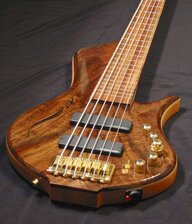
To do this on a multiscale, you still need the pickups to sense all of the strings at XX% of the scale length, but since the scale lengths are all progressively different, the XX% position deviates from perpendicular.
 
On a normal parallel-fret bass, the strings, frets, pickups, and bridge are all orthogonal and right-angley. :cool: This means that the pickups will sense all of the strings at XX% of the scale length, making tonal response even and consistent.

I have a hard time seeing how that makes much of a practical difference though, since XX% changes as soon as you fret a note. The further up the neck you play, the bigger XX% becomes relative to the speaking length of the string. Or am I looking at this wrong?
 
  • Like
Reactions: RodRy and dwizum
I have a hard time seeing how that makes much of a practical difference though, since XX% changes as soon as you fret a note. The further up the neck you play, the bigger XX% becomes relative to the speaking length of the string. Or am I looking at this wrong?
I don't know, I'm not a science-y guy. But I do know that if you mount a P pickup in a normal position and then the same pickup "flipped", the sound is completely different. We also know that if the pickup is closer to the bridge, you get a more treble-y sound as opposed to it being closer to the neck, right? So, if you place a pickup completely perpendicular to the centerline of the neck on a multiscale, your bass side strings will have the pickup closer to the neck while your treble side strings will have the pickup closer to the bridge, which WILL result in an uneven tone across the strings (meaning the bass strings are gonna be super bass-y while the treble strings are gonna be super treble-y). Like I said, I'm not smart enough to understand the science, but I do own a bass with a reverse-P so I'm smart enough to understand that. ;)
 
Good point. I guess the starting value of XX%, i.e. pickup position, on each string introduces a constant across all possible fretted lengths for that string. I'm just spitting in the wind here; my actual scientific method is to put the pickup <<somewhere>>, see if I like it and then make up an impressive story about why it works :)
 
I have a hard time seeing how that makes much of a practical difference though, since XX% changes as soon as you fret a note. The further up the neck you play, the bigger XX% becomes relative to the speaking length of the string. Or am I looking at this wrong?

That's somewhat true but it's not a nice linear relationship - the effect of pickup position doesn't scale cleanly with string length. A given relative pickup position (say, putting the pickup at 15% of the scale length) on a longer scale length will sound different than the same relative position on a shorter scale length - as the scale length decreases, you tend to need pickups further from the bridge, relatively, to get the same tone. The tone of a 34" scale with the pickup at 15% might more similar to a 24" scale with the pickup at 20% versus actually at the same 15%. So the difference from causing a shorter scale length (and a longer relative position) by fretting a note isn't as big as you'd think.

Plus, generally, it seems like people are more concerned about tone for notes that are close on the fretboard (i.e. do all the strings sound similar when they're played around X fret) rather than absolute differences (i.e. does the low string played at higher frets sound the same as the higher strings played at lower frets).
 
  • Like
Reactions: RodRy and Reedt2000
Mostly I just wanted the pickups to be "slanted" in a similar manner to the last fret, which is aesthetically pleasing to me. I'll argue with people after it's built. :roflmao:
"Well, let's see the one you built...." :smug:

From there it was "Okay, so how treble-y do I want this to sound?" and that sort of sets the distance from the bridge. I dunno, I'm guessing at all of this. :laugh:
 
Good point. I guess the starting value of XX%, i.e. pickup position, on each string introduces a constant across all possible fretted lengths for that string. I'm just spitting in the wind here; my actual scientific method is to put the pickup <<somewhere>>, see if I like it and then make up an impressive story about why it works :)

Exactly, it's about making "XX%" consistent across all the strings.

One of the things I haven't figured out yet is a way to test the pickup positions before cutting holes in the bass body. It's complicated with multiple pickups on a multiscale bass, because each one should theoretically be at a different angle also, but unfortunately I don't have a multiscale mule to test with.

I am considering reverse compensating for the relative angle of the pickups on the multiscale so I can test on a single scale. They should sound similar that way, but exactly how effective that might be is still TBD.
 
  • Like
Reactions: RodRy and Reedt2000