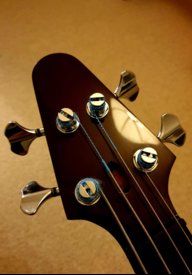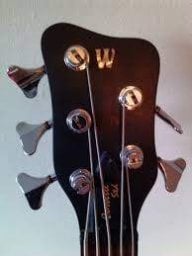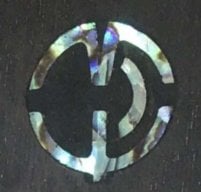
That's one hell of a KNOB or a very tiny lathe.Interesting. I generally drill my holes on the lathe using a jacobs chuck in the tailstock. Seems like the better way to assure the hole is on center.
View attachment 4177949

TalkBass has been independent since 1998. Add your voice.
Create a free account to reply to discussions, view embedded media, and browse with fewer display ads.
Join free Log in
Want zero display ads or expanded classifieds tools? Compare plans.
That's one hell of a KNOB or a very tiny lathe.Interesting. I generally drill my holes on the lathe using a jacobs chuck in the tailstock. Seems like the better way to assure the hole is on center.
View attachment 4177949
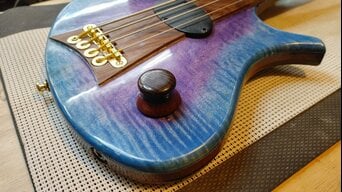
That's one hell of a KNOB or a very tiny lathe.



Having never worked on wenge myself, I conclude that it's a wood which must be approached carefully. My past experiences with other woods like this are that a drill press is absolutely best, and taking a shallow "peck" at the hole (maybe 1/16" at a time), backing out and letting the bit cool, then peck at it again, back out, rinse and repeat. I'm sure our more experienced friends will be along to let us know if I'm all wet or not.Things were going really smooth until the screw extractor bit broke in half -
View attachment 4185832
Have I mentioned that wenge must be made of concrete and hatred?
Luckily there was just enough extractor bit left to flip it around and use the teeth on the opposite end (yes, it came with teeth on both ends, thank God).
So next I'm back to plugging the hole and then trying to redrill new screw holes in what is essentially my driveway and praying to the demon Gods that I don't break anything else off. I'm honestly freaked out beyond reality here and I may just put this on hold until I actually get a drill press. Trying to do this with a handheld drill isn't working. I can see that my brad point bit is actually bent ever so slightly. So yeah......
But, now we're up to:
Darkglass Tone Capsule is in hand.
Pickups are in hand.
Volume pot is in hand.
Jack and all my switches arrive this week.
I really need to get going on this thing.

Missed this earlier. I suggest "move right to machine screws and a real tap" (well, more for the hard wood than cheap screws) - works quite well most of the time. "But it's not a wood screw!" Yet it works. "You need to use an insert!" No, most of the time you really don't, unless you are cranking the <bleep> out of the screws, and mostly you shouldn't need to do that. (note, I mean inserts for threaded holes. I fully agree that a metal insert for wooden knobs is a Very Good Idea.)Really hard woods or needing to use screws of questionable origin you can make a "tap" out of a screw by filing/dremeling a slot down the side of the screw to create a cutting edge. Turn the screw in and back it out like a tap and tap the hole into the wood.
I kinda like this idea.Missed this earlier. I suggest "move right to machine screws and a real tap"...


I'm thinking about ordering some of this, probably white, and painting the bottom of the inlay holes with it, then filling with clear epoxy.
You'll want to look into @Fat Freddy 's work with resins and glow powder, or at least I think you will. It's scattered through a long build thread. referred to earlier in this long build thread. #402I'm thinking about ordering some of this, probably white, and painting the bottom of the inlay holes with it, then filling with clear epoxy.
I'll have to order some and test it out on some scrap to see if it works.
Apparently I'm an over achiever. Thus the reason I walked away.
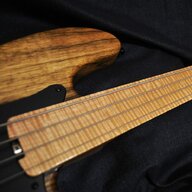


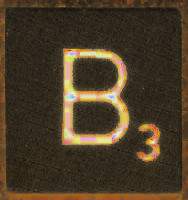

...remember that wenge is made of concrete and hatred.
I wonder how well it would work or how beneficial it would be to tap the hole, then soak the threads with a thin CA, remove the excess by wicking it up with a cotton swab or twisted up paper towel, then hitting it with activator.Sometimes you can use a bolt instead of a screw by tapping the hole for threads