Enjoy the benefits of a premium membership!
Upgrade Account
-
TalkBass has been independent since 1998. Add your voice.
Create a free account to reply to discussions, view embedded media, and browse with fewer display ads.
Join free Log in
Want zero display ads or expanded classifieds tools? Compare plans.
You are using an out of date browser. It may not display this or other websites correctly.
You should upgrade or use an alternative browser.
You should upgrade or use an alternative browser.
First Five String Bass
- Thread starter steeleyes
- Start date
More options
Who Replied?
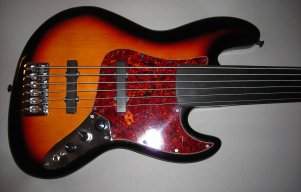
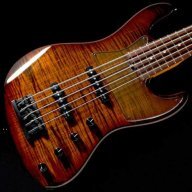
I really want to by a Five string bass and give it a go.
Can anyone give me some tips on tuning and anything else to help me get started once I buy?
Thanks
Tune it B-G. (E-C is special purpose like a 6er). Learn to play further up the neck without open strings. Learn how patterns can be moved from key to key by moving them up or down the neck or side to side from string to string. Put your thumb on the back of the neck and don't try to grab it like a ball bat. In short, learn what it can do for you rather than trying to make it a 4 string with a few extra notes. If you try to play it like a 4 string, pretty soon you'll be back playing a 4 string and it will be like 'coming home".


Buy it and play it. You'll get used to it.
I use BEADG for what I do.
I use BEADG for what I do.

Try the bass you want first. Not all B strings sound as good as they look.
Put your 4 string bass away. Don't switch back and forth between 4's and 5's. Just play the 5 until your muscle memory is adjusted. Don't give up cos it's easier to play your old 4 string bass.
Don't stretch for a note, move your hand so that your fingers are above the note you want to play.
You might want to evaluate your cabs at some point. You don't want muddy or too much bass. 10's and 12's are good for low notes. They keep your sound tighter and more controlled.
Put your 4 string bass away. Don't switch back and forth between 4's and 5's. Just play the 5 until your muscle memory is adjusted. Don't give up cos it's easier to play your old 4 string bass.
Don't stretch for a note, move your hand so that your fingers are above the note you want to play.
You might want to evaluate your cabs at some point. You don't want muddy or too much bass. 10's and 12's are good for low notes. They keep your sound tighter and more controlled.

If you decide that the tuning is going to standard(BEADG)look for a 35"scale.I really want to by a Five string bass and give it a go.
Can anyone give me some tips on tuning and anything else to help me get started once I buy?
Thanks
So that the low B is not "floppy"

I play both up & down the neck based upon where & how I want to express notes. For Young Country, it's a lot of pocket playing with occasional flourishes. Learn the tunes that motivate your playing & you'll find your way. BUT, use that B string. It allows for more flexibility.

I have a pretty simple tip when moving from a 4 to a 5. This also comes in handy going from a 4 to a 6 or a 5 to a 6. In fact I originally did this with a 7 string Conklin.I really want to by a Five string bass and give it a go.
Can anyone give me some tips on tuning and anything else to help me get started once I buy?
Thanks
in your case you already have a 4 string and you're wanting to move to a 5. for me the biggest confusion of moving to a bass with more strings was I'd accidentally play the wrong string. So a trick is to take advantage of the visual difference in strings until you're muscle memory comes back together. I did this using a combination or regular strings and dr neon strings. So If you've been playing 4 string for example. Use a neon b string and regular e,a,d, and g strings. It looks a bit silly but you're muscle memory will catch up fast enough that you only have to do it once .
If you already own a 4 and your moving to a 5 string you only need to buy one set of strings to do this. Use the e, a, d, and g strings that Come on the bass. Buy a 5 string set of neons and swap the b strings, and you can save the remaining 4 string for your 4 strings bass down the road
Hope this helps


And just hang out on the B string all day? Pretty inefficient if you ask me - and would eventually take its toll on my fingers and cause them fatigue. B strings are pretty big.Just play from the 5th to 12th fret all the time. You'll get used to it in no time.
And just hang out on the B string all day? Pretty inefficient if you ask me - and would eventually take its toll on my fingers and cause them fatigue. B strings are pretty big.
You don't play anything but 4 strings, right?
And just hang out on the B string all day? Pretty inefficient if you ask me - and would eventually take its toll on my fingers and cause them fatigue. B strings are pretty big.
I specifically wrote "you'll get used to it in no time". What part of that didn't you comprehend? getting used to a 5 string has got nothing to do with playing the 5 string proficiently at professional level. The OP wants to know how to get started. Hanging around the B string a few days will get anyone used to it.
B strings is big? After the 5th fret, the distance between each fret gets noticeably smaller. There is very little finger fatigue. Also the tension is quite low. The only problem I see is wrist fatigue from bending the wrist at odd angles when playing ABOVE the 5th fret, and that happens when the bass is too high or too low. This leads to tendonitis in the long run. You don't have to believe anything I wrote, after all I'm just a novice hack who just happens to play 4, 5, 6 strings from 37 to 32 inch scale and I'm only having a minor wrist problem. But hey, I have overcome finger fatigue thanks to playing the B string!!!
Tune it B-G. (E-C is special purpose like a 6er). Learn to play further up the neck without open strings. Learn how patterns can be moved from key to key by moving them up or down the neck or side to side from string to string. Put your thumb on the back of the neck and don't try to grab it like a ball bat. In short, learn what it can do for you rather than trying to make it a 4 string with a few extra notes. If you try to play it like a 4 string, pretty soon you'll be back playing a 4 string and it will be like 'coming home".
This is exactly the reason why I wrote play 5th to the 12th. Between the 5th and 12th, you'll have covered most notes you use regularly, without open strings. You will force yourself to start learning the notes on the extra string if you stick around here for a FEW DAYS (not forever, because quite honestly after the 7th, 8th fret, the B string notes sound like crap).
I don't recommend anything above the 12th fret on the B string because it sounds like crap and if your guitar is not adjusted correctly to your body, it will put a tremendous amount of stress on your wrist. Quite frankly unless you're a super soloist, I doubt it's even needed to play that high on the B string. But then again, you could be just that!

Tune it B-G. (E-C is special purpose like a 6er). Learn to play further up the neck without open strings. Learn how patterns can be moved from key to key by moving them up or down the neck or side to side from string to string. Put your thumb on the back of the neck and don't try to grab it like a ball bat. In short, learn what it can do for you rather than trying to make it a 4 string with a few extra notes. If you try to play it like a 4 string, pretty soon you'll be back playing a 4 string and it will be like 'coming home".
Buy it and play it. You'll get used to it.
I use BEADG for what I do.
Try the bass you want first. Not all B strings sound as good as they look.
Put your 4 string bass away. Don't switch back and forth between 4's and 5's. Just play the 5 until your muscle memory is adjusted. Don't give up cos it's easier to play your old 4 string bass.
Don't stretch for a note, move your hand so that your fingers are above the note you want to play.
You might want to evaluate your cabs at some point. You don't want muddy or too much bass. 10's and 12's are good for low notes. They keep your sound tighter and more controlled.
All that.
If you decide that the tuning is going to standard(BEADG)look for a 35"scale.
So that the low B is not "floppy"
Some 34" scale basses have decent Bs. The Brubaker comes to mind right off the bat. 34" scale with a very solid B... so do some of the Peavey basses.. my US Cirrus is a 34" scale bass and it has a great B string. To the OP I suggest you just ask around here before you decide to buy because there are some with great Bs.
B-G is standard. Tune it differently if you have a reason to tune it differently. Most people get a 5er because they want more low notes, but if you want more high notes instead, tune E-C.
I honestly never had any major trouble switching back and forth and I think people make too big a deal out of it. If you're having trouble, just use the B string as a thumb rest at first and play the rest of it as you would a 4 string. Then add in low notes (or grab a note higher on the B string if you want) as you need or want them. No biggie.
I honestly never had any major trouble switching back and forth and I think people make too big a deal out of it. If you're having trouble, just use the B string as a thumb rest at first and play the rest of it as you would a 4 string. Then add in low notes (or grab a note higher on the B string if you want) as you need or want them. No biggie.
Learn new music where the B strings is a must
Play your favorite song only using E-A-D-G to train yourself not using the B accidently
Learn floating thumb or movable anchor as you'll need to mute that B string, a lot of 4 strings player can't over come this situation
Play your favorite song only using E-A-D-G to train yourself not using the B accidently
Learn floating thumb or movable anchor as you'll need to mute that B string, a lot of 4 strings player can't over come this situation

My second bass ever was a five string and i havent been back to a four string since. Over all its the same, I have mine tuned B-G. The extra string doesnt get used a ton, at least in my playing. but it is great to have when its needed. it feels like it would be difficult to go to five strings, i thought so too when i was younger. But once you get it, your going to find that its a pretty easy transition The biggest thing is memorizing the notes on the neck. scale patterns and intervals are also important to renember.