• TalkBass has been independent since 1998. Add your voice.
    Create a free account to reply to discussions, view embedded media, and browse with fewer display ads.
    Join freeLog in
    Want zero display ads or expanded classifieds tools? Compare plans.

Flatwound Strings

It might not need any adjustment at all. Either way, it's easy to do. Here is a video of John Carruthers, who has worked for just about every manufacturer out there (as well as his own custom builds). The first video is for TR adjustment. I post the other three in case you have interest in learning to do a complete set up. Which is good to know and will save you $$ by doing it yourself.


This is what I needed. Thanks!
 
  • Like
Reactions: funkinbottom
I am VERY new to the bass. I figured that I have some time during this pandemic, so why not learn something new.

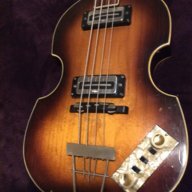
This is my BB434M. I changed out the knobs for StewMac Speed Knobs, replaced the pickguard, and added a Levy’s strap. Together with some open-back, over the ears headphones, my PJB Big Head headphone amp, and lessons via TalkingBass, I’ve started on this journey.

I’ve been reading all of the posts regarding flatwound strings. They sound like something I would like to try. If I maintain the OEM string size, looks like the flat wounds require higher tension. Will the truss rod need to be adjusted? Is this a task I can do (I want to learn my bass) or should it be done by a professional?

View attachment 4006700
Are you looking to become a bass player or a guitar tech?
 
  • Like
Reactions: L2ATJR
As much as I like TI flats... I wouldn’t recommend them for that bass. They have a certain feel and tone that doesn’t sit well with everyone . There are very pricey . You either love them or you hate them.
Id buy them used if you decide to try them out .
I have them on a Pbass but I don’t like them on a jazz or a PJ or Stingray.

I would suggest Ernie Ball Cobalt flats . They feel and sound great. It a bright flat that paid well with Jazz bass, PJ’s, and StingRays.
Daddario chromes would be my 2nd suggestion.
 
  • Like
Reactions: L2ATJR
Agree with this 100%. But I will say, make sure you have the right size hex wrench and that it’s seated in the nut completely before you start turning it. I’ve seen more truss rods damaged by people stripping out the nut by using the wrong tool or not having it set into the nut properly and then rounding it out while they’re trying to get it to turn. Start with the right tool inserted fully and properly, and you’ll really lower the chances of damaging things. Also remember to make small adjustments at a time and avoid forcing anything.
That is something that I don't think I'll ever understand, if it don't fit don't turn it.
An Allen key or a screwdriver are not complicated tools.
 
About 8 years ago I switched my Mike Lull PJ5 from DR Low-Riders to GHS Precision Flats. Then about 4 years ago I put a set of TI flats on. I made no adjustments to the bass either time. The neck is fine, as is the action. If you need to adjust the bass that's OK, if you don't. . . . you don't.
 
  • Like
Reactions: Roger W and L2ATJR
About 8 years ago I switched my Mike Lull PJ5 from DR Low-Riders to GHS Precision Flats. Then about 4 years ago I put a set of TI flats on. I made no adjustments to the bass either time. The neck is fine, as is the action. If you need to adjust the bass that's OK, if you don't. . . . you don't.

Seems like you have extensive experience with all three of those string sets. How would you compare/rate them?
 
Sorry for such a dopey newbie question, but because I used DB strings most of the time until recently when I got some headed basses, is there any difference in installing them compared to rounds? I assume not, but the 5 string set I just ordered were expensive and I'd rather not stuff it up. New had a set of flats before, ever.
 
Seems like you have extensive experience with all three of those string sets. How would you compare/rate them?

Hi, I bought a Mike Lull PJ5 and a friend asked to check it out because he was thinking about getting a Lull as well. After he bought his P5 I tried it and . . . . it sounded better than mine! His had a fuller, fatter, larger sound. I couldn't work out why or how. I emailed the previous owner and Mike Lull but couldn't find a reason. Then my friend mentioned that he had flats on it. I hadn't even noticed the strings! I put a set of GHS Precision flats on my bass, and there it was, the sound. I hadn't used flats since discovering roundwound strings in 1970. It seems I had forgotten all I knew about them and I was surprised how good they made the P bass sound.

I got the TI flats at a very good price but the difference between the GHS and TI strings was a lot less than I was expecting, but I'd still recommend either. The difference between the DR rounds and GHS flats was light years! I rarely use the J pickup because as a P5 this bass just sounds perfect with either sets of flats. I had a listen to LaBella's on a Fender Jazz and didn't hear enough of a difference in the sound to make me change the TI's. Putting the flatwound strings on was such a simple change, with such an enormous improvement in sound and tone.

I even tried flats on my active 5 string Sadowsky Jazz, but quickly decided I preferd rounds on that bass
 
  • Like
Reactions: friend33 and L2ATJR
Thanks, nice review! I’m thinking about putting flats on my LB-100 at some point soon. As a guitar player, I’ve gotten to the point where I use TI‘s on most all my guitars, both flat round and round round. Just such good strings.
 
That is a nice looking bass you have there!

Honestly, in my mind, the thing which best justifies flats is "band mix." If I were only playing at home, I'd be fine with rounds. Rounds have a lovelier, more piano-like sound. But....all that timbre and texture gets mostly lost in a live band mix. Flats are thunkier, and they BITE through a loud mix with more authority than rounds. I am over-generalizing here of course, but this is my (exaggerated) perspective. Solo'd, or in a bedroom mix, rounds sound better. On the field of battle, I use flats. And I grin. And sometimes I use a foam mute. And grin bigger.
 
Another vote for IT Flats. Love them! Their high flexibility and low tension might take some getting used to, but they seem to retain a remarkable degree of timbre and texture, for flats. They are a sort of hybrid string. Flat surface, with much of the tone of rounds. I like LaBellas too, though they are a different from TIs as night versus day. High tension and extraordinary thump.
 
Flats of the same gauge as what is already on the bass generally need a truss rod tweak because with less space between the windings of the flat ribbon wrap than between the windings of the round wrap, flats generally have more mass for the given diameter of string. It is mass, not diameter that determines the tension of a string at a given pitch and scale length.

So if a player goes lighter, for example, from a typical 45's rounds set to a 40's flat set, then the truss rod adjustment may be none, a little more, or a little less, depending on the overall mass, and therefore tension, of the set.


I think what impacts the tension more is actually the core of the string not the wrapping, the core is the only thing that supports the string, everything else is wrapped around that. That is why different strings of the same gauge can have different tension. OH FWIW, I'm one of the ones who really dislike TI flats, I tried two different sets spaced by about ten years, tried them on a Ric then on a P bass. I thought they sounded better on the Ric but overall kind of blah. I bought the second set because so many people rave about them here but nope, didn't do it for me. I really like La Bellas and Fenders.
 
Last edited:
I think what impacts the tension more is actually the core of the string not the wrapping, the core is the only thing that supports the string, everything else is wrapped around that. That is why different strings of the same gauge can have different tension. OH FWIW, I'm one of the ones who really dislike TI flats, I tried two different sets spaced by about ten years, tried them on a Ric then on a P bass. I thought they sounded better on the Ric but overall kind of blah. I bought the second set because so many people rave about them here but nope, didn't do it for me. I really like La Bellas and Fenders.
Well, no. Don't "think." Go take a physics class. Go read page 4 of the D'Addario tension booklet and page 3 of the GHS tension booklet. Don't confuse tension with flexibility. Yes, Flexibility can have as much to do with subjective feel as does raw tension. You are describing flexibility, not tension. Raw tension is derived from the overall mass of the string for the given pitch and scale length, not the core, not the diameter, not anything else.

The core, both the diameter and the shape (hex or round) does impact an important factor: bridge compensation. The stretch of the core determines how far back the bridge saddle must be adjusted to keep the string in tune up the neck. Generally, the larger diameter of the core, the more the offset of the bridge saddle. Just take a look at any typical guitar that uses plain strings for the EBG strings. The bridge saddles are progressively farther back. Now, some bass string companies use different cores, especially if they use multiple wraps; that is why on some basses the offset isn't necessarily progressive from G to E strings (or B for 5-string or C for 6-string basses).
 
  • Like
Reactions: TDR1138 and L2ATJR
Well, no. Don't "think." Go take a physics class. Go read page 4 of the D'Addario tension booklet and page 3 of the GHS tension booklet. Don't confuse tension with flexibility. Yes, Flexibility can have as much to do with subjective feel as does raw tension. You are describing flexibility, not tension. Raw tension is derived from the overall mass of the string for the given pitch and scale length, not the core, not the diameter, not anything else.

The core, both the diameter and the shape (hex or round) does impact an important factor: bridge compensation. The stretch of the core determines how far back the bridge saddle must be adjusted to keep the string in tune up the neck. Generally, the larger diameter of the core, the more the offset of the bridge saddle. Just take a look at any typical guitar that uses plain strings for the EBG strings. The bridge saddles are progressively farther back. Now, some bass string companies use different cores, especially if they use multiple wraps; that is why on some basses the offset isn't necessarily progressive from G to E strings (or B for 5-string or C for 6-string basses).

When I said "I think" I was being polite, whether I am using correct "physics" terms or not, the wrapping of a string around the core has nothing to do with how much tension the string has when it is tuned to pitch. The core is the only part of the string wrapped around the ball on one end should be the only part wrapped around the tuning peg on the other end, you have noticed that the wrappings stops at both ends, correct?

Two things impact flexibility, how tight the string is when tuned to pitch and how much the core can flex. The wrapping may impact flexibility somewhat but it is more the core.

Incidentally I have taken physics and a lot of other science classes in my time.
 
Last edited:
the wrapping of a string around the core has nothing to do with how much tension the string has when it is tuned to pitch.
It absolutely does. While the winding is not under tension, it increases the mass of the string, and therefore its tension at pitch. That's why it is there in the first place: plain steel strings become too stiff and inharmonic to be successfully used as musical instrument strings past a certain diameter so, for low pitches, wound strings need be used instead, because their construction allows them to have the required mass but also decent flexibility; @iiipopes is correct.
 
  • Like
Reactions: iiipopes
The whole thing about "flats are higher tension" is based on the fact that certain types of old school flats are high tension. It really isn't accurate anymore with the great selection of flats we have these days. Some flats are high tension, some are low tension. The same goes for roundwounds: Some are higher tension than others. Tension isn't necessarily a flats vs rounds things. You can get flats that are much lower tension than most roundwounds.

If you change to a different type of strings you will most likely need to adjust the truss rod for a perfect setup. Even if you go from rounds to a different type of rounds or flats to a different type of flats.

Don't touch the truss rod unless you know what to do. It's not difficult, there are lots of good videos online where you can learn setup but DO NOT mess with the truss rod until you understand how it works. Remember: Even a quarter turn can make a lot of difference. A half turn would be VERY much. If the bass needs more than half a turn it can be a sign of more serious problems and you should consider bringing the bass to a luthier/guitar tech.
 
  • Like
Reactions: L2ATJR and TDR1138