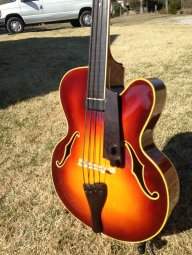
Yes, the floating top design is another approach to shaping the overall tone of the bass, using its wooden structure. It's a more extreme version of what you get from doing heavy chambering in the body, and/or building the body structurally soft, so that it can flex. All that stuff that most of us Luthiers endlessly experiment with.
With the floating top design, The main structure of the body is made fairly rigid, and a separate wooden "top" structure is mounted on top of it. This top structure is designed and mounted on several points, so that it can flex under load, apart from the body. Note how the tailpiece is mounted to the body, take the main structural load of the string tension. The bridge is mounted to the top structure. When you pluck the strings, the oscillation of the strings, through the bridge, causes the top structure to flex. Which causes the bridge to go into its own little oscillation dance. And that changes the sound on the strings, as the two oscillations will partially cancel and interfere with each other. The pickup then "hears" what's on the string, gives it its own subtle EQ curve adjustment, and sends it on down to the amp.
This is all done to shape the sound of the bass through the amp. It's not done to improve the acoustic (unplugged) sound, although that may be a side effect.
Side note:
To me, there are three main parts to the Sound of a bass:
First is the EQ curve, the whole profile of signal level vs frequency, when a particular note is played. It's usually thought of in wide bands of highs, mids, lows, etc.
Second is the attack curve, which is the overall signal level vs time. How a note starts, blooms, decays, and ends.
Third is what I call Coloration, which is often described as warmth and richness vs cold and synthetic. It's the addition of subtle background tones, to either side of the frequency of the main note played.
Anyway, most of the work that we do with changing the sound of the bass by tweaking the wooden structure, is done to add coloration and change the shape of the attack curve. The design/choice of the pickup can play a big part in the overall EQ curve, but (with a few exceptions) really can't change the attack curve or coloration. In designing a bass, we first work with the structure to get the attack curve and coloration where we want it, and then work with the pickup design/choice to even out the EQ curve.
That's purpose of designs like these floating top basses: To make an electric bass (through the amp) have the coloration, attack curve, and general EQ curve of an acoustic instrument.
And there are other ways to get there. Lots of room for experimenting.