• TalkBass has been independent since 1998. Add your voice.
    Create a free account to reply to discussions, view embedded media, and browse with fewer display ads.
    Join freeLog in
    Want zero display ads or expanded classifieds tools? Compare plans.

Fodera: 34" w/ Extended B, or 35" Regular B???

It's basic physics. Yeah the nut is stopping ths string from viabrating BUT longer strings still need to be tuned tighter to achieve the same pitch.

Originally posted by Joelc73
I'm simply pointing out the fact that the nuances of what causes the perception of a "tight" string are vast. I have no doubt that the text book references that you and others are quoting regarding physics are correct. My point in the art vs science reference is that the above metioned nuances (and the world that bass players live in) are far from measurable.

I thought it was a "basic physics"? Come on dude. You come here pushing an idea as physics, with an attitude like "every dummy knows it". Then when people take the time to help you understand that it simply is not correct, you back out and effectively paint them as over-analytical eggheads.

The idea of trying to turn art into science is ludicrist

About as much as somebody who doesn't know the definition of the word "tight" saying "it's basic physics. . .", hmm?

P.S. I think the word you were looking for is "ludicrous".
 
Originally posted by Peter McFerrin


If you put a wood neck that thin on any musical instrument, you're gonna get some "slop" no matter how much tension you have on each string.

I will have to disagree with you on that. I have put the Dingwalls up against many, many high end basses, such as F Bass, Ken Smith, Alembic, Sadowsky, Lakland, Spector, Warwick and Pedulla and I haven't had any problems with this slop.

I have also heard you say repeatedly that they are so thin, but do you know what the thickness of the neck is? Sure they are no baseball bat style Warwick neck, but they really aren't that thin, no thinner than the F basses and Smiths I played, different profile, yes, but not significantly if any thinner.

Anyway, this is getting pretty far off topic.

Geoff
 
Originally posted by geshel


About as much as somebody who doesn't know the definition of the word "tight" saying "it's basic physics. . .", hmm?

P.S. I think the word you were looking for is "ludicrous".

We moved from a science fair to a spelling bee...

You say I'm pushing "my ideas" under the heading of physics and fact. You couldn't be further from the truth. Yes, (as you were sooo kind to point out) I did say "a longer string needs to be tighter than a shorter one to achieve the same pitch." If that statement is wrong, then I stand corrected, if I'm not (which I think we both know is the case) then my statement can and should only be taken within the context of how it was said. If, like a savy politician, you want to pull different quotes from different sections and past them together to make your point, have fun.

Probably most importantly, I have ZERO skin in the game as to whether a longer B works or not. I've found it useful. As I've often said there are way too many variables to instrument construction to isolate one factor as THE ONE that impacts the overall performance. In the basses I've had with longer B's, I've noticed (not imagined and hoped for) a "better" B string. My belief is that the extended B had an INFLUENCE on that effect, not necessarily SOLELY CAUSED that effect.

Again, get what works for you. By the way, I currently DO NOT have an extended B, so as I said I have no vested interest. Interestingly enough, I'm waiting for the Fed EX guy right now to drop off a Fodera 5 with a 3 + 2 headstock, which has the shortest B string length of any Fodera headstock design. So again, I'm simply trying to provide the orginal author of the post with my REAL WORLD experience - to be helpful, not to "push my ideas."

Sorry for the long post, but it bothers me to be attacked when I'm simply trying to provide additional data to someone who requested it.
 
CNC is sometimes refered to as

NC or Numerical Control.

its a programmable device that allows for the input of 3D or 2D data and processed into a language the mill can understand.

great for repeatability and accuracy.

perfect for things like....

BASS GUITAR BODIES and NECKS!

very cheap to have done overseas where workers get paid pennies compared to our dollars.

other industries have used pacific rim builders for decades.

f
 
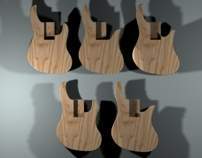
CNC are machined cut and carved basses. Like Gibson, fender, ibanez, peavey, etc. There are exceptions, but most instruments under a $1000 are CNC’d. Heck, then agian there are basses over 3000 which are CNC'd as well. Its just a machine that saves time........ hows that.

Its basically woods thrown into a machine and cut, carved and routed. No tone checking no care to inspecting woods, etc., etc. It’s a CHEAP way of building a lot of instruments fast.
 
The choice of tools of course says nothing about how the piece of wood is selected or how the quality control is done. Quality wise I'd prefer a CNC process to a manual one, provided the wood was selected the same way. The reason would be more consistent dimensions and finish quality, and thus probably more consistent sound characteristics.
 
One thing I know is that Sadowsky 5 strings in general have great sounding and taut B strings. They don't have tilt-back headstocks, or extended B's, or 35" scales, and it's a one piece neck with no graphite bars. Just a thought.:)
 
Peter McFerrin told us what could be measured objectively. The thread here ask about B strings. It's fundamental is around 30.9 Hz. Ask any audiophile what it takes to give a accurate rendering of that note. He will probably tell you that you need 3 thing: rigidity, mass and length or space. The cabinet and the cone needs to be as rigid as possible. The magnet and cabinet need mass. You also need a big enough cone and a long enough room. To have the full wavelength of a 50 hz note, you need 22 feet... and you need about 36 linear feet for a 30.9 hertz wave to be complite...

All this stuff applies for bass. The question that needs answering is this; how would an extended B change any of the above variables? It doesn't speak, anuthing past the nut or bridge isn't part of the speaking length. The tuning peg is further from the nut, you might end up with stability problem. It definitly doesn't add to the rigidity of the bass. Does it change the mass? I don't think so.

have a nice day
PL
 
I believe if you play many instruments you will find the logic, its called inconsistencies.

exactly the opposite.

CNC eliminates inconsistencies.

your original statement alluded to CNC forcing poor wood choices.

CNC has nothing to do with material selection.

i understand what you are saying, that a few of the bigger builders who use CNC, have poor quality control, and use inferior materials to keep pricing down.

you can use CNC and have premium woods pre-selected, yielding fantastic instruments.

again, CNC does NOT equal shoddy product.

f
 
I referred to the quality of wood used. Not the function of the machine!

well, according to this quote:

Its (CNC) basically woods thrown into a machine and cut, carved and routed. No tone checking no care to inspecting woods, etc., etc. It’s a CHEAP way of building a lot of instruments fast.

you incorrectly paired CNC and poor QC.

but now, i understand what you really meant.

:)

f
 
Originally posted by Joelc73

Yes, (as you were sooo kind to point out) I did say "a longer string needs to be tighter than a shorter one to achieve the same pitch." If that statement is wrong, then I stand corrected, if I'm not (which I think we both know is the case) then my statement can and should only be taken within the context of how it was said.

It would be helpful if you included your entire sentence:

Yeah the nut is stopping ths string from viabrating BUT longer strings still need to be tuned tighter to achieve the same pitch

Put in context with the first half of the sentence (and you accuse me of taking it out of context), it is wrong. You're implying that the length past the nut is included in the length when you say "longer strings". It isn't. It's only the vibrating length that matters. Can we move on now?