• TalkBass has been independent since 1998. Add your voice.
    Create a free account to reply to discussions, view embedded media, and browse with fewer display ads.
    Join freeLog in
    Want zero display ads or expanded classifieds tools? Compare plans.

Fodera Club Part IV

Status
Not open for further replies.
Hi gang -- I feel like I have been away from TB for 10 years (it's actually been just shy of 10 days). Anyway, I am a bit swamped getting back into the swing of things here and so rather than post multiple responses to the many good questions raised since I last posted, I am going to take a crack at handling them all here...read on!

1. Fodera Body Sizing. The size of the bodies DOES change with ALL relevant factors...# of strings, scale length AND even string spacing. Since each one is made as a custom instrument we are able to alter the body shape to EXACTLY suit the spec. By way of example, the body of a 35" Monarch 5 will be slightly elongated compared with a 34" Monarch 5 and both would be slightly wider than any Monarch 4...make sense? The differences are subtle and not always obvious to the naked eye, but they do have a definite impact on the feel of the basses. I might add that from a business perspective, building this way is financial suicide (as we gain ZERO economies of scale), however, it DOES make a better playing instrument which is why we do it! LOL.

2. Eucalyptus. We never use it as a body wood...only for tops. It is incredibly dense and heavy. Most of the Eucalyptus we have used has been pinkish in color, but the color can vary quite considerably. We just sourced an INCREDIBLE new parcel of Eucalyptus that is almost the color of Maple (with a faint pink / peach cast) but with a simply astonishing 3 dimensional depth to its flame / quilted figure. Vinny and I were literally giggling like kids when we unpacked it.

Tonally, we have not built enough basses with it to have a truly broad sample from which to draw conclusions, but given that the wood is very, very dense it should serve to brighten the overall tonal spectrum of a bass on which it is used. Remember that our tops function more like a "spice" to the overall tone as opposed to being one of the main ingredients, but as Olive Fodera correctly indicated in his post...a very dense wood like Eucalyptus is going to have a much greater impact on overall tone than would something like Buckeye. It is also NOT a top that should be considered for those looking for lightweight basses.

3. Effect of the Tone Block on Sound. This does play a significant role in determining the overall sound of one of our Elite instruments. More so than does the wood used for the top. Climb is correct in noting that a Fodera built with Ash body wings and a Maple tone block will have a different sound than if we used an Ash tone block. We have actually built many basses with Ash body wings AND Ash tone blocks. However, Vinny also loves building with Ash body wings and flamed Maple tone blocks. In addition to providing a little more "sparkle" / brightness to the instrument's tone, it looks killer!

4. Rich Treat's Top is Crotch Claro Walnut. I can't wait to see it once it is glued up!!

I think that covers most of what I missed while being away. It is great to be back and thanks to all of you for supporting what we do!
 
Welcome back Jason!!!

just a question about the body size thing, since I've ordered one Matt Garrison 6 with 16.5mm spacing, I guess it may looks similar to a MG5 with standard 19mm spacing? Thanks.
 
Thanks!!

It will look VERY similar, but the body will be ever so slightly narrower...

J

Welcome back Jason!!!

just a question about the body size thing, since I've ordered one Matt Garrison 6 with 16.5mm spacing, I guess it may looks similar to a MG5 with standard 19mm spacing? Thanks.
 
A friend found a nice 1992 Anthony Jackson Contrabass at a local to him GC... for $2500. He was nice enough to think of me when he decided not to purchase it. That was "cheap" in my book.
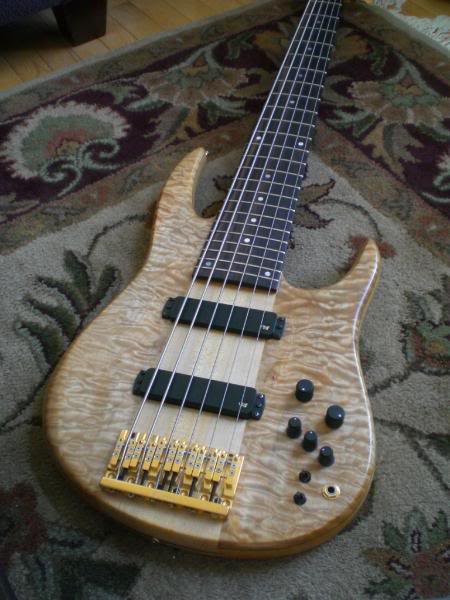
CIMG0291.jpg
This is the AJ that was in the Atlanta GC, right?
 
Hi,
I'm wondering what are the mains differences between this to bass (I have seen pictures of two of this bass with 4 strings, and they look like very similar, but concerning the tone, the weight, playability, ...).
For few month, i'm looking for a monarch4 to complete my Emperor5, and I have seen an Emperor4 to sell in my country, so I would like to have some advice before moving.
Thanks for your help.
 
Hi,
I'm wondering what are the mains differences between this to bass (I have seen pictures of two of this bass with 4 strings, and they look like very similar, but concerning the tone, the weight, playability, ...).
For few month, i'm looking for a monarch4 to complete my Emperor5, and I have seen an Emperor4 to sell in my country, so I would like to have some advice before moving.
Thanks for your help.

Not knowing difference in the tone and weight (which I'm wondering too), I found thread telling of the difference in appearance and play ability, which was posted by Jason.

Here..
---------------------------------------------------------
The Emperor is very similarly sized to a Jazz Bass, however, the Monarch is one of the most compact full scale (meaning 34") bass guitars you can find -- that is what first drew me to the Fodera brand. I am 5'6" on a good day with short arms.

I wanted a 34" scale instrument that I could comfortably play all night in the first position without having my shoulder ache...the Monarch fits that bill.

Which is better for a given person is highly personal...if you can stop by the shop and feel both of them, that would be great.

They also have a different look. The Monarch's body is symmetrical and the Emperor is Asymmetrical. Not saying that anyone ever chooses an instrument because of looks....

I have found that the Monarch is so compact that in a lot of ways a 34" Monarch "feels" like a 33" Emperor...if that makes any sense...
 
Hi gang -- I feel like I have been away from TB for 10 years (it's actually been just shy of 10 days). Anyway, I am a bit swamped getting back into the swing of things here and so rather than post multiple responses to the many good questions raised since I last posted, I am going to take a crack at handling them all here...read on!

1. Fodera Body Sizing. The size of the bodies DOES change with ALL relevant factors...# of strings, scale length AND even string spacing. Since each one is made as a custom instrument we are able to alter the body shape to EXACTLY suit the spec. By way of example, the body of a 35" Monarch 5 will be slightly elongated compared with a 34" Monarch 5 and both would be slightly wider than any Monarch 4...make sense? The differences are subtle and not always obvious to the naked eye, but they do have a definite impact on the feel of the basses. I might add that from a business perspective, building this way is financial suicide (as we gain ZERO economies of scale), however, it DOES make a better playing instrument which is why we do it! LOL.

2. Eucalyptus. We never use it as a body wood...only for tops. It is incredibly dense and heavy. Most of the Eucalyptus we have used has been pinkish in color, but the color can vary quite considerably. We just sourced an INCREDIBLE new parcel of Eucalyptus that is almost the color of Maple (with a faint pink / peach cast) but with a simply astonishing 3 dimensional depth to its flame / quilted figure. Vinny and I were literally giggling like kids when we unpacked it.

Tonally, we have not built enough basses with it to have a truly broad sample from which to draw conclusions, but given that the wood is very, very dense it should serve to brighten the overall tonal spectrum of a bass on which it is used. Remember that our tops function more like a "spice" to the overall tone as opposed to being one of the main ingredients, but as Olive Fodera correctly indicated in his post...a very dense wood like Eucalyptus is going to have a much greater impact on overall tone than would something like Buckeye. It is also NOT a top that should be considered for those looking for lightweight basses.

3. Effect of the Tone Block on Sound. This does play a significant role in determining the overall sound of one of our Elite instruments. More so than does the wood used for the top. Climb is correct in noting that a Fodera built with Ash body wings and a Maple tone block will have a different sound than if we used an Ash tone block. We have actually built many basses with Ash body wings AND Ash tone blocks. However, Vinny also loves building with Ash body wings and flamed Maple tone blocks. In addition to providing a little more "sparkle" / brightness to the instrument's tone, it looks killer!

4. Rich Treat's Top is Crotch Claro Walnut. I can't wait to see it once it is glued up!!

I think that covers most of what I missed while being away. It is great to be back and thanks to all of you for supporting what we do!

It looks like that a Emperor Deluxe 5 have deeper cutaway so it has better access to the 24 fret on the G-string than a Elite 5!

It that true?
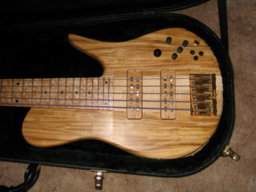
 
Quit possibly may be the scale length of the basses in the pics.I know for a fact the Spalted Maple top was a Bass I was the original owner and had made for me and it is a 35 in scale bass!I have since switched to all 33 or 34 scale Foderas.
 
Looks pretty clear to me that the top two Emperors have the cutaway's deepest point in line with the 24th fret, while the two bottom Emperors have the deepest point at the 23rd fret. Looks clear as day.

Probably just a difference in era.
 
I've owned several of each, Elite and Deluxe, and can say I definitely prefer the Deluxe in terms of playability in the upper registers. I never owned two at the same time to compare and can't remember if one had better access to the 24th fret, but the dovetail neck joint just felt so much smoother and less clunky compared to the neckthrough.
 
Status
Not open for further replies.