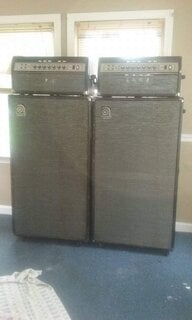
Here's an example of the challenges with folded horn topologies, this is the B-36 (more common than the B-48 due to the size/weight), you can see that there is a large mid bass hump (which is about 50Hz lower on the B48) and even if these measurements aren't perfect (this came off of the web, the SHAPE of the curve is accurate as I remember the measurements I did) and how it falls quickly at the low end. It's quite efficient at the mid hump however, this is the tradeoff.
View attachment 3937780
Above the mid-bass hump, around 350Hz, the response also falls like a rock and all the peaks and valleys are due to internal reflections within the throat of the horn. All folded horns share this shape, though the longer the horn throat combined with a larger mouth extend the low frequency... at the expense of even worse mid response.
Now one way to get MUCH better low frequency performance is to combine the folded horns so that the mouths couple. Doubling the mouth area for a given throat length increases the LF sensitivity and increases the effective LF extension. For pro audio applications, these cabinets are typically crossed over around 100 - 200Hz, so the mid response doesn't matter. Also, if you were to measure the distortion of the folded horn, it would be quite low where the horn is effective and rises very high as the throat reflections come into play.
Adding a mid driver with a crossover, and rolling off the mid response of the folded horn with a proper crossover is a much better sounding solution, is much more articulate. That's the reason for the added mid driver in folded horn cabinets like the B48MF.







 .
.