

Enjoy the benefits of a premium membership!
Upgrade Account
-
TalkBass has been independent since 1998. Add your voice.
Create a free account to reply to discussions, view embedded media, and browse with fewer display ads.
Join free Log in
Want zero display ads or expanded classifieds tools? Compare plans.
You are using an out of date browser. It may not display this or other websites correctly.
You should upgrade or use an alternative browser.
You should upgrade or use an alternative browser.
More options
Who Replied?How does that equal this: "It would be more versatile as you can comb filter out frequencies to emulate body types, along with damping"?
So the wood is a comb filter AND that is what you would use to emulate body types? Wood?
I was just trying to point out that the effect of the wood can only be as a filter. In theory you could have a sufficiently pure signal and then subtract elements to arrive at the end result. Some synthesisers use this principle and can produce a wide variety of tones by subtraction, and via envelopes. Thus, in theory, a bass that had absolutely no resonances, could be a starting point for emulation.
A synthetic generates a signal electronically.
That's technically an electronic synthesiser, and early on in the history of synthesis electro-mechanical means were used to generate the initial signals. That's the point I was trying to bring out, but I admit I probably didn't explain it very well.
Since a bass guitar is using a mechanical system (the string) to generate a signal that is then being modified by magnetic and electronic means, I wouldn't consider it to be an acoustic instrument, but an electro-mechanical one, and in that sense if you drew a Venn diagram it would overlap with things such as the Hammond organ. In terms of the means of generation of the initial signal, then the Venn diagram would overlap with instruments that propagate their sound acoustically.
I hope that's a little clearer.

Those are the ones I own right now. Ones I have previously owned probably brings the number I have owned to 30 to 40. Played? I don't keep count. 100? 200? 300? I am not sure how to even estimate that.
Not trying to be funny, there's playing and then there's playing. Not saying you're doing one or the other. Being able to spend real quality time with an instrument can reveal some pretty interesting things. Do you do your own setups?
I was just trying to point out that the effect of the wood can only be as a filter. In theory you could have a sufficiently pure signal and then subtract elements to arrive at the end result. Some synthesisers use this principle and can produce a wide variety of tones by subtraction, and via envelopes. Thus, in theory, a bass that had absolutely no resonances, could be a starting point for emulation.
Wood can only be a filter? Cool... I'll leave you with that. It doesn't explain applying a comb filter, which I'll also leave be.

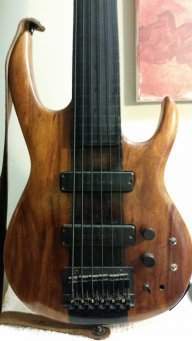
Rw will be much warmer "blurry" on top end. Maple quicker response, brighter up high, tighter in lows.
Not silly, real
Or, Maple will be colder, more harsh or strident on the top end. RW warmer, more lush.
Just a matter of perspective, the actual difference being taken into account with the spectral influences of the rest of the signal chain, and playing style.

That's technically an electronic synthesiser, and early on in the history of synthesis electro-mechanical means were used to generate the initial signals. That's the point I was trying to bring out, but I admit I probably didn't explain it very well.
Since a bass guitar is using a mechanical system (the string) to generate a signal that is then being modified by magnetic and electronic means, I wouldn't consider it to be an acoustic instrument, but an electro-mechanical one, and in that sense if you drew a Venn diagram it would overlap with things such as the Hammond organ. In terms of the means of generation of the initial signal, then the Venn diagram would overlap with instruments that propagate their sound acoustically.
I hope that's a little clearer.
No it really isn't. Have you played a Hammond unplugged?
A synth keyboard is still electromechanical and you still don't hear pitch when it's unamplified. The semantics gyrations you're willing to go through... wow.
Sorry but IMO the more technical you try to be the more you seem to lose sight of what's right in your face.
Yes, an electric bass has pickups. But that doesn't change the fact that even with the electronics removed you can still play and hear it.
Venn diagram?

That wasn't my point, but that a dead spot is the extreme example of subtraction. Interestingly in the 1948 paper, though, for transverse vibrational modes across all species of pine and samples, the resonant frequencies were 450+-50Hz, roughly, apart from one which was 1600Hz, although it was a smaller physical sample than all the others.
Let's return to the beginning of this tangent. You: "About the only difference it's likely to make is in dead spots. But if the wood made a lot of difference to tone, then it would be a bad thing, as it would effectively mean your bass would have to be all dead spots".
I believe that wood can make a lot of difference. Not based on studies or white papers. I've not found that to automatically be a bad thing. This would apparently yield a bass with all dead spots.
Then again, if they're all dead spots , they'd match each other. It's like saying you make everything a priority... which would mean nothing would be a priority.

I don't have nearly as much experience as the majority of TBers so I'm here to pick up what I can glean. IMO, this is the type of subject that can be hard to get a firm handle on, at least from where I am at this point in time. Granted, basses produce sounds unplugged. I'm willing to accept that basses can sound differently based on differences in wood type, hardware, construction, etc. So far, this is observed by the human ear acoustically.
Now, what happens when plugged in? Now we're considering only what the pickup "hears". For the bass itself (not just the strings) to color the sound, the bass would need to change the way the strings move (vibrate) in a quantitative and/or qualitative way that can be "heard" by the pickups. For you tonewood believers, is this making sense? I'm trying to distill the topic into simple parts if I can. You guys and this thread are a sounding board to help clarify this stuff. I don't have a solid position one way or the other at this time.
Now, what happens when plugged in? Now we're considering only what the pickup "hears". For the bass itself (not just the strings) to color the sound, the bass would need to change the way the strings move (vibrate) in a quantitative and/or qualitative way that can be "heard" by the pickups. For you tonewood believers, is this making sense? I'm trying to distill the topic into simple parts if I can. You guys and this thread are a sounding board to help clarify this stuff. I don't have a solid position one way or the other at this time.

You've got a good handle on it. Where wood affects the sound, is how it affects string vibrations through resonant frequencies.I don't have nearly as much experience as the majority of TBers so I'm here to pick up what I can glean. IMO, this is the type of subject that can be hard to get a firm handle on, at least from where I am at this point in time. Granted, basses produce sounds unplugged. I'm willing to accept that basses can sound differently based on differences in wood type, hardware, construction, etc. So far, this is observed by the human ear acoustically.
Now, what happens when plugged in? Now we're considering only what the pickup "hears". For the bass itself (not just the strings) to color the sound, the bass would need to change the way the strings move (vibrate) in a quantitative and/or qualitative way that can be "heard" by the pickups. For you tonewood believers, is this making sense? I'm trying to distill the topic into simple parts if I can. You guys and this thread are a sounding board to help clarify this stuff. I don't have a solid position one way or the other at this time.
The strings will vibrate differently, depending on what they are attached to, and how that material reacts to that vibration.
In many instances, it can be subtle, and only really heard in the overtones (rosewood seeming warmer than maple for example). The fundamental notes to my ear is unchanged. It's the upper harmonic content that is affected.
No it really isn't. Have you played a Hammond unplugged?
A synth keyboard is still electromechanical and you still don't hear pitch when it's unamplified. The semantics gyrations you're willing to go through... wow.
Sorry but IMO the more technical you try to be the more you seem to lose sight of what's right in your face.
Yes, an electric bass has pickups. But that doesn't change the fact that even with the electronics removed you can still play and hear it.
Venn diagram?
That you can hear a bass guitar unplugged doesn't mean that the bass guitar sound reproduction system through an amp is acoustic. If you unplug mellotron you can hear the sound of the tape transports, but it doesn't make it an acoustic instrument. Hearing an electric bass unplugged is extraneous sound to its role as an electro-mechanical sound reproduction system in which the string acts as a signal source.
Not trying to be funny, there's playing and then there's playing. Not saying you're doing one or the other. Being able to spend real quality time with an instrument can reveal some pretty interesting things. Do you do your own setups?
Yes, I do my own setups, and have for at least a decade and a half.

- Jan 12, 2011
- 4,578
- 2,460
- Disclosures
- Artist, Trickfish Amplification Bartolini Emerging Artist, MTD Kingston Emerging Artist. Artist, Tsunami Cables
Maple boards require some, but less maintenance than a rosewood board
Less oiling, more cleaning if you want it to look nice. Same cleaning (edit: required of the rosewood board) if you don't want to catch plague.
Last edited:
- Jan 12, 2011
- 4,578
- 2,460
- Disclosures
- Artist, Trickfish Amplification Bartolini Emerging Artist, MTD Kingston Emerging Artist. Artist, Tsunami Cables
I wipe down after I play and I wash my hands before I play. Rosewood and ebony really show the crud LOL.Less oiling, more cleaning if you want it to look nice. Same cleaning if you don't want to catch plague.
I wipe down after I play and I wash my hands before I play. Rosewood and ebony really show the crud LOL.
My current maple boarded instrument (until I swap my Telecaster neck over) only has a light varnish, which I wore through, and looks filthy. Previous ones seemed to be a bit more resistant, thankfully. I can't see the dark finger filth on the rosewood board so I tend to ignore it. I view it as an anti-theft strategy
I wipe down after I play and I wash my hands before I play. Rosewood and ebony really show the crud LOL.
I would feel confident shaking your hand even after you play...
That you can hear a bass guitar unplugged doesn't mean that the bass guitar sound reproduction system through an amp is acoustic. If you unplug mellotron you can hear the sound of the tape transports, but it doesn't make it an acoustic instrument. Hearing an electric bass unplugged is extraneous sound to its role as an electro-mechanical sound reproduction system in which the string acts as a signal source.
That explains your confusion.
I've repeatedly said that electric basses are fundamentally acoustic devices. I've explained at length why. Not once did I say that this involved an amplifier of any type... other than a chin or drywall.
So you insert that into this discussion for what purpose? A white flag? And the sound of an unplugged Mellotron's tapes just continues the silliness. Can't respond to the Hammond? No doubt. Yes, the Leslie's rotating devices make noise. Can you take that sound, play it in 16ths, play a I-IV-V progression... because you can on an unplugged bass.
PITCH MATTERS. Do you seriously not understand that? If so, cool.
I know what a Venn diagram is. You OTOH don't seem to realize that one populated with irrelevant info is irrelevant.


