![[skyraider]](/data/avatars/l/270/270200.jpg?1620016349)
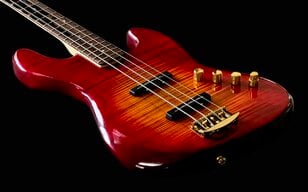
Thanks, Robert. I can't report on the durability-- I finished that only last night! I have roundwounds on it, so we'll see!

TalkBass has been independent since 1998. Add your voice.
Create a free account to reply to discussions, view embedded media, and browse with fewer display ads.
Join free Log in
Want zero display ads or expanded classifieds tools? Compare plans.


Wow!To close the loop, I ended up with CA.
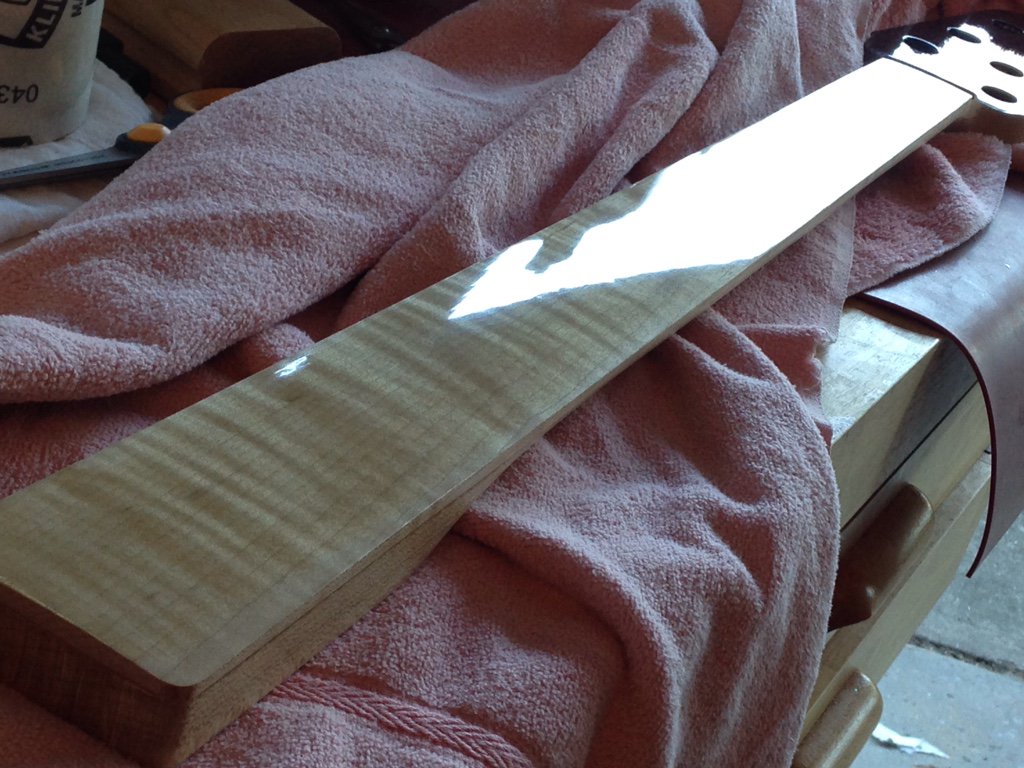
Polished like glass. Four months of playing with rounds and no visible wear.

I wonder what type/brand of tape people who have the most success use for the pour method? I would imagine that would play a large role in how successful you are.

YesHere's a question... Can one do a CA coating on a fretted fret board?
I think the 5-minute epoxy is a thicker consistency, maybe using it for your dam line might be a good idea...
I wouldn't do that, the 5 minute stuff doesn't dry as clear or as hard.
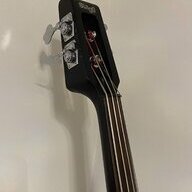
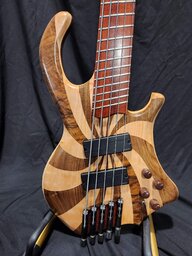
Yes, it helps a lot. Thank you!I have built mostly fretless instruments all have been with uncoated finger boards. The one I just built (in my avatar) I coated the fingerboard with CA glue. I use round wound strings on that bass, so I have two variables - the strings and the CA coated board that make it different than other basses. It's definitely brighter, but I can still dig a good mwah out of it when needed. I really have not noticed any clack when playing expressively on this bass. I guess if I play aggressively and move that left hand fast I can get a good vibration going as I move up the neck, but it's not hard to control, and I wouldn't call it clack. I think the difference between the CA board and a non-coated board has more to do with the tone of the note than clack. The notes are brighter and more defined, less muddy, that muddiness is part of the charm of fretless and you do lose a bit of that for sure (again this is combination of two things on this particular bass).
I always find it difficult to describe sound with words, I'm not sure this helps or not.
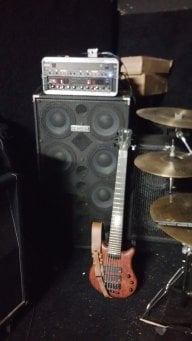
I second this my board is poly'd but it is brighter than some of my uncoated basses and some others I've heard. the mwah is great and playing expressively can still sound smooth and refined. Works great for stuff like tech death metal as it cuts and everyone loves a good fretless sound especially the guitar playersI have built mostly fretless instruments all have been with uncoated finger boards. The one I just built (in my avatar) I coated the fingerboard with CA glue. I use round wound strings on that bass, so I have two variables - the strings and the CA coated board that make it different than other basses. It's definitely brighter, but I can still dig a good mwah out of it when needed. I really have not noticed any clack when playing expressively on this bass. I guess if I play aggressively and move that left hand fast I can get a good vibration going as I move up the neck, but it's not hard to control, and I wouldn't call it clack. I think the difference between the CA board and a non-coated board has more to do with the tone of the note than clack. The notes are brighter and more defined, less muddy, that muddiness is part of the charm of fretless and you do lose a bit of that for sure (again this is combination of two things on this particular bass).
I always find it difficult to describe sound with words, I'm not sure this helps or not.