• TalkBass has been independent since 1998. Add your voice.
    Create a free account to reply to discussions, view embedded media, and browse with fewer display ads.
    Join freeLog in
    Want zero display ads or expanded classifieds tools? Compare plans.

Fretless - lined or unlined? Let's survey this question..What's your preference?

So let's conduct our own Fretless Bass Market Survey

1) are you a regular fretless electric bassist? - Y/N

2) does the fingerboard or top edge of your favored fretless bass have lines, or is it fully unlined? - Lined/Unlined

3) all other things equal, if you bought your next fretless bass from a brand that offered the choice of either a Lined or Unlined fretless neck, which would you purchase? - Lined/Unlined

4) if you only had the one choice (as with Godin) of your less favored fingerboard preference, from your favored fretless bass brand, would you buy one? - Yes/No

5) Please describe your view on this subject? - ________________________

1. yes - at times have rarely used a fretted instrument (both 4 and 5-string)
2. fully unlined. I won't own one with lines (reasoning below). Does have dots on the edge that correspond to the "fret" positions @ 3-5-7-9-12-15-17-19-21-24
3. won't buy a lined bass - won't even consider it
4. see 3
5. I have strong views (obviously). Way back in the day my first electric fretless was a converted fretted bass. I had the frets filled with rosewood (on a rosewood board) so they were subtle. I was also learning upright at the time. I doubled for about 10 years also playing fretted. In '00 I found a Zon 5-string fretless with a Lightwave system that I fell in love with. It was 5-string, unlined. I'd never played 5-string at that point, but dove in with both feet. Played that bass for almost 10 years, rarely touching a fretted. Last 7 years I've gone through a number of other fretli, currently have a Smith 5-string and Rob Allen 4-string. Both unlined.

I'm a firm believer that lines on the fingerboard are an impediment. The reason being that we (humans) have a long evolutionary history that has instilled the primacy of visual cues into our brains. The problem is that with a fretless bass you're trying to make a sound, not match a visual marker. Combine this with the imperfection of intonation, gig distractions, etc, relying on the line as your main reference is problematic. I think that no lines (dots as a rough indicator) forces you to rely more on your ears, which in the long run gets you to a stronger place.

There are obviously pros and others who swear by lines, and more power to them (no need to cite examples). For me it is a clear answer, but I think that in general no-lines is a better path. That is my opinion, totally YMMV. There is no absolute "right" answer.
 
  • Like
Reactions: amper
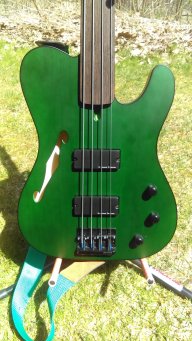
The Tune TWB63WN in post #121 will have the lined fretless fingerboard replaced with an unlined fretless Macassar ebony fingerboard.
It will be done by Bruce Johnson.
Snapshot_20161008_3.JPG
 
Last edited:
On this issue, I can get with any approach another player chooses, with the following exceptions:

1) other player makes categorical condescending comment about my preferences.

2) other player chooses whatever fingerboard configuration purely based on appearance (in itself OK), but then can't play the thing in tune. Not ok. Playing With poor intonation is not ok.

3) bears reapeating; playing with poor intonation is not ok.

Everything else is fine. If you play fretless with a competent level of intonation, then I don't care what the instrument looks like or how you do it. Whatever works. The intonation matters. The looks don't matter (except, possibly to the player); and furthermore, appearance is not a factor in a player's level of skill.

Carry on.
 
Furthermore, would someone please explain to me how there is anything more than ego stroke going on by ramming it down other players' throats that lines are "training wheels;" the inference being that players with lines on the fingerboard are therefore inferior players? I mean I suppose if a player is that insecure about their playing, then whatever; but, I don't see that being constructive discussion.

I understand why lines drive some players nuts. No problem there. But, the general area of markings is 100% subjective. I say use the markings that allow you to play well and in tune. Don't diss other players for their different preferences about markings. That's bush league.
 
I advise a good bra fitting for that puffy chest problem.

The day I walk into a classical concert and see the string section playing with lines instruments is the day I will tell you that lines aren't training wheels. The day I see *this* guy (my dad's cousin's wife's brother) playing his instrument with lines is the day I will buy an instrument with lines.

ma-yo-yo-3-pc-michael-oneill-949x466.jpg
 
  • Like
Reactions: Watchootognbout
Here's my last comment about markings.

If any of us were put on stage, asked to play the head to Billie's Bounce at tempo, and the house goes 100% dark (and ignoring photon producing markings), most of us are at least going to have a tight sphincter moment. Some will have a train wreck.

Why? Because on bass guitar, some kind of visual markings are appropriate to accurately play parts with large position shifts. We are ALL using some form of markings for large position shifts. OK, if you can play the Charlie Parker Omnibus from front to back without looking at your fingerboard once, then cool; I am truly in awe and an admirer. The rest of us mortals use markings. So, I'm just saying, let's not get into my markings are better than your markings.

BTW, I have markings on the fingerboard of my fretted basses. That doesn't bother me either.
 
Last edited:
Furthermore, would someone please explain to me how there is anything more than ego stroke going on by ramming it down other players' throats that lines are "training wheels;" the inference being that players with lines on the fingerboard are therefore inferior players? I mean I suppose if a player is that insecure about their playing, then whatever; but, I don't see that being constructive discussion.

I understand why lines drive some players nuts. No problem there. But, the general area of markings is 100% subjective. I say use the markings that allow you to play well and in tune. Don't diss other players for their different preferences about markings. That's bush league.

No offense, but your extreme response kind of smacks of insecurity. Why would you care if someone else thinks of lines as "training wheels"?
 
Fretless exclusively, right now.
Unlined
Unlined
Would accept lined, but not preferred.
I think an unlined neck is sleeker looking, but I still use side dots, and prefer them located at the fret position.
 
Last edited:
I advise a good bra fitting for that puffy chest problem.

The day I walk into a classical concert and see the string section playing with lines instruments is the day I will tell you that lines aren't training wheels. The day I see *this* guy (my dad's cousin's wife's brother) playing his instrument with lines is the day I will buy an instrument with lines.

ma-yo-yo-3-pc-michael-oneill-949x466.jpg
That guy has been known to play with this guy:
IMG_0033.JPG


Look closely. Notice anything?

Do you actually play upright? Because there are a couple of differences. Just a couple. For one thing, try taking the dots off the side of your bass guitar fingerboard. That string section of yours doesn't have them. Guess you don't need them either. Good luck with that.

Again, I simply don't understand why there is so much angst over this silly topic.:rollno:
 
No offense, but your extreme response kind of smacks of insecurity. Why would you care if someone else thinks of lines as "training wheels"?
I can see why you might think that. In fact, as you say, I am well beyond caring what other people think about what I do. I do admit to getting caught up and in Internet based misinformation that is at the level of high school popularity behavior. My problem is I think we can be better than that. I am trying to advocate a broader perspective on how we look at markings. I think if you read my last several posts, that should line up.
 
I'm a firm believer that lines on the fingerboard are an impediment. The reason being that we (humans) have a long evolutionary history that has instilled the primacy of visual cues into our brains. The problem is that with a fretless bass you're trying to make a sound, not match a visual marker. Combine this with the imperfection of intonation, gig distractions, etc, relying on the line as your main reference is problematic. I think that no lines (dots as a rough indicator) forces you to rely more on your ears, which in the long run gets you to a stronger place.

There's a lot of false conclusions that are being jumped to here.
1. Having lines does not make them your primary visual focus. All instruments have visual cues- if you have no lines and even no dots, you still have the neck and your hands to stare at. Staring at the lines without also listening is the choice of the player, not an ingrained action. Looking at side dots is no different than looking at lines- they're both an aid to get your hand in the right place. What does one being a more "rough" reference do to make it better than the other- you still want visual cues but don't want them to be that accurate? :D You're no more likely to get overly focused on lines than you are to become overly focused on side dots.
2. Having lines does not make you use your ears any less. Reliance on your ears is completely up to the player, not the instrument. There are people who can't look and listen with equal attention paid to both. These are likely the same people who can't walk and chew gum at the same time.
3. You are matching a visual marker when you play fretless; whether you choose to pay attention to it to take advantage of it is another matter. An in tune note is not some ephemeral thing- the notes are in a specific, repeatable location. Twist your tuners like crazy and the notes are still in a fixed, repeatable location , just a different distance from the dots or lines than they were before. There's been many studies proving the benefits of hand eye coordination- you're going to get to a stronger place if you use all three, and likely with a shorter learning period and a stronger memorization.
4. The proof's in the pudding. If playing unlined put fretless players in a stronger place, there'd be a noticeable difference in skill between lined and unlined players, and/or a large percentage of the top bassists would be using unlined. We all know neither of those are true.

Good intonation doesn't come from just your ears. Your ears only tell you if you played the right note after the fact, when it's too late. It's getting your hands in the right place before you play the note that matters. Your eyes and your ears will aid you in getting your fingers in the right place, and using both with get you there faster.

This subject comes up here usually a couple times a year. It's unfortunate that the same dogmas don't ever seem to subside.
 
No offense, but your extreme response kind of smacks of insecurity. Why would you care if someone else thinks of lines as "training wheels"?

Because if someone is telling you you're doing something, anything, with training wheels, they're either making an effort to degrade what you're doing, or trying to elevate themselves above the way you are doing things.

It's inherently rude, but also pretty ridiculous. I'm curious what kind of training Gary Willis is working on that people who say he uses training wheels have already accomplished. What gigs are they getting that Willis didn't get because he uses lines and they don't?