I honestly don't think any of the contributiors thus far give a toss about that kind of thing...
;-)
But fixed regardless

and after reading this thread through .... looks like it won't be on my signature much longer anywayz

TalkBass has been independent since 1998. Add your voice.
Create a free account to reply to discussions, view embedded media, and browse with fewer display ads.
Join free Log in
Want zero display ads or expanded classifieds tools? Compare plans.
I honestly don't think any of the contributiors thus far give a toss about that kind of thing...
;-)

I honestly don't think any of the contributiors thus far give a toss about that kind of thing...


Sure, but maybe the OP wants to update his signature & maybe gives a toss.
Clearly you don't, considering how you spelled contributors
It's always a sticking point with someone, even when you're trying to be nice about it.
I thought "friendly reminder" would sound nice, but I still get blowback

Sure, but maybe the OP wants to update his signature & maybe gives a toss.
Clearly you don't, considering how you spelled contributors
It's always a sticking point with someone, even when you're trying to be nice about it.
I thought "friendly reminder" would sound nice, but I still get blowback

That is basically what I was trying to get at anybody who has played fretless for a while knows the correct position moves behind the line as you increase pitch further up the neck. I was just saying finding that perfect on the line spot lower near the nut becomes kind of weird because it is in between your side markers (if you have into nate between the markers) and further up the neck moves further back. Should have clarified better but you summed up what I was trying to say in a sense. I would not recommend intonating where the center of fret would be.I would say not because errors will accumulate as you move away from the setpoint. If you move your finger towards the nut to get more behind the line you will intonate sharp. As you go up the neck you will get progressively further away from the line, and as you go towards the nut you will get progressively closer to, or over, it. I think its better to have each dot as close to perfect as possible, then just use the markers as a guide but use your ears to arbitrate.

That's exactly what worked best for me. Lines only made everything worse in my learning.If I'm going to put the time in, I think it might be easier to just go with an unlined neck
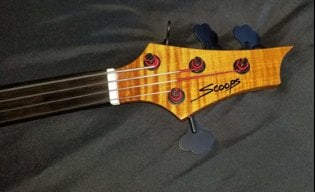
View attachment 1118312 The tip of your finger should be roughly on the line, provided your instrument is correctly intonated. Try stopping (this is fretless so fretting is out!) the note with your fingernail or edge of a bank card on the octave line... Is it in tune with the open string?
Ultimately no-one will judge you on where your fingers go provided you are in tune...
Sorry, but this pic is not consistent with the text. It's clear that in the case of the first and second finger, the pads are reasonably close. For the third and fourth fingers I can still see the line.
I don't know about that pic, his fingers look a little flat to me.View attachment 1118312 The tip of your finger should be roughly on the line, provided your instrument is correctly intonated. Try stopping (this is fretless so fretting is out!) the note with your fingernail or edge of a bank card on the octave line... Is it in tune with the open string?
Ultimately no-one will judge you on where your fingers go provided you are in tune...



This is why I hate lined fretless basses - they are CONFUSING.
my advice - try to ignore the lines. Completely. Play with your EARS. Play scales and lots of them until your hands and your ears are on the same page. That's the way it worked for me - and it happens - it really does - but it takes serious practice.

This is why I prefer unlined, your fingers have to go to the correct place on a blank board and your ears tell you if you got it right or not. There is no other aid. Which makes it tricky playing unlined fretless on a dark stage with bad monitoring

Whether you are in tune on a fretless or not, is not dictated by setting the intonation, but by where you place your fingers on the board. Violins and double basses don't have adjustable intonation on their bridges. Those instruments rely on the player's ability to find the right notes. So does fretless bass. However, if you are playing a lined board, intonating the bass correctly will give your fingers a pretty solid "reference point" on the fingerboard on every "fret". Unlined board with side dots, lined board... Whatever works for you. Also, I find the idea of *not looking at the neck* quite stupid. If it helps you play better and more in tune, go for it. Eventually, once you get more experienced with fretless, you'll find yourself gawking less and less at your fingers.