• TalkBass has been independent since 1998. Add your voice.
    Create a free account to reply to discussions, view embedded media, and browse with fewer display ads.
    Join freeLog in
    Want zero display ads or expanded classifieds tools? Compare plans.

Fretless playing question ...

This is why I hate lined fretless basses - they are CONFUSING.

my advice - try to ignore the lines. Completely. Play with your EARS. Play scales and lots of them until your hands and your ears are on the same page. That's the way it worked for me - and it happens - it really does - but it takes serious practice.
In addition to scales, learning some common melodies is also great fretless practice.
Learning "Happy Birthday" in all 12 keys is a great fretless excercise.
My favorite exercise melody is Star Spangled Banner.
 
I very much enjoy fretless. There is a sense of freedom. If you have played awhile your fingers and ears do all work..I close my eyes when playing. I may not be 100 % in tune all the time but no audience is going to notice if you are slightly flat or sharp accept if you are holding a note or chord .. not good.

You play fretless perfectly in tune, it rather defeats the purpose, if you ask me.
 
Hey all,

I've recently purchased my first fretless bass after playing fretted basses for 30+ years.

Before I decided to invest big money into a high end axe, I bought a Squire VM fretless.
I noticed that to play in tune, I have to press down almost literally right on the fretline of the note I want to play and the following note .... Is this normal for fretless basses that have fret markers in the neck? Will I find this with pretty much any fretless I buy that has fret markers? ... If so I may consider returning the bass and buying one with no fret markers, just a plain unmarked neck.

Any feedback or advice on this would be appreciated - Thanks
Even if your fretless has no lines, you still have to put your fingers in the right place.
What if the right place isn't exactly on a line?

What would happen if I said, "a lined fretless is like paint by numbers", or "a trombone with note marks" but followed it with IMHO, YMMV and ended with a smiley face? :laugh:
 
Hey all,

I've recently purchased my first fretless bass after playing fretted basses for 30+ years.

Before I decided to invest big money into a high end axe, I bought a Squire VM fretless.
I noticed that to play in tune, I have to press down almost literally right on the fretline of the note I want to play and the following note .... Is this normal for fretless basses that have fret markers in the neck? Will I find this with pretty much any fretless I buy that has fret markers? ... If so I may consider returning the bass and buying one with no fret markers, just a plain unmarked neck.

Any feedback or advice on this would be appreciated - Thanks

I also just bought my first fretless after 30+ years!...got a MIM Jazz 5 string...frets were removed and filled professionally and I bought it here on TB! After playing with it for a few hours it definitely seems that one must place the finger right on the line. Good luck on your fretless journey!
 
  • Like
Reactions: BK bassist
That's exactly what worked best for me. Lines only made everything worse in my learning.
Me, too. I started learning fretless only a few months after I started learning fretted bass, so I learned both almost concurrently. I found the fret lines on my first fretless to be completely confusing to me. They just cluttered up a process that, in my mind, should have been simpler.

In retrospect, I'm sure I would have gotten used to it, but I sold it and got an unlined fretless and never looked back. It just worked better for the way my brain is wired. That was over 30 years ago - can't turn that boat around now! I've only owned unlined fretless basses since. As far as looking is concerned, I respect those who can play a bass and never look at the fingerboard, but I'm not one of them. Fretless electric basses have a much longer expanse of fingerboard without any landmarks than upright basses have. If I'm making a big shift I rely heavily on my edge markers

You play fretless perfectly in tune, it rather defeats the purpose, if you ask me.
I have to respectfully disagree with you there. I play fretless primarily for the feel (I find fretless boards more comfortable to play) and for the envelope of the note. Both the attack and decay are considerably different than a fretted bass. Do I also enjoy the added expressive possibilities you get with fretless? Sure! But that's not the prime reason for me. I'm perfectly happy to keep in reined in for bandleaders who don't care for the "fretless tricks" that get so many fretless players ostracized. However, I totally get why some players only ever use it for its 'fretlessness' and play for effect and I have no problem with that, it's just not what I do (usually).
 
It's actually good practice on a fretted bass to be very close, essentially on the fret. Your energy should be directed toward the back edge of the crown of the fret, as close as you can without muting the note with the fat part of your finger hanging over the fret. Playing "between the lines" requires more pressure, and is prone to pulling strings out of tune. You'll get the punchiest tone doing it right.

Fretless is almost the same, the apex of pressure should be right at the fret line... if the fret line is right ;)
 
  • Like
Reactions: Watchootognbout
If I'm making a big shift I rely heavily on my edge markers
Same here. I'll try to not look as much as possible, but those bigger jumps still need a glance at the side dots, for me.

Ironically, as many times as I tried fretless, it never connected with me until I had to take up upright. THAT made sense to me, for some stupid reason. After that, electric fretless made much more sense.
 
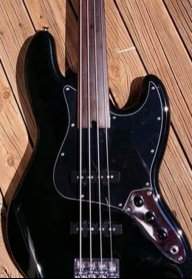
EXACTLY where I'm coming from. After 30 years of playing pretty much solidly right in the middle of the frets, now to all of a sudden need to play right up on the line (or pretty close) is going to require a learning curve. If I'm going to put the time in, I think it might be easier to just go with an unlined neck .... I was actually considering this beauty:
View attachment 1118365
You'd be better off with an unlined fretless and use your ears. Open strings are your friend to help you play in tune.
You'll have to adjust your left hand technique a bit---- the "correct way" to play a fretted instrument is not "in the middle" of the frets, but close to the fret--- I don't expect that to change for you after 30 years, so better to ditch the fret lines.
 
  • Like
Reactions: Nickweissmusic
Side Dots can at the least - provide some useful orientation - but in general:
YOU SHOULD NOT BE LOOKING AT THE FINGERBOARD WHILE PLAYING FRETLESS BASS.

Use your ears and make those micro-tonal adjustments in real time without looking.
This is the way forward.... Avoid crutches.

Mostly just trust your ear

I've only been playing fretless for around 6 months and still find I need those crutches of the side dots. I actually have to look at the fretboard a lot more on the fretless than the fretted bass.
I obviously don't have a very good ear. While I can hear every time my intonation is off even just a little bit, but without looking at my side dots I can rarely pick whether i'm a little sharp or flat.
 
  • Like
Reactions: Watchootognbout
Sorry, but this pic is not consistent with the text. It's clear that in the case of the first and second finger, the pads are reasonably close. For the third and fourth fingers I can still see the line.

I can see that myself, but as already noted, the lines are a guide, everyone's fingers are different, setup preferences are personal and ears arbitrate, so it doesn't really matter...
 
It's actually good practice on a fretted bass to be very close, essentially on the fret. Your energy should be directed toward the back edge of the crown of the fret, as close as you can without muting the note with the fat part of your finger hanging over the fret. Playing "between the lines" requires more pressure, and is prone to pulling strings out of tune. You'll get the punchiest tone doing it right.

Fretless is almost the same, the apex of pressure should be right at the fret line... if the fret line is right ;)

I don't find this to be true. I use pretty low action on fretted and don't really have to use much pressure to play my basses.
:)
 
  • Like
Reactions: Watchootognbout
I don't find this to be true. I use pretty low action on fretted and don't really have to use much pressure to play my basses.
:)

You're not disagreeing with me, you're disagreeing with physics. The closer you hold your fingers to the fret, the less pressure you need, regardless of how low your action is. Congratulations on your low action. You're not taking advantage of its full potential unless you fret properly.
 
You're not disagreeing with me, you're disagreeing with physics. The closer you hold your fingers to the fret, the less pressure you need, regardless of how low your action is. Congratulations on your low action. You're not taking advantage of its full potential unless you fret properly.


That is genuinely funny. Thanks. What exactly am I not taking full advantage of?
:D

Easily one of my favorite fallacies.

As if there's only one proper way to fret. I still disagree with this: "Playing "between the lines" requires more pressure, and is prone to pulling strings out of tune. You'll get the punchiest tone doing it right.
:meh:

Because while it may very well work best for you, the idea that it's universally true is frankly nonsense. But some folks like to think in boxes so knock yourself out. One of the keys to a fretted bass is that the fret cuts the length of the string instead of your finger. The idea that you have to press hard, period is antiquated. Put forth usually by folks who can't finger out how to get punch with low action, which is entirely physically possible for others and quite demonstrable.
;)

Physics and I get along quite nicely. The physics of low action is pretty sweet if you figure out how to work with it. I just had a friend of mine who's an accomplished bassist play one of mine and declare that "you can't really dig in with the action like this". I asked him to hand the bass back to me and I dug in. Even hit the low B very hard without choking out the note. The problem wasn't the bass, it was the bass and the particular player.
 
Last edited:
  • Like
Reactions: Watchootognbout
That is genuinely funny. Thanks. What exactly am I not taking full advantage of?
:D

Easily one of my favorite fallacies.

As if there's only one proper way to fret. I still disagree with this: "Playing "between the lines" requires more pressure, and is prone to pulling strings out of tune. You'll get the punchiest tone doing it right.
:meh:

Because while it may very well work best for you, the idea that it's universally true is frankly nonsense. But some folks like to think in boxes so knock yourself out. One of the keys to a fretted bass is that the fret cuts the length of the string instead of your finger. The idea that you have to press hard, period is antiquated. Put forth usually by folks who can't finger out how to get punch with low action, which is entirely physically possible for others and quite demonstrable.
;)

Physics and I get along quite nicely. The physics of low action is pretty sweet if you figure out how to work with it. I just had a friend of mine who's an accomplished bassist play one of mine and declare that "you can't really dig in with the action like this". I asked him to hand the bass back to me and I dug in. Even hit the low B very hard without choking out the note. The problem wasn't the bass, it was the bass and the particular player.

There actually really is one proper way to fret- as close to the fret as possible, without going over. "Price is right" rules apply. Frets do allow a little leeway for difficult phrases or chords where that's impossible, and everyone's hands are different, but if you can see fretboard in between your finger and the fret, you're probably doing it wrong.

Playing with speed, finesse, and consistent pitch requires efficiency- getting the most work done with the least amount of effort. The further you are behind the fret, the more pressure you need to get the same amount of work done. That's not me saying that, it's the laws of physics, I'm just the messenger. Yes, you might be able to get results fretting in the middle of your fret, good for you. The fact is, you could sound even better, use less effort and play even faster/ smoother/ more consistently if you used proper technique. If your action is low to begin with, that just means there's potential for more speed, agility and consistency, vs. a bass with tougher action. If you're playing in the middle of the fret, you're not taking advantage of that. That's what I mean by not getting the most potential out of your instrument.

YouTube is free. Watch pros play. Google is free. Look it up. This is not a secret, but I'm surprised to see how many people don't know about it.
 
  • Like
Reactions: SteveCS
Put the radio on, pick up your bass & turn out the light. Shaky at first but incredibly freeing.

It'll greatly improve your ear & your hand shape. You'll also learn how thumb position helps as reference for your finger placement.


I'd strongly advise sticking to one scale length of fretless for a while, preferably the same as your main/fretted basses. I have 4 Fretless basses: 18" lined, and 30", 34" & 41" unlined.... all have wooden bridges (unable to set each strings intonation separately).