• TalkBass has been independent since 1998. Add your voice.
    Create a free account to reply to discussions, view embedded media, and browse with fewer display ads.
    Join freeLog in
    Want zero display ads or expanded classifieds tools? Compare plans.

Fretless Side Dots

Sasha Blanton

Supporting Member
Jun 27, 2020
45
90
Hey, I know this topic has been discussed here before but I couldn't find an answer to one particular question.

Why are the fretless side dots often only on every other note...and if you are using the dots as a guideline then how are you suppose to do the same for the non-dotted note...is it just the middle between 2 dots...?

Thanks!

Also -- I know you should use your ears, so hoping to avoid that debate.
 
I like dots at 1,2,and 3 then the regular intervals.

the in between are roughly in between, just as the dotted are roughly where the dots are.
 
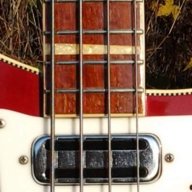
I reference the dots on my fretless mainly to get in the general area when changing positions - then it's up to my ears. So estimating in between the dots is "good enough." Having a dot at every fret position (like some Rickenbacker fretlesses) would make it hard unless the 3, 5, 7,... dots were different somehow (which they weren't on the Rickenbackers).
 
Hey, I know this topic has been discussed here before but I couldn't find an answer to one particular question.

Why are the fretless side dots often only on every other note...and if you are using the dots as a guideline then how are you suppose to do the same for the non-dotted note...is it just the middle between 2 dots...?

Thanks!

Also -- I know you should use your ears, so hoping to avoid that debate.
In my professional world this is called a GCE (Gross Conceptual Error). The dots are position locators just like the dots and inlays on a fretted instrument. You don't use them to locate where the note is played. You do that with experience and your ear, along with muscle memory.

The mathematical location of a note between the "dots" is theoretically not half way in between. It will be the same ratio as the reduction in distance between the frets on a fretted neck, which means a little further down the neck. However, see my comment in the first paragraph of this reply
 
I have a Vantage VA-900B factory fretless. A full two-octave neck, no lines, and came stock with side dots at every position. Twenty-four identical dots along an otherwise unmarked neck. (And a very short upper horn.) Let me tell you, not very useful at all. (Having the 12th marker a single dot like all the others did not help, I suppose.)

I drilled out all the "unnecessary" dots and left the typical 1, 3, 5, 7, 9, 12, 15... etc. Much better. (Still haven't added a second dot to the 12th, but I don't play it out much anymore.)
 
I have one de-fretted bass, and I thought while I was re-marking the dots, why not mark every fret. Well like @Abner experienced above...a dot at every fret stops being a useful marker because there are so many all lined up in a row that you can't tell where you are without doing a lot of counting. I tried a second version where I used 2 alternating colors, but that's been only slightly less confusing. I'll be converting it to "traditional" fretless markings the next time I need a project.
 
  • Like
Reactions: Abner
I have one de-fretted bass, and I thought while I was re-marking the dots, why not mark every fret. Well like @Abner experienced above...a dot at every fret stops being a useful marker because there are so many all lined up in a row that you can't tell where you are without doing a lot of counting. I tried a second version where I used 2 alternating colors, but that's been only slightly less confusing. I'll be converting it to "traditional" fretless markings the next time I need a project.

How about lines and dots. This has worked well for me. Looks just like a fretted neck from the side basically. Also, since this is fanned fretless, side line reference is more of a general thing since each string intonates in a slightly different place.

IMG_1168.jpg
 
My old Fender fretless neck has no lines, but the side dots are where the 3rd 5th 7th.....dots would be. They are very handy starting songs and for big hand shifts. I have heard that some fretless necks have their dots in the same place they would be on a fretted bass. I don't think this would be anywhere near as useful.
 
Not a complicated issue but there is some division so I will not say anything nasty, I pinkie promise.

Fretless bass guitars represent a very small subset of the bass market which is itself a very small subset of the guitar market. So it is reasonable that large manufacturers might not invest in separate tooling to locate pilot holes for insertion of clay or other media in different position as any other bass. Hopefully this makes sense. While a Fodera or Sadowsy or Alembic can accommodate your wish for a fee, Fender (example) is using automated mills and templates. Assume for every 2,500 Strats there is 1 Tony Franklin. If I'm not exact I know from my own industry experience that I'm at least pretty close with my estimate. So a separate die or even a router program is a large investment for a small, niche product.
I can also speak specifically to my own fretlesses (avatar!) that my side dots are exactly where they would be if there were frets.

@rickdog and others commented that the 3-5-7-12--- pattern is a reference. The fretless bass guitar is for all practical purposes a standard bass guitar without frets. So the markings are familiarities. This is independent of the fret line conversation.

I'd ask the other question. If you are playing a fretted bass and you look at the neck are you setting your eye to the fret or according to the dot? For me it would be the dot. I know the distance from the dot (visible cue) to the fret or fretless position. To be honest I could easily learn to live without dots or inlays.
I grew up with violins and cello and playing a fretless feels familiar. I know some have lines and some don't and that's cool, play what you like. But upright basses, cellos, trombones don't have any kind of marker. So it's also a reasonable assumption that some fretless makers will think you need marks and some will not.

You could argue either way that they are needed or not needed. But it is much more likely they are in the traditional "between fret" location than in actual note location due to manufacturing practices.
 
My two fretless BGs have the dots, which is more than my DB! It's hard to look at the DB fingerboard when I'm playing though, so it really forces ear playing.
How about lines and dots.
I just ordered one that's got that kind of marking. My first thought was "but why?" I mean, I get it, but it makes my eye twitch a little with the visual clutter on an otherwise unadorned neck. It's only visible to the player though, so I'm not bothered enough for it to be a deal breaker.
 
My two fretless BGs have the dots, which is more than my DB! It's hard to look at the DB fingerboard when I'm playing though, so it really forces ear playing.

I just ordered one that's got that kind of marking. My first thought was "but why?" I mean, I get it, but it makes my eye twitch a little with the visual clutter on an otherwise unadorned neck. It's only visible to the player though, so I'm not bothered enough for it to be a deal breaker.

When I look down at a fretted bass neck I basically see the same thing. I can see where the actual frets are along the edge of the fretboard wood and the dots. This is really the 'same'. I also have a deep hatred of being on dark stages and not being able to see the side of my fretboard. I'll always be someone who just feels more comfortable using both my eyes and my muscle memory no matter how many thousands and thousands of hours of play. I've gone to all luminlay side dots on all my basses and after a few hundred shows with them, I'd have it no other way.
 
I like the dots right where the frets would be. I find it disorienting otherwise.

I have an unlined fretless bass (it’s a 1993 Musicman Stingray...... surprise surprise
.....) - it has dot markers at the locations the frets would be, 3;5;7;9;12; 15;17;19;21. This is the same as a fretted Stingray except the dots are where the fret line positions would be (rather than in the centre of the frets as per a fretted version). So it can’t be that difficult for manufacturers beyond the boutique builders?

Whilst I use my ears the markers are a good additional point of reference (as they are on a fretted bass) - as I found out playing on a very dark stage area with spot lights - a nerve racking performance with the dots completely invisible - a good reason for LEDs or luminlays!! However I was pretty well accurate.
 
Last edited:
When I look down at a fretted bass neck I basically see the same thing. I can see where the actual frets are along the edge of the fretboard wood and the dots. This is really the 'same'. I also have a deep hatred of being on dark stages and not being able to see the side of my fretboard. I'll always be someone who just feels more comfortable using both my eyes and my muscle memory no matter how many thousands and thousands of hours of play. I've gone to all luminlay side dots on all my basses and after a few hundred shows with them, I'd have it no other way.
Like I say, I get it, but it's not something I would seek out as a feature for myself. I was just a little confused/surprised when I zoomed in on the pics of the bass I'm ordering. I think it makes more sense than a lined fingerboard for sure, if you want the visual reference without spoiling the uninterrupted expanse of wood grain.
 
  • Like
Reactions: Derek Nolan
Like I say, I get it, but it's not something I would seek out as a feature for myself. I was just a little confused/surprised when I zoomed in on the pics of the bass I'm ordering. I think it makes more sense than a lined fingerboard for sure, if you want the visual reference without spoiling the uninterrupted expanse of wood grain.

Mines lined too. ;)

IMG_0789.jpg


Its a conversion, so it has to be...but I had the old inlay lines cut out of it and replaced with higher contrast ones for the same reason as I said before.

And this.

IMG_9661.jpg


I also have a fretless 6 that's parallel, but I'm much better on the five since I've played multiscale for so long now.
 
Here's a hint, if you're lookin at the dots you're probably out of tune.

An astute observation - however if you have to play a line which involves a jump up the board to a different octave and you don’t have the reference point it can be difficult to land exactly in tune. A good example is a walking bass line. I much prefer the look of an unlined board (anyone who plays a fanned fret fretless deserves a medal in my view - that would really stress me out!!)

69FEE211-007C-4DF6-93BF-365B4E929499.jpeg