• TalkBass has been independent since 1998. Add your voice.
    Create a free account to reply to discussions, view embedded media, and browse with fewer display ads.
    Join freeLog in
    Want zero display ads or expanded classifieds tools? Compare plans.

Fretted Fretless

Will you be adding a radius back to the fingerboard after the pour to remove the extra material along the sides?

Yes. 14" to be precise.

As a non-luthier, are epoxy fingerboards a thing? Because my understanding is that he's basically putting an epoxy fingerboard over his traditional fretboard.
Yes, epoxy fingerboards are a thing
Yes, I am just putting epoxy on top of a regular fingerboard

Answer me Scoops I'm asking you a question!

???
 
  • Like
Reactions: moderatelyfunky
So one thought I am having is how far down I take the epoxy.
Just above the fret? I think this is where I start

Another thought

We all know that fretless basses don't work well with slapping. You can make it work, but it is more difficult.
Why? I think the fret play a critical role

So if I expose the frets just a bit, I get the metal of the fret, with the flatness of a fretless

Potential that could be realized: a fretless that can do slap easily
 
I'll just gently point out that ignoring people who disagree with you IS cancel culture.

Good luck.
I actually agree with you, but there have been no disagreements, just naysaying, and critiques that are quite obviously coming from a place of ignorance.

This is observational and not intended to disrespect. I've posted ignorant crap before too. :D
 
  • Like
Reactions: MovinTarget
I actually agree with you, but there have been no disagreements, just naysaying, and critiques that are quite obviously coming from a place of ignorance.

This is observational and not intended to disrespect. I've posted ignorant crap before too. :D

I'm just perennially puzzled by people who post things in public fora, then get butthurt when there's any sort of backlash. I'll never understand that.

If we're not interested in a free exchange of ideas, then what's the point of posting? Whether the OP likes it or not, the "naysayers" might actually have a point...
 
I don't understand why you'd want to do this, but that doesn't mean anything as there's a great many things I don't understand.

So please carry on. As long as we (and especially the OP) learn something, this is time well spent.
 
I'd give some thought to the type of epoxy used: It has to be hard enough to have a good playing surface that will hold up to some wear and tear, but elastic enough so that the truss rod can be adjusted without cracking the epoxy layer (bending both ways - strain and compression need to be considered). Some experimentation with different materials may be in order. Good luck!

Most epoxy treated fingerboards have a pretty thin layer of epoxy - the wood underneath helps the epoxy survive tensile stresses. Here, the layer is thick enough that the wood fibers underneath probably won't help as much. You can help the epoxy survive in tension (avoid cracks) by making the layer you're adding a composite - adding glass fiber or graphite fiber layers within it, Any fabric with decent tensile strength will help - a lot of knife handles are done with paper or even old jeans as the fabric. The process would essentially be gluing on fiberglass (or other fabric) rectangles with epoxy as the glue (making sure you saturate the fabric with glue), layer by layer, then leveling, and polishing once the thickness is where you need it to be. If the last layer of fabric is one that goes over the frets, it might help avoid cracks at the fret locations as well.
Whatever you do, wear a dust mask when you're leveling and polishing the fingerboard - no telling what those particles might do to your lungs.

One of the things I like about a fretless is the slightly thinner neck - you take out the height of the frets, the thing is sometimes nicer to play. Here you won't get that, but maybe you'll like it.
 
way back in 2002 ( didn't read every reply so...) there was a company (dude) making basses with concave frets. sounded fretless unless you stopped dead on the concave fret then it sounded fretted. cool as poopie and I really wanted one. I can't remember the name but maybe it's already been mention in the 3 pages of replies I didn't read.
 
You have been very defensive about some very benign comments throughout this thread, and what you are saying just doesn't make sense.

In any case, I'm moving on. I was curious to see how this would turn out, but not curious enough to make it worth the unpleasant attitude. Best of luck.

In scoops defense if I were to be teased by the people here I'd act defensive too. Let's point out that some of those benign comments have ended with snarky remarks/jabs. But, it's best to ignore them and move on rather than give in to the childish behavior so I guess when it comes to threads/forums we forget to put on our big boy pants and move on with our lives. "If you don't have anything nice to say, don't say it at all" a wise man once told me. :rolleyes:
 
So if I expose the frets just a bit, I get the metal of the fret, with the flatness of a fretless
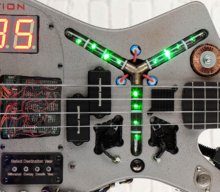
Potential that could be realized: a fretless that can do slap easily

I don't know, that sounds like a Jack of something, master of nothing. If you leave the frets exposed you won't get a fretless sound, neither will it play like a fretted neck. But as you said, it's an experiment and maybe it'll sound interesting.
 
I'm interested to see how this works out.
My working with epoxy is limited to spending a few days helping my Uncle sanding layers of epoxy on this boat:
https://www.soundingsonline.com/features/restoring-a-classic-trawler

My concern is regarding durability and stability.Durable epoxy is -as far as I know- usually laid down in successive layers that are sanded and smoothed out in between. Thick pour-all-at-once epoxy projects are usually on solid surfaces like a tabletop with poker chips embedded in it.

A neck has expected flex through the seasons and via truss rod adjustments. I'm not sure that a layer of epoxy that thick is going to resist cracking over the years.

It was mentioned by someone that it's better than ripping the frets out, but that is silly, since if properly backbowed and heated, frets should be able to be removed with no more damage to the surrounding material than would be removed anyway in replacing the frets with veneer.

Also, there is the matter of weight. You're essentially adding another fingerboard of heavy epoxy on top of the existing board. In the end, I think you're going to end up with a heavy, potentially ruined neck but crazier things have been done, and sometimes the joy is in the process and experimentation, not the final result.

Lastly, I would add that if one's heart is really set on this, it'd be best to grind the frets down as low as possible so you can pour less epoxy on the board.

EDIT: Just read that you've poured already. The die is cast...
 
  • Like
Reactions: Loring
It's amazing how many people have dropped into this thread and offered negative advice.

It's almost as if they have failed to grasp that this is an experiment, for the sake of experimentation, using a cheap neck, by a guy with considerable experience using epoxy on necks.

Come on people! Why do you have to be such downers??

I can't like this post enough. Constructive criticism to help him achieve his goals or point out potential pitfalls might be appreciated, but there just seems to bee a whole lotta, "grumble, grumble, different think bad, grumble." It's a cheap neck and he's doing it because he can just to see what results. Some of you are acting like he's destroying a rare and expensive bass instead of experimenting on an inexpensive neck. I've probably lost more money selling a cheap bass I modded and still didn't like. Hell, even if he was destroying a rare and expensive bass, who cares?