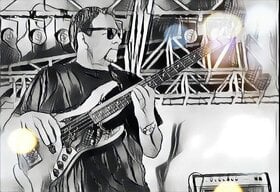
Here is a related essay, and quite frankly, I've wondered this myself in recent years…

TalkBass has been independent since 1998. Add your voice.
Create a free account to reply to discussions, view embedded media, and browse with fewer display ads.
Join free Log in
Want zero display ads or expanded classifieds tools? Compare plans.

PaywallHere is a related essay, and quite frankly, I've wondered this myself in recent years…
Damn, first the video(for some), then this. Maybe if you Google "What Happened To The Funk?"Paywall



Just finished watching. Interesting doc but a bit fluffy. And the identity politics angle was a bit tiresome (though fully predictable). Cool that the bass got the focus it did, but absolutely no mention of the foundational role of New Orleans and, if nothing else, second line drumming? No mention of go-go? I know it was just a one part documentary but I was hoping it would go deeper. Still a worthwhile watch for sure though.

New Orleans was at the foundation of a lot of the syncopated rhythms of funk. It's not a question of how many popular bands came out of NO, but a matter of funk DNA. To have a documentary on the history of the style and not talk about that link is off to me. Go-go was regional (although it was pretty big within certain British and Japanese circles) but it represented a very particular style of funk that has remained more or less intact for longer than any other funk "movement". It was also getting sampled and recreated by hip-hop producers left right and center in the ´80s (not to mention being used as a template for a not-insignificant number of remixes of pop records in that same decade). To have a documentary on the history of funk and not even mention it once is leaving a hole in that historical account.Go-Go was great music, but was mainly regional. I can only name three Go Go acts with national hits:
Trouble Funk (Drop the Bomb,) Experience Unlimited (Da Butt,) Chuck Brown and the Soul Searchers (Bustin' Loose.) Go Go also had a rising profile at the same time as Rap and Rap quickly eclipsed it.
New Orleans Funk was also largely regional although The Meters were a major act and Allan Toussaint made a national and international impact. That said, Chocolate Milk was a cool band from New Orleans.
The documentary was right to focus on the seminal influence of James Brown and the dominance of Ohio bands.
As for identity politics, the music came out of the era of Black Power and Pan Africanism. Those are just the facts.
As for the identity politics, I agree that an account of the social context of the music is important to an understanding of the history of funk, but I felt this documentary went beyond that. I got the impression that the interview subjects were being prompted off camera to "say something about the blackness of funk".
New Orleans was at the foundation of a lot of the syncopated rhythms of funk. It's not a question of how many popular bands came out of NO, but a matter of funk DNA. To have a documentary on the history of the style and not talk about that link is off to me. Go-go was regional (although it was pretty big within certain British and Japanese circles) but it represented a very particular style of funk that has remained more or less intact for longer than any other funk "movement". It was also getting sampled and recreated by hip-hop producers left right and center in the ´80s (not to mention being used as a template for a not-insignificant number of remixes of pop records in that same decade). To have a documentary on the history of funk and not even mention it once is leaving a hole in that historical account.
As for the identity politics, I agree that an account of the social context of the music is important to an understanding of the history of funk, but I felt this documentary went beyond that. I got the impression that the interview subjects were being prompted off camera to "say something about the blackness of funk".
You are overstating New Orleans importance in relation to Funk. The relationship between New Orleans and Jazz is a straight line, but when it comes to other variants of African American music, it is one of many streams flowing into a great river (of course, New Orleans was built by a great river.) When James Brown was born in Edgefield Cointy, SC, the state was still majority Black. On the coast, Black South Carolinians mainly spoke Gullah, a dialect tied to the state's origin as a supplier of rice for Barbados and the fact that most of the people enslaved on the coast were from the Senegambia region because of their skill in rice cultivation. That region along the Savannah River to this day has a large African American population. African rhythm is extremely strong in that culture. It was expressed in church and without the church, there is no Funk.Go-Go was great music, but was mainly regional. I can only name three Go Go acts with national hits:
Trouble Funk (Drop the Bomb,) Experience Unlimited (Da Butt,) Chuck Brown and the Soul Searchers (Bustin' Loose.) Go Go also had a rising profile at the same time as Rap and Rap quickly eclipsed it.
New Orleans Funk was also largely regional although The Meters were a major act and Allan Toussaint made a national and international impact. That said, Chocolate Milk was a cool band from New Orleans.
The documentary was right to focus on the seminal influence of James Brown and the dominance of Ohio bands.
As for identity politics, the music came out of the era of Black Power and Pan Africanism. Those are just the facts.
So you're saying that second line drumming did not have a notable impact on the development of funk? There are certainly some scholars who would disagree but as I don't have any sources handy I won't push the issue any further. I'll just say that the historical aspects covered in the documentary in question aren't exactly news to anyone but the uninitiated, and it would have been nice to get a deeper take. It's cool to talk about bass and interview bassists, but what about the drums? We all know about the African connection, but what about the marching band connection? What about the nuts and bolts of the music itself? It's PBS, so I'm probably expecting too much in terms of musicological depth - but it would have been nice. At this point I'm more interested in the musicological take rather than the cultural studies take on... well, pretty much any music. But that's me, and I'm probably not PBS's target audience.You are overstating New Orleans importance in relation to Funk. The relationship between New Orleans and Jazz is a straight line, but when it comes to other variants of African American music, it is one of many streams flowing into a great river (of course, New Orleans was built by a great river.) When James Brown was born in Edgefield Cointy, SC, the state was still majority Black. On the coast, Black South Carolinians mainly spoke Gullah, a dialect tied to the state's origin as a supplier of rice for Barbados and the fact that most of the people enslaved on the coast were from the Senegambia region because of their skill in rice cultivation. That region along the Savannah River to this day has a large African American population. African rhythm is extremely strong in that culture. It was expressed in church and without the church, there is no Funk.
As a professor of African history and an African American with roots in Alabama, South Carolina, Georgia, and Florida, Funk indeed comes out of the local culture. As a young man, I remember hearing the organist during a church service and thinking of George Duke.
As for the mention of Blackness, it seems like you do not know how much these issues are on the minds of Black people, Marcus Miller has been involved in the UN initiative dealing with the impact of the slave trade. He has often talked about his background as a man of Afro-Caribbean origin. You ever pay attention to songs he wrote, even as a young man, like Maputo (capital of Mozambique?) Another person who was interviewed was Dr. Todd Boyd. He has been an activist over sixty years. He spearheaded the Black Power salutes in Mexico City back in 1968. Heck, just listen to what James Brown himself was saying as he went to Nigeria and what was then Zaire. Marcus Miller is eight months older than me, he and I grew hearing and talking about those issues and the older people interviewed were active in them. Nobody had to coax to talk about Blackness once they realized the focus of the project.
Music is cultureAt this point I'm more interested in the musicological take rather than the cultural studies take on... well, pretty much any music. But that's me, and I'm probably not PBS's target audience.

I did not say New Orleans had no influence on Funk. I do not believe its influence on Funk is as direct or strong as its influence on Jazz. I made that pretty clear. I do think it is easy to overemphasize New Orleans and discount the influence of other areas.So you're saying that second line drumming did not have a notable impact on the development of funk? There are certainly some scholars who would disagree but as I don't have any sources handy I won't push the issue any further. I'll just say that the historical aspects covered in the documentary in question aren't exactly news to anyone but the uninitiated, and it would have been nice to get a deeper take. It's cool to talk about bass and interview bassists, but what about the drums? We all know about the African connection, but what about the marching band connection? What about the nuts and bolts of the music itself? It's PBS, so I'm probably expecting too much in terms of musicological depth - but it would have been nice. At this point I'm more interested in the musicological take rather than the cultural studies take on... well, pretty much any music. But that's me, and I'm probably not PBS's target audience.
Agreed about New Orleans and Jazz, but I still think it's worth a mention where funk is concerned. Ideally at least. But again, I'm probably hoping for too much where a one-shot documentary is concerned.I did not say New Orleans had no influence on Funk. I do not believe its influence on Funk is as direct or strong as its influence on Jazz. I made that pretty clear. I do think it is easy to overemphasize New Orleans and discount the influence of other areas.
Music is a product of culture, but looking at music from a strictly cultural studies perspective leaves a lot out. This has been one of the frustrations of musicologists in the non art-music sphere for a long time. Ethnomusicology, for example, would often be taught in cultural studies departments but not in actual music departments, with a focus on strictly the cultural aspects of music (with relatively little attention given to the inner workings of the music itself). A little bit of both is nice.Music is culture