

Enjoy the benefits of a premium membership!
Upgrade Account
-
TalkBass has been independent since 1998. Add your voice.
Create a free account to reply to discussions, view embedded media, and browse with fewer display ads.
Join free Log in
Want zero display ads or expanded classifieds tools? Compare plans.
You are using an out of date browser. It may not display this or other websites correctly.
You should upgrade or use an alternative browser.
You should upgrade or use an alternative browser.
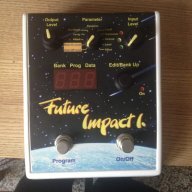
Future Impact now available!! WAS: deep impact reissue!!! interested?
- Thread starter lokki
- Start date
More options
Who Replied?
Hard syncing unison oscillators makes no sense, since it is identical with having just one oscillator.
Andras Szalay
I'm not sure I understand - are you saying that numerous oscillators with alternate waveform types cannot be hard-synced without becoming identical/redundant?
The syncing suggestion was so that when playing more staccato, the waveforms start/stop at the same time.
The low frequency drifting/phasing would then be reduced when new notes are played.
Maybe the issue is with the unison of shifted pitches - each oscillator seems to be starting at a different point of phase - this is not such an issue if it was happening consistently, but it seems to happen randomly, causing significant cyclical phase/amplitude attenuation in the 40 - 180 Hz range - (I haven't experienced this behaviour in any other synthesizer).
Maybe it's designed to be this way - I still love this pedal, and I'm grateful for your creation! @Andras Szalay
can you post a patch of yours that shows the behaviour clearly? that way i can load it to the editor and see/hear what you mean exactly...I'm not sure I understand - are you saying that numerous oscillators with alternate waveform types cannot be hard-synced without becoming identical/redundant?
The syncing suggestion was so that when playing more staccato, the waveforms start/stop at the same time.
The low frequency drifting/phasing would then be reduced when new notes are played.
Maybe the issue is with the unison of shifted pitches - each oscillator seems to be starting at a different point of phase - this is not such an issue if it was happening consistently, but it seems to happen randomly, causing significant cyclical phase/amplitude attenuation in the 40 - 180 Hz range - (I haven't experienced this behaviour in any other synthesizer).
Maybe it's designed to be this way - I still love this pedal, and I'm grateful for your creation! @Andras Szalay
can you post a patch of yours that shows the behaviour clearly? that way i can load it to the editor and see/hear what you mean exactly...
Download link
04Problem Patch 2.prg and 1 more file
Here are the problem patches.
Patch 8 is the one with the low end phase issues; just play an 'F' note on the A string (steady 8th notes), and listen to the random-cyclical, low end dip & swell.
Patch 4 seems to sound completely different every time I select it!
I have to scroll back to other patch sounds, at least 3 times before patch 4 finally plays the way it was programmed to?
Both patches may need to be loaded into the pedal for you to observe this behaviour.
Very odd, and maybe a software bug!
Kind regards,
@lokki @Andras Szalay

Andras Szalay
Commercial User
This suggests that you may have a problem with your MIDI interface. Do you have a chance to try another MIDI interface to check if this behavior changes?Patch 4 seems to sound completely different every time I select it! I have to scroll back to other patch sounds, at least 3 times before patch 4 finally plays the way it was programmed to? Both patches may need to be loaded into the pedal for you to observe this behaviour.
Andras Szalay
Andras Szalay
Commercial User
Since on the FI every oscillator can generate an arbitrary mixture of all possible waveforms, if the oscillators are started in sync and they are tuned to unison, then the second is redundant, you can generate exactly the same waveform from one oscillator only as well.I'm not sure I understand - are you saying that numerous oscillators with alternate waveform types cannot be hard-synced without becoming identical/redundant?
The syncing suggestion was so that when playing more staccato, the waveforms start/stop at the same time.
The low frequency drifting/phasing would then be reduced when new notes are played.
Maybe it's designed to be this way - I still love this pedal, and I'm grateful for your creation! @Andras Szalay
The FI was designed intentionally this way, that oscillators are not synced. Syncing them in a way as some Moog synthesizers sync their oscillators -- a certain phase of oscillator A restarts oscillator B in every vibration -- would not be possible technically. But it would be possible to start every oscillator with the same phase when the note is started. I will investigate this, if it sounds interesting it may become optionally part of a new software release, when the patch file format will have to change anyway.
Andras Szalay


I'm confused, why wouldn't hard sync work if osc2 is tuned or swept between the root and higher octaves?
I get some pretty cool vocal robot noises on my other synths when modulating osc2 over a few intervals above the fundamental.
Note sync where every wave starts in phase would be cool. It would provide a consistant and pronounced attack at the beginning of each trigger. When using note sync on my moog My ears perceive it as a more complicated single oscillator, which is cool for many patches.
I get some pretty cool vocal robot noises on my other synths when modulating osc2 over a few intervals above the fundamental.
Note sync where every wave starts in phase would be cool. It would provide a consistant and pronounced attack at the beginning of each trigger. When using note sync on my moog My ears perceive it as a more complicated single oscillator, which is cool for many patches.
Last edited:

@Andras SzalaySince on the FI every oscillator can generate an arbitrary mixture of all possible waveforms, if the oscillators are started in sync and they are tuned to unison, then the second is redundant, you can generate exactly the same waveform from one oscillator only as well.
The FI was designed intentionally this way, that oscillators are not synced. Syncing them in a way as some Moog synthesizers sync their oscillators -- a certain phase of oscillator A restarts oscillator B in every vibration -- would not be possible technically. But it would be possible to start every oscillator with the same phase when the note is started. I will investigate this, if it sounds interesting it may become optionally part of a new software release, when the patch file format will have to change anyway.
Andras Szalay
Glad to hear you are working on some updates! Any idea when we might see them?
Also you mentioned in your post that the patch file format will be changing. If that is the case, will our old patches be compatible with the new software? Thanks for your hard work making this the best synth pedal on the market!
i think he means scrolling back and forth from the f.i. directly without a midi interface attached. or am i mistaken?This suggests that you may have a problem with your MIDI interface. Do you have a chance to try another MIDI interface to check if this behavior changes?
Andras Szalay
i think he means scrolling back and forth from the f.i. directly without a midi interface attached. or am i mistaken?
Correct!
Everytime I get to patch 4, it sounds different......
I have to scroll up & down, through different patches a few times & back again to get patch 4 to play with the right tonality.
since i don't have my f.i. ready just now i just did take a look at your patches with the editor,Download link
04Problem Patch 2.prg and 1 more file
Here are the problem patches.
Patch 8 is the one with the low end phase issues; just play an 'F' note on the A string (steady 8th notes), and listen to the random-cyclical, low end dip & swell.
Patch 4 seems to sound completely different every time I select it!
I have to scroll back to other patch sounds, at least 3 times before patch 4 finally plays the way it was programmed to?
Both patches may need to be loaded into the pedal for you to observe this behaviour.
Very odd, and maybe a software bug!
Kind regards,
@lokki @Andras Szalay
let me comment on patch nr. 8 since i can see some issues here, patch nr, 4 i will have to load to the pedal to see if i can reproduce.
ok, on to 8

in both vco1 and vco2 you are modulating the pulsewith of the square via the lfo, at slightly different tuning an octave apart...also the lfodepth is sligthly different. this is basically asking for trouble in the phasing compartment
try to use pitch beat instead of fine, this will make the beating consistent over the whole range of the instrument.it is the nature of a pw-waveform that is modulated to loose and gain "bass" (among other things) at least i have observed this on many other synths when programming bass sounds.
on both vco1 and vco2 you are exceeding the 127 volume limit of the individual voices, which means that they will generate foldover distortion. are you aware of this feature? basically this will create very rich overtones. but again, together with the beating and the lfo this will create rather unpredictable results. try lowering the individual voices volume if you don't want foldover to happen, here is the relevant part of the manual for reference:
Foldover Distortion: A very unique feature of FI is the foldover distortion. Depending on the implemented algorithm, when a signal processor is over- loaded it will either clip the peak of the signal, or it will fold over. While clipping is often used to generate a moderate amount of overtones, foldover is practically never used since it generates such a high overtone content that will make the sound unusable due to out of tune aliasing products. However, the huge processing power used in FI allows to generate the oscillators with a 512 kHz oversampling rate, guaranteeing that the aliasing portion in the sound remains negligible. Foldover Distortion will happen either in one oscillator alone, or as a combination of separate oscillators.
Every oscillator waveform will drive the summation to maximum amplitude alone, if it is set to 127. Foldover Distortion will happen if the sum of all wave- form amplitudes becomes more than 127 (or, at least it can happen, depending on the phase of the components). Since every oscillator can have two dynamically changing portions of the sound, the pulse width modulation and the SAW VCA, these can be used to generate a sound with dynamically changing spectrum, even without a filter.
Another step of foldover distortion can happen between separate oscillators. When the four oscillators are summed, the sum will fold over if the sum of the amplitudes is higher than 127. Therefore, in clean default sounds the oscillator master volumes are set to 32, so foldover cannot happen. The effect of foldover distortion between oscillators that are tuned to different frequencies or just beating is rather unpredictable, it leaves a lot of freedom for experimenting.
Last edited:
Andras Szalay
Commercial User
An important lesson
Today a hungarian bass player visited me who bought a FI a short while ago. He loved it from the beginning, but complained by Gabor that he has different hardware problems. Gabor offered him a replacement, but after that he still had the problems. I was pretty sure that it cannot be that he got successively two bad devices (actually we never had a failure return yet). Since he lives not far from me in Budapest, I offered him to visit me -- much easier than remote debugging. He had time to time one of three problems:
1. Right display digit flickering.
2. When he turned on the signal with the ON/OFF foot pedal, sometimes the devices rebooted.
3. Even when it did not reboot, it clicked very loudly, by some programs triggering a short synth note.
I asked him to set it up with all his own stuff, as he uses, with his own cables and his own power supply. When he started to show me problem 3. was obvious. However, I immediately heard one more problem that he did not recognize, a 50 Hz (well, actually 100 Hz) hum. I suspected the power supply. I replaced it with my own, and the clicks and hum was gone. The FI was obviously perfectly OK, the power supply was the reason of his problems. I used an Electro-Harmonix EU9.6DC-200 supply. His one was a ZOOM AD-0006E. I did not investigate the problem to details, but I measured what is the difference between the two supplies. While the ZOOM claims to be 9V, it is not stabilized and when the ON/OFF of the FI was off it delivered 13.7V (!!!!!), and when it was ON (the current consumption is much higher in this case because of the relay) it was falling back to 13V. Also, on top of the DC voltage there was 200mV hum. I did not see problem 2 --- he said, it happened rarely -- but it can be explained by the weak supply. When the switch is turned ON, the relay squeezes a short current peak that is surely higher than the average normal consumption. This peak could interrupt the supply, so the device rebooted.
The lesson is:
1. As we write in the manual, use a 9V STABILIZED power supply.
2. If you experience any of the above problems or similar, suspect first the supply and try another one.
3. Avoid ZOOM AD-0006E.
Andras Szalay
Today a hungarian bass player visited me who bought a FI a short while ago. He loved it from the beginning, but complained by Gabor that he has different hardware problems. Gabor offered him a replacement, but after that he still had the problems. I was pretty sure that it cannot be that he got successively two bad devices (actually we never had a failure return yet). Since he lives not far from me in Budapest, I offered him to visit me -- much easier than remote debugging. He had time to time one of three problems:
1. Right display digit flickering.
2. When he turned on the signal with the ON/OFF foot pedal, sometimes the devices rebooted.
3. Even when it did not reboot, it clicked very loudly, by some programs triggering a short synth note.
I asked him to set it up with all his own stuff, as he uses, with his own cables and his own power supply. When he started to show me problem 3. was obvious. However, I immediately heard one more problem that he did not recognize, a 50 Hz (well, actually 100 Hz) hum. I suspected the power supply. I replaced it with my own, and the clicks and hum was gone. The FI was obviously perfectly OK, the power supply was the reason of his problems. I used an Electro-Harmonix EU9.6DC-200 supply. His one was a ZOOM AD-0006E. I did not investigate the problem to details, but I measured what is the difference between the two supplies. While the ZOOM claims to be 9V, it is not stabilized and when the ON/OFF of the FI was off it delivered 13.7V (!!!!!), and when it was ON (the current consumption is much higher in this case because of the relay) it was falling back to 13V. Also, on top of the DC voltage there was 200mV hum. I did not see problem 2 --- he said, it happened rarely -- but it can be explained by the weak supply. When the switch is turned ON, the relay squeezes a short current peak that is surely higher than the average normal consumption. This peak could interrupt the supply, so the device rebooted.
The lesson is:
1. As we write in the manual, use a 9V STABILIZED power supply.
2. If you experience any of the above problems or similar, suspect first the supply and try another one.
3. Avoid ZOOM AD-0006E.
Andras Szalay

Quick question on shipping times -
My wife surprised me with a Future Impact for Christmas. Magyar Posta shows "Item sent abroad" on 12-20-16 and there has been no further communication. Apparently the USPS and Hungary don't share information?
We still haven't received the pedal. Does this seem like a normal transit time?
My wife surprised me with a Future Impact for Christmas. Magyar Posta shows "Item sent abroad" on 12-20-16 and there has been no further communication. Apparently the USPS and Hungary don't share information?
We still haven't received the pedal. Does this seem like a normal transit time?

Gabor_Gerenyi
Commercial User
- Oct 18, 2015
- 19
- 136
- 58
- Disclosures
- Elektromedia Ltd. aka pandaMidi and Panda Audio sales/marketing manager
Quick question on shipping times -
My wife surprised me with a Future Impact for Christmas. Magyar Posta shows "Item sent abroad" on 12-20-16 and there has been no further communication. Apparently the USPS and Hungary don't share information?
We still haven't received the pedal. Does this seem like a normal transit time?
Hey,
What has happened this Christmas was the biggest online ordering boom in the internet history, that's why a couple of our US clients haven't received their item until now. While normal delivery time outside the holiday season lowered very reasonably during the last two years (typically a few days), from the last days of November it has worsened dramatically. But it is a realistic hope to really have everybody's package arrived this week. Just ask for more info at the nearest post office, they will sure have something.
And yes, for some reason USPS never share tracking info with the Hungarian partner, don't ask me why. The rest of the world is trackable for us, even such exotic and now chaotic places like Venezuela.

An important lesson
Today a hungarian bass player visited me who bought a FI a short while ago. He loved it from the beginning, but complained by Gabor that he has different hardware problems. Gabor offered him a replacement, but after that he still had the problems. I was pretty sure that it cannot be that he got successively two bad devices (actually we never had a failure return yet). Since he lives not far from me in Budapest, I offered him to visit me -- much easier than remote debugging. He had time to time one of three problems:
1. Right display digit flickering.
2. When he turned on the signal with the ON/OFF foot pedal, sometimes the devices rebooted.
3. Even when it did not reboot, it clicked very loudly, by some programs triggering a short synth note.
I asked him to set it up with all his own stuff, as he uses, with his own cables and his own power supply. When he started to show me problem 3. was obvious. However, I immediately heard one more problem that he did not recognize, a 50 Hz (well, actually 100 Hz) hum. I suspected the power supply. I replaced it with my own, and the clicks and hum was gone. The FI was obviously perfectly OK, the power supply was the reason of his problems. I used an Electro-Harmonix EU9.6DC-200 supply. His one was a ZOOM AD-0006E. I did not investigate the problem to details, but I measured what is the difference between the two supplies. While the ZOOM claims to be 9V, it is not stabilized and when the ON/OFF of the FI was off it delivered 13.7V (!!!!!), and when it was ON (the current consumption is much higher in this case because of the relay) it was falling back to 13V. Also, on top of the DC voltage there was 200mV hum. I did not see problem 2 --- he said, it happened rarely -- but it can be explained by the weak supply. When the switch is turned ON, the relay squeezes a short current peak that is surely higher than the average normal consumption. This peak could interrupt the supply, so the device rebooted.
The lesson is:
1. As we write in the manual, use a 9V STABILIZED power supply.
2. If you experience any of the above problems or similar, suspect first the supply and try another one.
3. Avoid ZOOM AD-0006E.
Andras Szalay
I have experienced this behaviour with mine - with different power supplies. I recall my old Deep Impact used to do something similar, the display was often flickering and acting strangely.
An important lesson
Today a hungarian bass player visited me who bought a FI a short while ago. He loved it from the beginning, but complained by Gabor that he has different hardware problems. Gabor offered him a replacement, but after that he still had the problems. I was pretty sure that it cannot be that he got successively two bad devices (actually we never had a failure return yet). Since he lives not far from me in Budapest, I offered him to visit me -- much easier than remote debugging. He had time to time one of three problems:
1. Right display digit flickering.
2. When he turned on the signal with the ON/OFF foot pedal, sometimes the devices rebooted.
3. Even when it did not reboot, it clicked very loudly, by some programs triggering a short synth note.
I asked him to set it up with all his own stuff, as he uses, with his own cables and his own power supply. When he started to show me problem 3. was obvious. However, I immediately heard one more problem that he did not recognize, a 50 Hz (well, actually 100 Hz) hum. I suspected the power supply. I replaced it with my own, and the clicks and hum was gone. The FI was obviously perfectly OK, the power supply was the reason of his problems. I used an Electro-Harmonix EU9.6DC-200 supply. His one was a ZOOM AD-0006E. I did not investigate the problem to details, but I measured what is the difference between the two supplies. While the ZOOM claims to be 9V, it is not stabilized and when the ON/OFF of the FI was off it delivered 13.7V (!!!!!), and when it was ON (the current consumption is much higher in this case because of the relay) it was falling back to 13V. Also, on top of the DC voltage there was 200mV hum. I did not see problem 2 --- he said, it happened rarely -- but it can be explained by the weak supply. When the switch is turned ON, the relay squeezes a short current peak that is surely higher than the average normal consumption. This peak could interrupt the supply, so the device rebooted.
The lesson is:
1. As we write in the manual, use a 9V STABILIZED power supply.
2. If you experience any of the above problems or similar, suspect first the supply and try another one.
3. Avoid ZOOM AD-0006E.
Andras Szalay
The bass player was me, thanks again for the best support a user can get!
Now I'm using a KORG adapter, and the unit works flawless. So, it's a nice lesson, always use good power supply, that's the beginning of everything, and even the best device may fail, if the juice is not proper.
Also, don't believe everything that's written, even if it's on a ZOOM.

Hey all,
I have been reading into the Future Impact I. I'm pretty new to midis and synths so I ask for your patience for I may ask questions that have already been answered. Now, when connecting the pedal to your computer, is it a USB to midi connector? Or do you need an interface to be able to edit through the computer?
Thanks for your help!
I have been reading into the Future Impact I. I'm pretty new to midis and synths so I ask for your patience for I may ask questions that have already been answered. Now, when connecting the pedal to your computer, is it a USB to midi connector? Or do you need an interface to be able to edit through the computer?
Thanks for your help!

One of the cheapest, yet guaranteed solutions is the Roland UM-ONE USB to MIDI cable. Get that and the software from the Future Impact site and you'll be set.Hey all,
I have been reading into the Future Impact I. I'm pretty new to midis and synths so I ask for your patience for I may ask questions that have already been answered. Now, when connecting the pedal to your computer, is it a USB to midi connector? Or do you need an interface to be able to edit through the computer?
Thanks for your help!


