

Enjoy the benefits of a premium membership!
Upgrade Account
-
TalkBass has been independent since 1998. Add your voice.
Create a free account to reply to discussions, view embedded media, and browse with fewer display ads.
Join free Log in
Want zero display ads or expanded classifieds tools? Compare plans.
You are using an out of date browser. It may not display this or other websites correctly.
You should upgrade or use an alternative browser.
You should upgrade or use an alternative browser.
Future Impact now available!! WAS: deep impact reissue!!! interested?
- Thread starter lokki
- Start date
More options
Who Replied?


Adamixoye
A PT Pro is cool for worship, right?
- Apr 9, 2012
- 18,158
- 69,338
- Disclosures
- Occasional Beta Tester for Confusion Studios, Singular Sound, and Source Audio
The "list" in this thread was always unofficial, but I have decided to no longer add to it. If someone wants to take it over, it's the first post on the top of page 25.

I, for one, can't tell you how thankful I am that the man is taking time out of his life to fix hole in the bass synth market. True respect/interest for the music.
Hell, take 3 years and get it right. My income sure isn't dependent on my synth sounds!
Hell, take 3 years and get it right. My income sure isn't dependent on my synth sounds!

77stingray
Supporting Member

I tried one once and I really liked it.
I am definitely supporting a reissue, and I would definitely want one at some point, although it wouldn't be my first priority.
I am definitely supporting a reissue, and I would definitely want one at some point, although it wouldn't be my first priority.
Last edited:

Hey All,
Brother Kulit17 asked if I could record some sample tracks of my Deep Impact with my 1993 Wal. Here is the deets in my message to him with sound clips:
I can tell you the Akai responds very well to the Wal. I have used a variety of bass types through it and it just doesn't have many weaknesses. You'll hear where the tracking fails but I was pushing it as an example. Apologies up front for the sloppy playing. These lines were improvised and 1 takers. Here are the specs:
Wal Black Poly Gold Hardware (Geddy) 1990
All controls are at neutral i.e. Both Pickups/10 for all "tone" controls/Volume 10
Running into an original Akai Deep Impact 1st gen (original owner) into an Avalon U5 into a Focusrite Saffire Pro40 into Protools with no modulation or adjustments to the tracks...they are raw as sh*t.
Tracks are numbered based on the Program channel. Each Channel has a default name but I may have tweaked them slightly. Each track is the "default" channel with the Wal. I included one track of the clean Wal (flat) for reference. The Wal is setup with LOW action, Rotosound Funkmaster FM66 .30/.50/.70/.90 (Yes, I wanted to see what it was like playing Geddy's setup and even though I normally use a Medium Light gauge and a slightly higher setup on my other basses, this setup is FUN AS HELL. You can get the Power Windows/Hold Your Fire/Presto sounds with ease if you know how to finesse the strings.) Thanks to some high quality bourbon I was in e minor the majority of the evening. Let me know what you all think and if you were even able to open them!
Cheers
-c
Brother Kulit17 asked if I could record some sample tracks of my Deep Impact with my 1993 Wal. Here is the deets in my message to him with sound clips:
I can tell you the Akai responds very well to the Wal. I have used a variety of bass types through it and it just doesn't have many weaknesses. You'll hear where the tracking fails but I was pushing it as an example. Apologies up front for the sloppy playing. These lines were improvised and 1 takers. Here are the specs:
Wal Black Poly Gold Hardware (Geddy) 1990
All controls are at neutral i.e. Both Pickups/10 for all "tone" controls/Volume 10
Running into an original Akai Deep Impact 1st gen (original owner) into an Avalon U5 into a Focusrite Saffire Pro40 into Protools with no modulation or adjustments to the tracks...they are raw as sh*t.
Tracks are numbered based on the Program channel. Each Channel has a default name but I may have tweaked them slightly. Each track is the "default" channel with the Wal. I included one track of the clean Wal (flat) for reference. The Wal is setup with LOW action, Rotosound Funkmaster FM66 .30/.50/.70/.90 (Yes, I wanted to see what it was like playing Geddy's setup and even though I normally use a Medium Light gauge and a slightly higher setup on my other basses, this setup is FUN AS HELL. You can get the Power Windows/Hold Your Fire/Presto sounds with ease if you know how to finesse the strings.) Thanks to some high quality bourbon I was in e minor the majority of the evening. Let me know what you all think and if you were even able to open them!
Cheers
-c
Attachments
-
1Wal_AkaiDImpact_Prog1Darkbubble.mp3592.3 KB · Views: 208
-
2Wal_DImpact_Prog2Hardcore.mp3907.9 KB · Views: 135
-
3Wal_DImpact_Prog3KitarohBass.mp3686.4 KB · Views: 106
-
4Wal_DImpact_Prog4BrightSynth.mp3573.1 KB · Views: 112
-
5Wal_DImpact_Prog5Brats.mp3576.4 KB · Views: 108
-
6Wal_DImpact_Prog6FatBottom.mp3616.7 KB · Views: 118
-
7Wal_DImpact_Prog7Majesty.mp3633.8 KB · Views: 105
-
8Wal_DImpact_Prog8HotSpice.mp3687.6 KB · Views: 100
-
9Wal_DImpact_Prog9Hiccups.mp3909.5 KB · Views: 122
-
WalBlkPolyTestFlat.mp3770.6 KB · Views: 97

Andras Szalay
Commercial User
Dear Friends,
After listening to your comments and opinion from the background I feel now it is time for me to step in and show you the first photos of the device that you are waiting so eagerly. First of all I want to say thank you to all of you who encouraged me to work on this project. I am especially thankful to Simon, who pushed me already long time ago to start this. But the greatest impact (a real “deep impact”) was when last autumn a journalist of the Japanese Bass Magazine approached me for an interview about the history of the Deep Impact, and he explained me that there is a huge second hand market -- with quite crazy prices -- of this device which has disappeared from the market long time ago. I did not want to believe it, I did not know about it until I looked at ebay. So, I understood that there is a real demand for such a product.
I did not have time yet to write a complete description of the Future Impact I., let me just summarize some of the most important facts.
First of all, the hardware and the software of the Future Impact I. does not have the slightest relationship to the hardware and software of the Deep Impact. While the Deep Impact was based on 20th century technology, the Future Impact I. runs on a 21st century processor that performs signal processing operations a hundred times faster than the Deep Impact’s processor, so the capabilities are not comparable. In spite of the huge processing power the device takes only 70 milliamperes from a Roland/Boss type 9V stabilized supply.
While the Deep Impact has 10 presets that are not programmable, just the major parameters can be edited on stage, the Future Impact I. has 100 presets that are fully programmable by the user with a computer editor, and the major parameters of the presets are editable on stage as well.
The first 10 presets of Future Impact are factory programmed to emulate exactly the sounds of the Deep Impact; the other 90 presets open up a new world of possibilities.
Some facts to express the difference:
The DI has 4 sawtooth oscillators, running at 32 kHz (very distorted, greasy sound in higher pitch range); the FI I. has 4 multi-oscillators running at 512 kHz, thus generating extremely clean signals. The oscillators have saw, triangle, and square wave signals that can be mixed arbitrarily for each oscillator individually. The square wave signal has adjustable pulse width. There is a separate LFO for each oscillator to modulate the pulsewidth, generating a warm, lively sound. The saw oscillators have a decay envelope each, so each oscillator can produce an individually changing dynamic waveform. On top of that, a foldover distortion applied on each oscillator separately can produce sounds with incredibly rich overtones.
The filter can be 12 dB/oct or 24 dB/oct and emulates the classic Moog filter.
An effect section will be included (not yet implemented) with all kind of time modulation effects.
I would love to be able to deliver this wonderful device to you tomorrow, but as it is an extremely complex device the development takes very lot of time, especially I have a lot of work yet on the software. I have to ask for your further patience, I believe delivery will be possible in the last quarter of this year. Soon I will be able to make a price calculation and let you know what to expect.
Andras Szalay
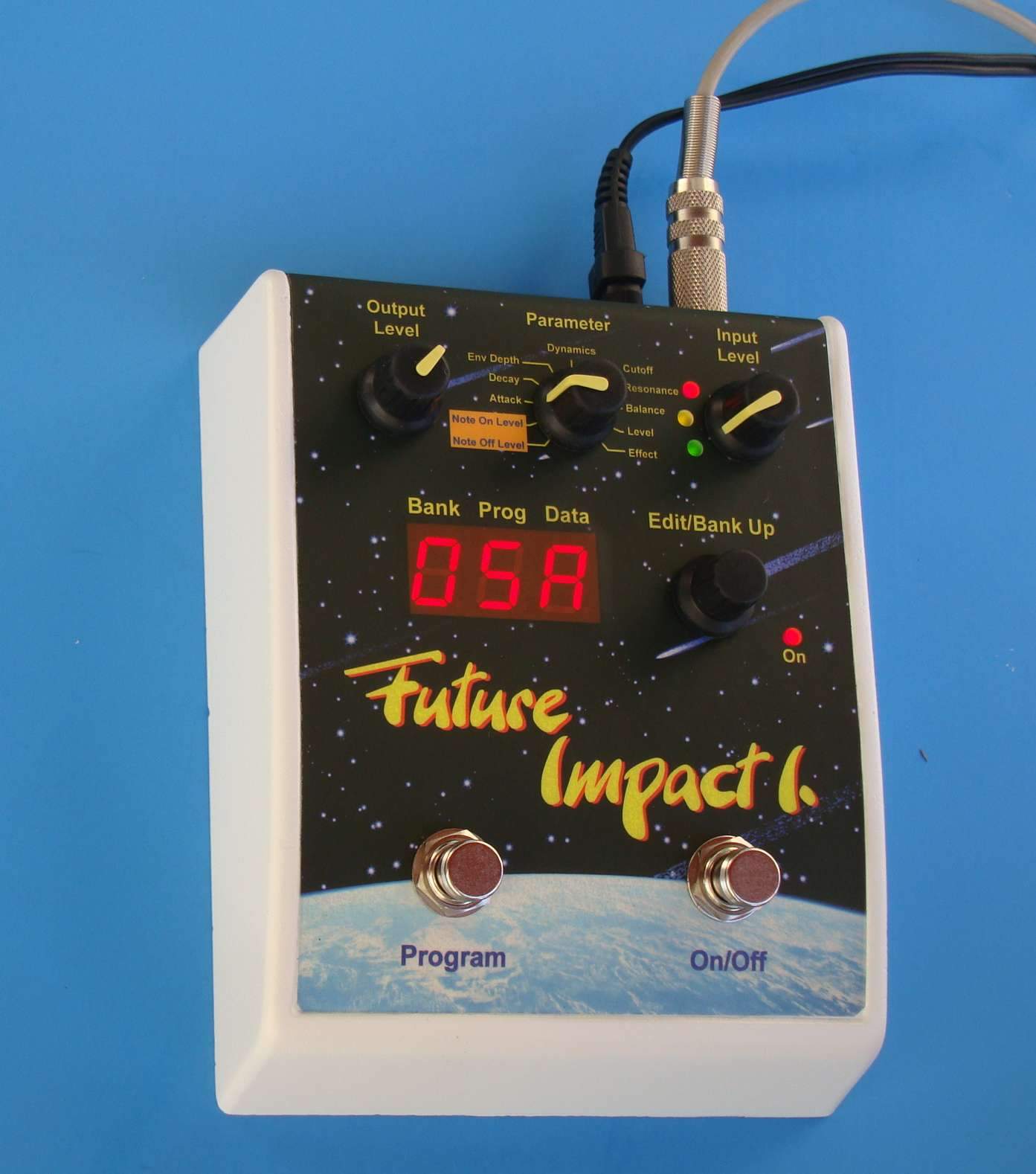

After listening to your comments and opinion from the background I feel now it is time for me to step in and show you the first photos of the device that you are waiting so eagerly. First of all I want to say thank you to all of you who encouraged me to work on this project. I am especially thankful to Simon, who pushed me already long time ago to start this. But the greatest impact (a real “deep impact”) was when last autumn a journalist of the Japanese Bass Magazine approached me for an interview about the history of the Deep Impact, and he explained me that there is a huge second hand market -- with quite crazy prices -- of this device which has disappeared from the market long time ago. I did not want to believe it, I did not know about it until I looked at ebay. So, I understood that there is a real demand for such a product.
I did not have time yet to write a complete description of the Future Impact I., let me just summarize some of the most important facts.
First of all, the hardware and the software of the Future Impact I. does not have the slightest relationship to the hardware and software of the Deep Impact. While the Deep Impact was based on 20th century technology, the Future Impact I. runs on a 21st century processor that performs signal processing operations a hundred times faster than the Deep Impact’s processor, so the capabilities are not comparable. In spite of the huge processing power the device takes only 70 milliamperes from a Roland/Boss type 9V stabilized supply.
While the Deep Impact has 10 presets that are not programmable, just the major parameters can be edited on stage, the Future Impact I. has 100 presets that are fully programmable by the user with a computer editor, and the major parameters of the presets are editable on stage as well.
The first 10 presets of Future Impact are factory programmed to emulate exactly the sounds of the Deep Impact; the other 90 presets open up a new world of possibilities.
Some facts to express the difference:
The DI has 4 sawtooth oscillators, running at 32 kHz (very distorted, greasy sound in higher pitch range); the FI I. has 4 multi-oscillators running at 512 kHz, thus generating extremely clean signals. The oscillators have saw, triangle, and square wave signals that can be mixed arbitrarily for each oscillator individually. The square wave signal has adjustable pulse width. There is a separate LFO for each oscillator to modulate the pulsewidth, generating a warm, lively sound. The saw oscillators have a decay envelope each, so each oscillator can produce an individually changing dynamic waveform. On top of that, a foldover distortion applied on each oscillator separately can produce sounds with incredibly rich overtones.
The filter can be 12 dB/oct or 24 dB/oct and emulates the classic Moog filter.
An effect section will be included (not yet implemented) with all kind of time modulation effects.
I would love to be able to deliver this wonderful device to you tomorrow, but as it is an extremely complex device the development takes very lot of time, especially I have a lot of work yet on the software. I have to ask for your further patience, I believe delivery will be possible in the last quarter of this year. Soon I will be able to make a price calculation and let you know what to expect.
Andras Szalay


Wow, sounds great and is awesome that you're bringing it back but frankly, if I may...... you may want to change up the visual element. Sorry to sound shallow but there is surely an element of how a pedal is received based on its looks.
Wow, sounds great and is awesome that you're bringing it back but frankly, if I may...... you may want to change up the visual element. Sorry to sound shallow but there is surely an element of how a pedal is received based on its looks.
I'm sure that's just a mock up version.
Adamixoye
A PT Pro is cool for worship, right?
- Apr 9, 2012
- 18,158
- 69,338
- Disclosures
- Occasional Beta Tester for Confusion Studios, Singular Sound, and Source Audio
Well all the other synth pedal that is in the market, super synth, g5, etc etc have weird power requirement. Even the boss syb5 needed 50ma...70ma means I can just run it through one output of my dc10That's your takeaway?
Adamixoye
A PT Pro is cool for worship, right?
- Apr 9, 2012
- 18,158
- 69,338
- Disclosures
- Occasional Beta Tester for Confusion Studios, Singular Sound, and Source Audio
Well all the other synth pedal that is in the market, super synth, g5, etc etc have weird power requirement. Even the boss syb5 needed 50ma...70ma means I can just run it through one output of my dc10
Yeah, I agree, that's actually really cool because usually synths are a problem. But I just thought it was funny, because there are 10 other more awesome things about this...
Yeah, I agree, that's actually really cool because usually synths are a problem. But I just thought it was funny, because there are 10 other more awesome things about this...
haha to be honest i am waitting for any of you guys to talk about
"While the Deep Impact was based on 20th century technology, the Future Impact I. runs on a 21st century processor that performs signal processing operations a hundred times faster than the Deep Impact’s processor, so the capabilities are not comparable."

- Apr 19, 2001
- 2,302
- 3,047
- Disclosures
- Beta tester Source Audio, demos/reviews of many others
Nice! I'm glad you added the MIDI in there. That's basically a must for my current board.


