• TalkBass has been independent since 1998. Add your voice.
    Create a free account to reply to discussions, view embedded media, and browse with fewer display ads.
    Join freeLog in
    Want zero display ads or expanded classifieds tools? Compare plans.

G&L Club Part 3

Status
Not open for further replies.
That's awesome! Sometimes a prototyped item sits around a shop for years and gets released into the wild at a much later date. Here's hoping the G&L paddle hits the streets in my lifetime.
 
Here she is

hs1.gif


back1.gif


pup1.gif


mb1.gif


sb1.gif


sbfull.gif
 
That's awesome! Sometimes a prototyped item sits around a shop for years and gets released into the wild at a much later date. Here's hoping the G&L paddle hits the streets in my lifetime.

Here are the pics.
1980 L-1000 fretless mahogany bought here on TB.
S/N dates to 1980, pots are 1979, body dated 1980, neck dated 1990.
Thinking prototype due to 4-bolt neck attachment - no extra holes on neck or socket. That and the slotted pole pickup started in 1981.
I tend to agree w/ S&S that this bass probably sat around in the shop and was released in 1990 with that fretless neck.

wunkay.front.jpg

wunkay.back.jpg

wunkay.slant.jpg

wunkay.body.slant.jpg

wunkay.head.jpg
 
Hi all, I hope you don't mind a couple basic questions about the L-1000. I've never had a chance to try one, but they sound pretty intriguing to this P bass guy. I did a search, but couldn't find definitive answers.

Body woods: I've learned that the L-1000 came in mahogany or ash in its early years. Were there any other body wood options? I saw a couple references to three wood options.

Boards: Maple or ebony, correct? I noticed some necks have skunk strips, are they more or less desirable? Only used at certain times? Were all the necks roughly the same dimensions? I know G&L offers multiple neck options now, but wasn't sure if that was the case when they got started.

Pickups: Some have slotted pole pieces, correct? (I may be describing them wrong.) Are they rare? Any tonal difference? I think I've got the control layout figured out at least.

Sorry for all the questions and thanks for your patience. If y'all ever need any Lakland info (:hiding:), I can actually be helpful on that front.:)
 
Yes , she's aggressive , I'm thinking the "rock" pbass . It's a p though in every way . All my p's sound diffferent , I have Lollar , DiMarzio Split p and Ken Smith p in different basses , all have subtle shades of "P" :D This one has some hair on it with a killer sweet and clear top end , it will be my goto "rock" bass from now on .
 
Well Greg if you are a P-bass guy you will love the L-1000. It is like a P-bass but much more powerful, with a huge bottom end. It also has the coil-splitter switch with three settings, humbucking/single-coil/bass boost (so-called OMG! mode), and passive bass-cut and treble-cut instead of a tone knob. Very versatile for a one-pickup bass.

Body woods: I've learned that the L-1000 came in mahogany or ash in its early years. Were there any other body wood options? I saw a couple references to three wood options.

I have read that Maple was used as well but those are rare. Maple was usually reserved for the lower-end SB-1 and SB-2 basses.

Boards: Maple or ebony, correct? I noticed some necks have skunk strips, are they more or less desirable? Only used at certain times? Were all the necks roughly the same dimensions? I know G&L offers multiple neck options now, but wasn't sure if that was the case when they got started.

Rosewood was used too. Most L-1000 necks are 1 11/16" at the nut and are very flat with a tight radius (7.5?). These are a favorite of many players. Probably some went out with 1 5/8" or 1 3/4" as well. All necks had a skunk stripe up to around '83 I think, when they started using the bi-cut neck:

[Invalid or Expired Link Removed]

Pickups: Some have slotted pole pieces, correct? (I may be describing them wrong.) Are they rare? Any tonal difference? I think I've got the control layout figured out at least.

Only the 1981 basses have slotted pole pieces, so yes they are kind of rare. They change the sound slightly depending on how you line up the slot. To my ears they have more harmonic content than other G&L pickups, but I only have three basses to judge with and my slot-pole is ash/maple so it might just be the wood combo.
 
Well Greg if you are a P-bass guy you will love the L-1000. It is like a P-bass but much more powerful, with a huge bottom end. It also has the coil-splitter switch with three settings, humbucking/single-coil/bass boost (so-called OMG! mode), and passive bass-cut and treble-cut instead of a tone knob. Very versatile for a one-pickup bass.


I have read that Maple was used as well but those are rare. Maple was usually reserved for the lower-end SB-1 and SB-2 basses.


Rosewood was used too. Most L-1000 necks are 1 11/16" at the nut and are very flat with a tight radius (7.5?). These are a favorite of many players. Probably some went out with 1 5/8" or 1 3/4" as well. All necks had a skunk stripe up to around '83 I think, when they started using the bi-cut neck:

[Invalid or Expired Link Removed]


Only the 1981 basses have slotted pole pieces, so yes they are kind of rare. They change the sound slightly depending on how you line up the slot. To my ears they have more harmonic content than other G&L pickups, but I only have three basses to judge with and my slot-pole is ash/maple so it might just be the wood combo.

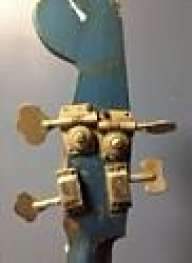
I've also seen poplar bodies from the 80s, usually on solid colors.

I had a Dec 1982 L-2000 with slot pole pickups, so they weren't just 1981.
 
Status
Not open for further replies.

Latest posts