• TalkBass has been independent since 1998. Add your voice.
    Create a free account to reply to discussions, view embedded media, and browse with fewer display ads.
    Join freeLog in
    Want zero display ads or expanded classifieds tools? Compare plans.

G&L Club Part 5

Status
Not open for further replies.
Well, it arrived. :)

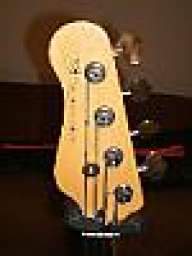
A new metallic burgundy Tribute SB-2.. other than intonation, setup was fine.

++ Absolutely gorgeous
++ completely floored by the tone of the neck pickup
++ 1.5" neck plays really really well (came from Ibanez SRA500 so was concerned over the neck.. SB-2 has same width and just a tad thicker)

- some hum comes from the bridge pickup when dialed in.. is this normal?
- low profile of neck pickup is not a great thumb rest..though as i get better and more used to it i am sure i shall adapt.

Anyway, took it to a jam session and the guitarist couldnt keep his eyes of it!!.. a 30yr veteran player, he said about 5 times "thats the best bass i have ever heard" and insisted we switched spots for a few songs.. ok by me.. I ended up with his Fender custom shop strat to play...

So finally I am in.. ## please :)

That's the same as my SB-2. That neck pickup doesn't make for such a great thumbrest. The bridge pickup does hum a bit.

Those little things are easily overlooked because the bass really cranks some serious tone and the neck is one of the sweetest I've played.

Congratulations!
 
- some hum comes from the bridge pickup when dialed in.. is this normal?

The neck pickup is humbucking so will be pretty quiet, the bridge pup is a single coil so it will pick up varying amounts of hum dependent upon the location. Some rooms are better than others, and yes it is normal for single coils to pick up hum. It's the reason why Leo Fender and others developed humbuckers very early in the life of electric guitars and basses.
 
thx.. didnt know the bridge pup was a single coil so all is good it seems :)

..for the sake of historical accuracy though, Leo was nowhere to be seen in the early development of humbuckers .. the first fender humbucking guitar was in the 70's using pups designed by Seth Lover..inventor of the Gibson PAF design


The neck pickup is humbucking so will be pretty quiet, the bridge pup is a single coil so it will pick up varying amounts of hum dependent upon the location. Some rooms are better than others, and yes it is normal for single coils to pick up hum. It's the reason why Leo Fender and others developed humbuckers very early in the life of electric guitars and basses.
 
thx.. didnt know the bridge pup was a single coil so all is good it seems :)

..for the sake of historical accuracy though, Leo was nowhere to be seen in the early development of humbuckers .. the first fender humbucking guitar was in the 70's using pups designed by Seth Lover..inventor of the Gibson PAF design

The split p-bass pickup is humbucking. It's a brilliant design, too.
 
Not exactly true.
The 1957 Precision Bass saw the move away from the single coil P bass pickup to the split-P design, which was indeed a humbucker, and still is.

Now, what you say may be true in terms of guitars like the Strat. One of reasons Leo was slow to move to PAF type humbuckers in guitars may have been that he felt tying two single coils together via "the strat switch" did enough of that for him. I'm no guitar history expert though.

..for the sake of historical accuracy though, Leo was nowhere to be seen in the early development of humbuckers .. the first fender humbucking guitar was in the 70's using pups designed by Seth Lover..inventor of the Gibson PAF design
 
Not exactly true.
The 1957 Precision Bass saw the move away from the single coil P bass pickup to the split-P design, which was indeed a humbucker, and still is.

Now, what you say may be true in terms of guitars like the Strat. One of reasons Leo was slow to move to PAF type humbuckers in guitars may have been that he felt tying two single coils together via "the strat switch" did enough of that for him. I'm no guitar history expert though.

...except that the Strat first had a 3-position switch, one for each single-coil. Players started to lodge the switch between positions to get two-pickup combinations. I don't know when the reverse-pole, reverse-wound mid pickup came into being, but with the 5-way switch the "2" and "4" positions became noise-canceling. I would not call this humbucking as there is a significant separation between the pickups, and the sound is uniquely Strat-like, not Gibson-like.
 
Hi, just found this club. I have a 86-87 G & L L2000 Lefty. Currently my second go to bass, I love it.
 

Attachments

  • DSC_0347.jpg
    DSC_0347.jpg
    108 KB · Views: 57
A great design for sure and its probably semantics, but i dont view the split P as a true humbucker.. noise reducing yes

Being an awkward old so and so I've just checked my 62P and it has 2 coils one reverse wound, one with reverse pole magnets. If that aint a humbucker what is it?


A bit of history on humbucking.

It was a term borrowed from old tube radios. Way back the magnet in the driver (speaker or loudspeaker as it was known as at this time) of some radios was an electromagnet, which was also used as the smoothing choke for the HT (high tension or voltage) supply to the tubes.

Because it was smoothing out power supply ripple it made the driver hum so to counteract this a small anti-phase coil was added with a rheostat (variable resistor) to control the current. This was connected across the low voltage AC heater supply. You would adjust the rheostat to null out the hum.

This small coil was given the name "humbucking coil".
 
As you obviously well know a true humbucker has the noise hum reducing coil alongside, either vertically or horizontally, to the signal coil..thereby cancelling hum at source.

by example, positions 2,4 of a strat reduces hum/noise but doesnt always eliminate it.. This is due to the physical displacement of the two pups, ie signal and noise reduction sensors are not physically co-located as in a humbucker.... so hum is reduced and may be eliminated. So its a hum reducing arrangement.

similarly, a p type pup relies on there being an even field of noise across the strings to be 100% effective... ie more hum/noise at the E,A string position relative to D,G is not fully cancelled by the reverse coil at D,G. so its hum reducing, not hum cancelling.

like i said, semantics mebbe, but upon checking, wiki agrees

Being an awkward old so and so I've just checked my 62P and it has 2 coils one reverse wound, one with reverse pole magnets. If that aint a humbucker what is it?


A bit of history on humbucking.

It was a term borrowed from old tube radios. Way back the magnet in the driver (speaker or loudspeaker as it was known as at this time) of some radios was an electromagnet, which was also used as the smoothing choke for the HT (high tension or voltage) supply to the tubes.

Because it was smoothing out power supply ripple it made the driver hum so to counteract this a small anti-phase coil was added with a rheostat (variable resistor) to control the current. This was connected across the low voltage AC heater supply. You would adjust the rheostat to null out the hum.

This small coil was given the name "humbucking coil".
 
like i said, semantics mebbe, but upon checking, wiki agrees

Yep, I think we are discussing semantics here.

You can call it hum reducing, I call it humbucking.

Having played a P for about 40 years I prefer to call it humbucking as I have never played a stage where I had a hum problem. Not something I could say about my recently acquired Jazz. I now gig a L-2500 and don't see that changing in the foreseeable future, except for an M-2500 and they haven't made it to this side of the pond yet.
 
Status
Not open for further replies.