• TalkBass has been independent since 1998. Add your voice.
    Create a free account to reply to discussions, view embedded media, and browse with fewer display ads.
    Join freeLog in
    Want zero display ads or expanded classifieds tools? Compare plans.

G&L Club Part 7

(Bass) MFDs were not made of common parts you get at Stew-Mac or Mojo Tone, etc. I've not paid much attention to their guitar pickups, so I won't comment on those. There's a lot of custom machining for the poles, custom plastic molds, laser cut flat work, etc. Could you put something together from generic parts and call it an MFD? Maybe, but, it won't be one or sound the same if you're not using the right components, which defeats the purpose.

NRE is Non-Recurring Engineering cost. That's the engineering work that goes into making a product. Plastic molds can easily cost 10's of thousands alone before they're production ready. Want machined pole pieces (a steel sleeve threaded on the I.D. with a machined steel pole piece threaded on the O.D. with a hex head in the top so you can turn it)? Those have to be designed and that's gonna cost you. How about custom flatwork? Yep... You'll have to determine the magnet gauss and dimensions, then get the magnets made to spec.

If the goal is to recreate what G&L had on a production level, then that takes engineering and that costs money. Just because there is a drawing in the patent doesn't mean there's no engineering to be done. That's just the starting point.
 
Last edited:
True. Anything that's plastic can be 3D printed. We may not be on the same page with what we're talking about. There's a difference between a small company or individual making a small quantity and huge company making them by the thousand.

Sure, having a manufacturer create master die cast molds to mass produce things is expensive. That's not necessary to get started or to do small batches. lol.

Here's an $1,100 CNC machine that does intricate metal work, engraving, carving, and laser etching.

I think you are seriously overthinking this. I get it, it's exciting to get over the top and have all these big things but, it's also totally unnecessary in 2026.

Last year I walked into a pawn shoppe and bought a 3D printer. I forget how much it cost so, let's just say $100 because it was definitely less. It doesn't print very big things but it can print bobbins, covers, and whatnot for pickups. Is it the most accurate or elegant? No idea. Nor does it really matter that much.

Let's not be delusional and think that each boutique or mass produced EMG is exactly exactly the same. Nor should we be thinking that there are reasonably measurable differences between halfway decently made guitar parts from part to part. Certainly nothing any human can perceive. lol. If you listen to Dylan Talks Tone, he'll say he winds his pickups between X & Y revolutions. i.e. Some days it's 8k, other days it's 8.2k. Whatever he feels like. lol. I'm sure they sound similar enough, especially when mixed with the rest of the signal chain, band, and final production of an album.

Ergo, if there's a fraction of a millimeter difference of something inside a pickup, it's still going to be a good pickup.

The best thing to do is to source MFDs, take them apart, take measurements and take notes, then start winding up your own. Get the resistance, magnet size, and a few other key specs close enough and it'll be close enough. Call it something different and say it was inspired by ____. And there you go, you've got yourself a new product.

As for the magnets, maybe I'll shoot these guys a quick E-mail and see what they have to say.

Looks like it's a pretty common product they offer and they have a good range of materials to choose from. So far, I'd say this endeavor is still less than $3k to get rollin'. I could have some produced by the end of the year and I'm just one guy who has been playing for twenty years, watched some videos, and got an Electrical Technician Certification a long time ago.

(BTW, I 🫡 you @lowfreqgeek for your electrical engineering knowledge & skills. I know some theory and can wire up 3-way switches etc but, it's a long way from having a degree in the field.)


 
Last edited:
If I plug my J into the amp set up for my MFD split coil, it's barely there: wouldn't you encounter balance issues?
Funny you should mention that. I have a pair of jazz basses, and no matter how I wire them, they have a wimpy output compared to my basses with MFDs. At first, I thought the pickups in them just sucked, but in one of them, I've changed pickups three times and it's still wimpy-sounding compared to my MFD-equipped basses. If one could be found, an MFD single coil from the SB-2 might work well in that spot.
 
Last edited:
True. Anything that's plastic can be 3D printed. We may not be on the same page with what we're talking about. There's a difference between a small company or individual making a small quantity and huge company making them by the thousand.

Sure, having a manufacturer create master die cast molds to mass produce things is expensive. That's not necessary to get started or to do small batches. lol.

Here's an $1,100 CNC machine that does intricate metal work, engraving, carving, and laser etching.

I think you are seriously overthinking this. I get it, it's exciting to get over the top and have all these big things but, it's also totally unnecessary in 2026.

Last year I walked into a pawn shoppe and bought a 3D printer. I forget how much it cost so, let's just say $100 because it was definitely less. It doesn't print very big things but it can print bobbins, covers, and whatnot for pickups. Is it the most accurate or elegant? No idea. Nor does it really matter that much.

Let's not be delusional and think that each boutique or mass produced EMG is exactly exactly the same. Nor should we be thinking that there are reasonably measurable differences between halfway decently made guitar parts from part to part. Certainly nothing any human can perceive. lol. If you listen to Dylan Talks Tone, he'll say he winds his pickups between X & Y revolutions. i.e. Some days it's 8k, other days it's 8.2k. Whatever he feels like. lol. I'm sure they sound similar enough, especially when mixed with the rest of the signal chain, band, and final production of an album.

Ergo, if there's a fraction of a millimeter difference of something inside a pickup, it's still going to be a good pickup.

The best thing to do is to source MFDs, take them apart, take measurements and take notes, then start winding up your own. Get the resistance, magnet size, and a few other key specs close enough and it'll be close enough. Call it something different and say it was inspired by ____. And there you go, you've got yourself a new product.

As for the magnets, maybe I'll shoot these guys a quick E-mail and see what they have to say.

Looks like it's a pretty common product they offer and they have a good range of materials to choose from. So far, I'd say this endeavor is still less than $3k to get rollin'. I could have some produced by the end of the year and I'm just one guy who has been playing for twenty years, watched some videos, and got an Electrical Technician Certification a long time ago.

(BTW, I 🫡 you @lowfreqgeek for your electrical engineering knowledge & skills. I know some theory and can wire up 3-way switches etc but, it's a long way from having a degree in the field.)


I'll agree we're talking about different things.

I see people lament that G&L MFDs are no longer being made, then suggest that there's a missed opportunity for someone, somewhere, to start making them in G&L's absence. This sentiment implies that someone, somewhere, should put up the time, financial burden, and energy to recreate MFD pickups as they were originally created by G&L.

My comments are based on a professional understanding of product development, with an outcome that matches the expectation of a professionally made, commercially viable end product for the masses. I also have some experience with pro-level custom pickup development and the engineering resources that went into doing custom pickups on a production scale and at production quality. So I'm speaking from experience.

I'm not talking about a hobbyist making a few one-offs that are sort of inspired by the real things, using similar (but not) off-the shelf items and 3D printed plastic covers. FWIW, I own and use daily a high-end FDM printer; I'm very aware of what the final product can be. I've also worked with a lot of custom molded plastics. There is a difference.

As an end-user, if I was spending $250-300 on a custom set of "G&L MFD" pickups, I wouldn't be impressed with someone's hobby project. Maybe I'm an outlier. I probably am, but I've bought and used the real thing, and I've been under the hood, so to speak. If I'm buying a pickup that promises to be an "MFD", I expect it to fulfil that promise in form, fit, and function. YMMV.
 
I'll agree we're talking about different things.

I see people lament that G&L MFDs are no longer being made, then suggest that there's a missed opportunity for someone, somewhere, to start making them in G&L's absence. This sentiment implies that someone, somewhere, should put up the time, financial burden, and energy to recreate MFD pickups as they were originally created by G&L.

My comments are based on a professional understanding of product development, with an outcome that matches the expectation of a professionally made, commercially viable end product for the masses. I also have some experience with pro-level custom pickup development and the engineering resources that went into doing custom pickups on a production scale and at production quality. So I'm speaking from experience.

I'm not talking about a hobbyist making a few one-offs that are sort of inspired by the real things, using similar (but not) off-the shelf items and 3D printed plastic covers. FWIW, I own and use daily a high-end FDM printer; I'm very aware of what the final product can be. I've also worked with a lot of custom molded plastics. There is a difference.

As an end-user, if I was spending $250-300 on a custom set of "G&L MFD" pickups, I wouldn't be impressed with someone's hobby project. Maybe I'm an outlier. I probably am, but I've bought and used the real thing, and I've been under the hood, so to speak. If I'm buying a pickup that promises to be an "MFD", I expect it to fulfil that promise in form, fit, and function. YMMV.
Yeah you're addressing the real issue here. I actually have an interest in expanding my preamp business to vintage style Music Man pickups as well as G&L MFDs, but I've held off on that idea for all of the reasons you've listed. That's not to say I won't eventually, but my concerns have to do with finding suppliers for the pole pieces, plates, magnets, covers, etc.

It's hard enough finding suppliers for the potentiometers that StingRays use (quality A100K and C1M pots with center detents can be hard to find in orders less than 1000). The amount of time, money, and effort required to find and source suppliers for pole pieces and custom plastic is intimidating. And I'm too small to manufacture all of that on my own. That said, designing new products and meeting people in the community is my favorite part of the business, so maybe. There's definitely a need in the G&L community.

On that note, what are the MFDs people are most looking for? I'd start with bass pickups. L2K, SB, Jazz?
 
On that note, what are the MFDs people are most looking for? I'd start with bass pickups. L2K, SB, Jazz?

I'll just say that before G&L went under, I was considering a set of the L2500 750 pickups, but they were "out of stock" for a long time. I was also interested in the M2500 pickups for a fretless project. Had they ever done an "M2500 750", *that* would've been it for me.
 
  • Like
Reactions: -Boscoe-
Good day!

Sorry to interrupt all the G&L/Fender/MFD stuff.

Does anyone know when G&L started using the two truss rod system in their basses?
I've never heard of G&L using two truss rods, but they switched to dual action truss rods at some point, and in their USA models, they ran a graphite stiffening rod. I don't know exactly when they switched to dual action with the graphite rod, but I know it was after 2008 because my SB-2 had a single action.
 
Nine One Six pickups is already making what they call "MFD Style" pickups, which look promising but I don't know if he makes the full-sized humbuckers.

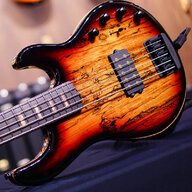
That single coil pictured is in a jazz-style case rather than the style that was in the SB-2, which mounted with screws at the ends. I wonder if it really is a drop-in for a jazz bass bridge pickup or if it's an oversized single coil like an SB-2's. Does anyone know? I tried to message the company, but I got an error message telling me to try again later.
 
Funny you should mention that. I have a pair of jazz basses, and no matter how I wire them, they have a wimpy output compared to my basses with MFDs. At first, I thought the pickups in them just sucked, but in one of them, I've changed pickups three times and it's still wimpy-sounding compared to my MFD-equipped basses. If one could be found, an MFD single coil from the SB-2 might work well in that spot.

I added a Fralin overwound J in the typical J position on a Kiloton. Or the ship guys did. It sounded great, but the tech said "took a while to tweak the balance" when I picked up the bass. Anyways, I sold the bass, not because of the J pickup, but because I never got along with the bridge MFD.

Screenshot_20260410_192903_Chrome.jpg
 
But perhaps send the MFD pickup to one amp and the J pickups to another......
No reason to use multiple amps. Use a (closed-)Source Audio: EQ2 or GFI System: EniQma pedal. They can be configured dual mono in and summed mono out. Unless you're into rack gear then find any dual channel compressor or equalizer and a summing box. Trim the louder pickups and cut frequencies before raising anything when setting the EQs.
There are a number of ways rather than big, possibly expensive, amplifiers.

what are the MFDs people are most looking for? I'd start with bass pickups. L2K, SB, Jazz?
I have the bi-coil jazz pickups and haven't tested the MFD jazz ones yet but, I'd want those.

Unless you can figure out how to make a new class of jazz-buckers. Two MFD jazz pickups side by side, able to be wired for all the options, in one enclosure. That's ultimately what I want in all but two of my basses. 4, 5, and 7-string versions.

People say the bass MFD humbuckers get 90% of the way to jazz. They say that those pups make good faux-J's. I want to be running jazz pups all the time with additional options so, I want 99% of that sound rather than something that's close. I'd happily carve away at the body of my basses in order to put the ideal pickups in.

( I'm happy with the MJ-4. Unless after changing the bridge to a Kahler vibrato and changing the string spacing between the original top string and the new highest I added, I find out I need to realign the pole pieces. So far it's been fine and I've done the same thing on my Fallout. This is the bass (MJ-5) I want the rest to sound like, generally speaking. The grain in the Ashula SRAS7 is too pretty to route but, it definitely needs G&L MFD Jazz sounding pickups and a new preamp )

By "all the options", ideally that would be mean for each:
series
parallel
single inner
single outter
P
reverse P
multi-coil split high/low for multiple preamps or outputs i.e. send top two strings to a filter style preamp or set the EQ differently etc. Kind of like Bartolini's 2J Squared but better ;P
Plus, an option to skip some of the highs with an OMG Mode. This would probably be only in the bridge but, could be an interesting way to offer really deep dub sounds when used in the neck.

I figure, if you set your goals there, anything simpler is already done and you can offer some with simpler wiring.

I'm also crazy enough to use a cat7 cable from an instrument with multi-coil pickups into separate MIDI EQ pedals and compressors so I can get exactly the sounds I'm looking for. I want my daily practice to sound and feel 95% as good as what an album would sound like. I'm not the kind of guy that enjoys playing an electric, acoustically. I like the sounds I've crafted and some good fuzz as my base bass tone. Call me spoiled. >: )
 
Last edited:
  • Like
Reactions: bpabon
Anyone else running Olintos on the sb1 or l100?.... these strings sound incredible on the sb1! I was never a fan of LaBella DTF's on the SB1..... but I'm smitten with the tone of these strings! Clarity and pitch definition while still thumping is reminiscent of the old Sadowsky Black Label flats.... but the Olintos sound a touch more aggressive. Getting some Phil Chen Blow By Blow vibes! Very nice! I hope they stay like this after full breakin.
 
Last edited:
  • Like
Reactions: dwellers
Funny you should mention that. I have a pair of jazz basses, and no matter how I wire them, they have a wimpy output compared to my basses with MFDs. At first, I thought the pickups in them just sucked, but in one of them, I've changed pickups three times and it's still wimpy-sounding compared to my MFD-equipped basses. If one could be found, an MFD single coil from the SB-2 might work well in that spot.

For several years I've been playing nothing but J-types and basses with MFDs, and of course, the MFD basses have much more output. I don't think any conventional J-bass pickups compare. For awhile I used Bardens in a Fender Jazz V, which were fairly hot and also sounded slightly like MFDs, but those aren't conventional J pickups.

For a couple of years, my main gigging basses were a Fender J and an SB-2, and, luckily, their volumes matched perfectly when I engaged the input pad on my G-K head when playing the SB-2.

In recent years, I've played almost all my gigs with either my M-2500 or my Sandberg TT-5 (J5), and the M has much higher output. So much, in fact, that if I run the M's volume at 100%, the Eden head at my bands' rehearsal/performance space totally freaks out, even if I cut the input gain. I have to cut the M's volume by about 25%. My G-K head handles it fine, so I use it when my band is the only one on the bill.
 
Hey all...I've been playing my SB-1 (which is listed for sale) and I'm really loving the MFD, especially after all the recent MFD love here. But what I'm not loving is the weight of the bass (over 9 lbs). It's heavy enough that I'm not gigging with it.

Question: is the only way to trim a few ounces with the tuners? Other than the bridge and the weight of the body wood, nothing else really contributes that much such that replacing would buy me anything. If it's just the tuners, they are already "ultra-lite" so maybe there's nothing to be saved there.

Oh well...I'm thinking this will just be a home/sitting/recording bass or very short gigs.
 
Questions for everyone who says the MFD's are sometimes too hot.
What's the first thing in your signal chain? Anything? Or are you going straight from bass into amp?
Are you using any type of distortion on the amp?
Have you ever tried using a compressor? That'll tame some of the extra loud stuff, and depending on the item, either keep the tone the same or give a certain character/saturation while potentially allowing overall volume reduction if desired. Rack units have two channels / inputs & outputs.


Typically I'm going into an EQ then compressor or vice-versa before I go into fuzz or anything else.

Also, there are mixers like what The Gig Rig just put out.

I'm sure Good Wood Audio or others do or could make something similar. These'll allow one to keep multiple instruments plugged in, adjust the output, and select which is active, and have an output for a tuner.
 
Last edited: