• TalkBass has been independent since 1998. Add your voice.
    Create a free account to reply to discussions, view embedded media, and browse with fewer display ads.
    Join freeLog in
    Want zero display ads or expanded classifieds tools? Compare plans.

G&L Club Part 7

Tuner hole size? Anyone?

This from Hipshot. Assume they're referring to American G&Ls

"Replace those sloppy, worn out tuning machines with a set of Hipshot American Classics. The HB1 is a direct replacement for the Schaller® BM tuner traditionally featured on MusicMan® and G&L® basses. Many independent custom builders choose this tuner as well.
  • Robust stamped and machined steel construction
  • 27:1 tuning ratio
  • Fits 11/16" (17.5mm) headstock holes"
 
Last edited:
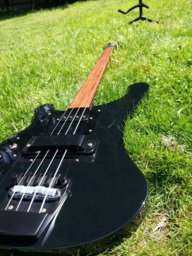
I know that the tribute ferrules are smaller. It's a tribute neck that is getting USA tuners and I need to know what size hole to drill. I'm not at home right now and thought if I post here I could pick up the bit on the way home.

My buddy gave me 16.5mm or .64 measurement which comes out to between 5/8" and 11/16" and I wanted to see what size will work? Will 11/16" make the ferrules loose in the holes?
 
NBD: 2000 G&L El Tookay MIJ Limited Edition
387D9CAC-30B7-4281-9C61-8FB5553D85AF.jpeg


BE25DFEB-CF2A-40AB-9D14-00828E38B603.jpeg

please excuse the dishes.
 
OK, now I GOT to know about those dishes! Backstory, please! (Also on the Tookay!)
I run a kitchen. Not much on the Tookay that most don't already know. MIJ and the fit & finish are in line with those instruments. QC seems impeccable. Unique color that I've never seen on a G&L. The finish has sort of set into the grain giving it a sort of nice antique look. Neck is solid as a rock with the skunk stripe on the back. Surely someone here knows more about the MIJ G&Ls than I do (I've only just discovered them and know that there aren't many).
 
When you say the SB2 has a hotter pickup:
I understand that means more output but I also associate hotter with less treble response and either a bass boost or low mid bump as compared to stock P pup? I've also felt that some hot P pups are less defined and can sometimes muddy up a busy mix.
Is this accurate to some, all, any of you?

Also sounds like different folks have had different experiences with rolling the volume pot back on an SB2 to tame the response. On a passive bass, I like my tone to be set with the volume pot dimed. Wondering if a resistor in series with the volume pot, or a different value pot would get me in this territory.
 
  • Like
Reactions: MascisMan
Before the flatheads G&L used a larger hex head. I read once that the flat heads were meant as a temp until they transitioned to the current small hex head. I've never noticed a sonic difference, but wasn't looking for one either.
I've seen talk of lining up the screw heads with the strings on the flatheads as a thing, but I don't know if it's been measured at all. I still have a large hex 1980 L1000 so I could measure diameter if anyone wants. My screw head pole L2K is long gone.

I was more curious the dimensions of the actual pickup of the vintage L's vs the current L's.
 
My buddy gave me 16.5mm or .64 measurement which comes out to between 5/8" and 11/16" and I wanted to see what size will work? Will 11/16" make the ferrules loose in the holes?
I was just on my way out and grabbed the neck and a digital caliper and measured one hole at 0.6875 (exactly 11/16").

Now I have a bit more time I've checked all the holes with and across the grain and they seem to average out at about 0.66" (16.8mm).

Try as I may I cannot repeat the original measurement so am beginning to think I had a brain fart and misread the caliper.

Sorry if I mislead anyone.
 
  • Like
Reactions: donahue
.027" delta does seem a bit loose even for G&L
This the equivalent to 9 sheets of note book paper

Lastly the closest standard bit would be 43/64's (.6719") or 21/32nds (.6562") neither of which is available at your local hardware store. For that matter, you would need a decent drill press or mill to hold that kind of tolerance in wood anyway. Drill small and ream for a tight fit?
 
  • Like
Reactions: donahue
When you say the SB2 has a hotter pickup:
I understand that means more output but I also associate hotter with less treble response and either a bass boost or low mid bump as compared to stock P pup? I've also felt that some hot P pups are less defined and can sometimes muddy up a busy mix.
Is this accurate to some, all, any of you?

Also sounds like different folks have had different experiences with rolling the volume pot back on an SB2 to tame the response. On a passive bass, I like my tone to be set with the volume pot dimed. Wondering if a resistor in series with the volume pot, or a different value pot would get me in this territory.
IME,
The SB-2, SB-2T in my case, is the only bass I'm ok with not running the volume on full.
I always dime the volume on my other basses.
Having the additional tone control is useful in certain instances.
If I'm running the volume less than 100%, it's enough to tame the highs, so the tone stays wide open.
If I'm running the volume full up, I'll use the tone to dial back the treble.
I don't feel the MFD split is typical of hot pickups.
To my ears, it is a very full-spectrum tone.
 
IME,
The SB-2, SB-2T in my case, is the only bass I'm ok with not running the volume on full.
I always dime the volume on my other basses.
Having the additional tone control is useful in certain instances.
If I'm running the volume less than 100%, it's enough to tame the highs, so the tone stays wide open.
If I'm running the volume full up, I'll use the tone to dial back the treble.
I don't feel the MFD split is typical of hot pickups.
To my ears, it is a very full-spectrum tone.

Yep, MFD pick-ups have fewer windings and a strong ceramic magnet underneath all the poles, the result is a sound profile that still has that mid bump (slightly shifted up due to the pick-up slightly being farther towards the bridge) but is also wider in response and quieter in noise than the standard split-coil. It's very responsive to touch, so it's not just "loud" as some people sometimes claim, I think the earlier description in this thread as 'chewy' works well, you can make it sound fairly gentle by a sufficiently light touch, but it'd still be fairly textured. Now, I'm not planning on getting another 4 stringer, but if I ever need a back-up for my SB-1, I'd likely put that glorious pick-up in a cheaper-than-a-USA-G&L bass and call it a day :)
 
When you say the SB2 has a hotter pickup:
I understand that means more output but I also associate hotter with less treble response and either a bass boost or low mid bump as compared to stock P pup? I've also felt that some hot P pups are less defined and can sometimes muddy up a busy mix.
Is this accurate to some, all, any of you?

Also sounds like different folks have had different experiences with rolling the volume pot back on an SB2 to tame the response. On a passive bass, I like my tone to be set with the volume pot dimed. Wondering if a resistor in series with the volume pot, or a different value pot would get me in this territory.

Yes. The neck pickup soloed is not a sound that works that well for me. I find it dominated by low mids. It's very thick. I've never played much with EQing because it's not that appealing to me.

But that's where the bridge pickup comes in. Start dialing that baby in and the SB-2 will cut through a mix no problem.

I don't know if that's what Leo intended but it seems to work.
 
Different question:
I find the Lakland Skylines to be excellent and don't see how the US models could be that much better.
The neck shape is just too shallow front to back for me (4401 & 4402).
How do you all rate the Tributes to the US models. My tribby has a bum neck so not sure where it really stands.
Interested in passive basses and probably just JB and SB series.
 
  • Like
Reactions: MascisMan

Latest posts