• TalkBass has been independent since 1998. Add your voice.
    Create a free account to reply to discussions, view embedded media, and browse with fewer display ads.
    Join freeLog in
    Want zero display ads or expanded classifieds tools? Compare plans.

G&L El Toro owners- question about passive mode

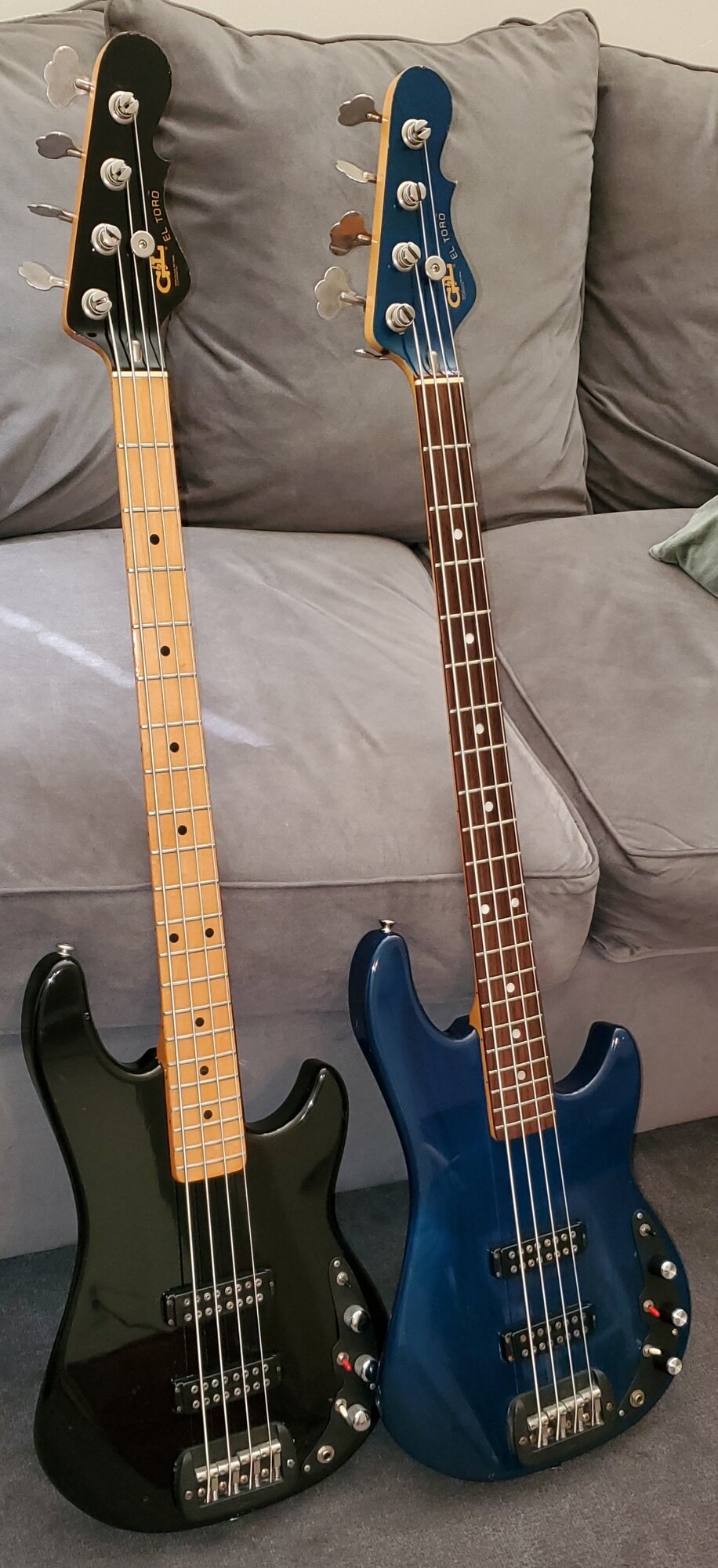
Hi All! I have a question for anyone who has a G&L El Toro. I'm fortunate enough to have two of them- they sound and play fantastic. Aggressive roar, if I had to sum it up in two words. But also tame-able. I can't say that without including a pic, so see below...

I have a question for you. Despite having owned both of these for years, I never tried passive mode until recently. I noticed that, in passive mode, the bass control acts like an additional volume control. There is very little output when the bass control is turned all the way down. Both of my Toros behave identically. Anyone know if "they all do this"? Appreciate your experiences! In the meanwhile I'll take a look at the schematic and see what I see.
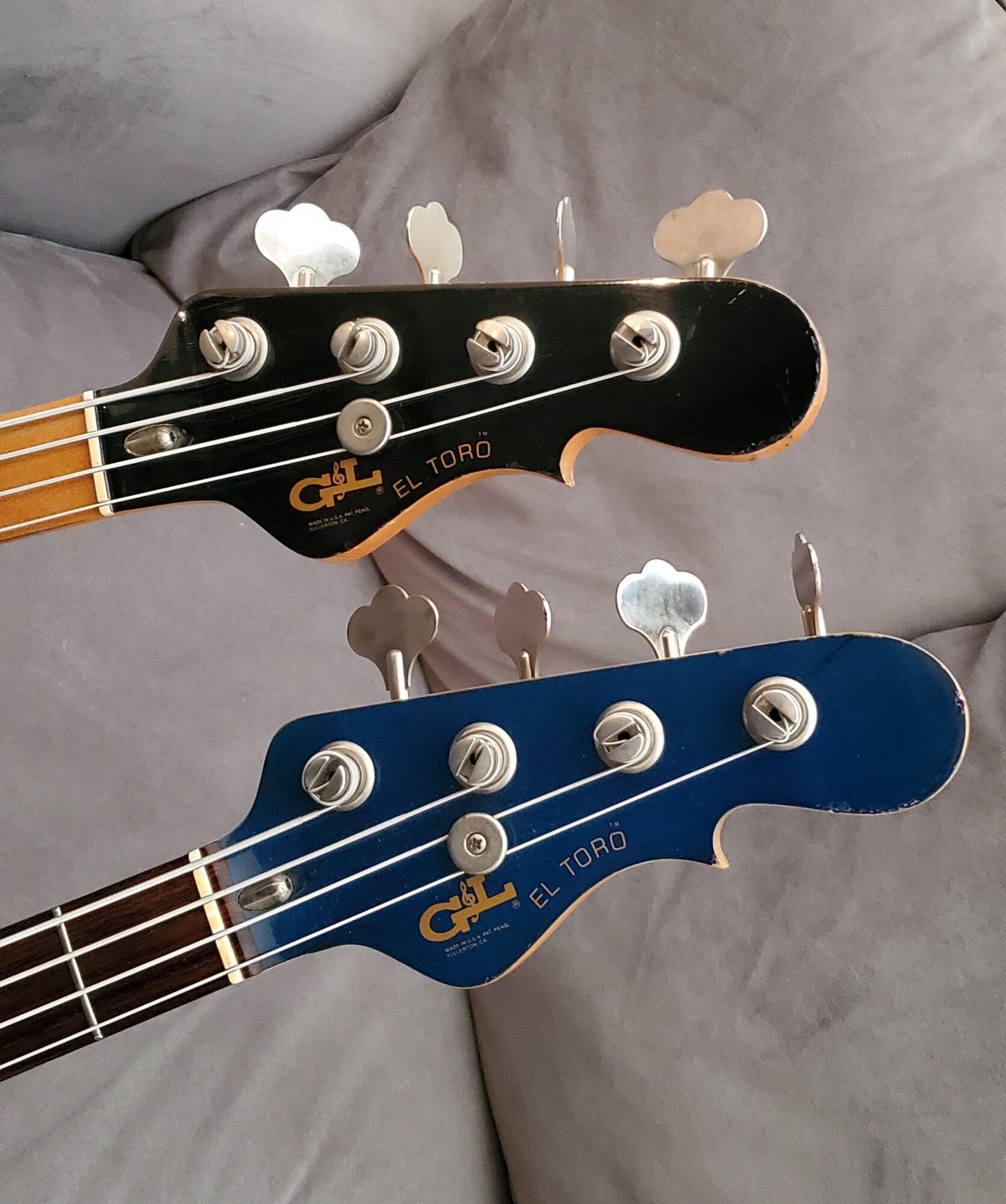
20200710_115839.jpg

20200710_115305.jpg
 
On mine it acts the same. I think it's because of the behaving of the bass roll off, not because of actual volume output.
I pretty much live on the passive mode, the output volume is more than enough and the active is out of control, it sends any preamp or audio interface into overdrive wich sometimes is not want you may want.
The (always passive) tone controls seem to have different slopes: the treble is quite normal as far as passive controls go, but the bass side semmes like it have an intense cut. Maybe it's because it actually cuts a lot, or the frequency point of cutting is too high in the mids, or maybe it's because I play bass because I actually like bass frequencies so I tend to miss them when they go away.
Anyway, I have recently ditched the active mode entirely by taking out the battery. The bass still works perfectly as a passive instrument, I do not have active mode any more, I have a kill switch instead :)

Pics of the bass just because why not ?

IMG-20250913-140322-edit-57641478328704.jpg


From a recent French get-together, the Toro is mine (and the others are not, unfortunately). Apart from the Roadworn PB, the Toro (from '84) is actually the youngest of the picture ;)
 
Are you playing with the Volume on full? There is a treble-bleed in the circuit that will favor treble when turning the Volume down (and in general will counter treble losses that are normal from a passive volume control even when on full). I've never played an El Toro, but my understanding is that the pickups are very treble and mid-forward to the point that cutting bass could quickly drop the noticeable "oomph" and particularly if you are simultaneously cutting the Tone control might be cutting a lot of the signal across the board. I have this problem on my Bass VI when I engage the bass-cut switch, where the Tone control will almost be able to cut the entire signal since I am cutting so much of both sides of the signal (bass/mids from the Bass-cut capacitor, Treble/mids from the Tone control). It is strange in your situation that this only happens in passive mode, because the preamp in the circuit comes after all the passive controls.

1759529440337.png
 
Hi All! I have a question for anyone who has a G&L El Toro. I'm fortunate enough to have two of them- they sound and play fantastic. Aggressive roar, if I had to sum it up in two words. But also tame-able. I can't say that without including a pic, so see below...

I have a question for you. Despite having owned both of these for years, I never tried passive mode until recently. I noticed that, in passive mode, the bass control acts like an additional volume control. There is very little output when the bass control is turned all the way down. Both of my Toros behave identically. Anyone know if "they all do this"? Appreciate your experiences! In the meanwhile I'll take a look at the schematic and see what I see.

View attachment 7335014
View attachment 7335015

Hey Jack, long time no talk, how's it going? I almost always play both of mine passive. I occasionally cut the bass a tad, but my combo's a 15" and my Genzler stack 15" & 2x10. I post my Toro! Toro! pic every Cinco de Mayo. That's a big party day here in Tucson.

Toro! Toro! Resized.jpg
 
Last edited:
Are you playing with the Volume on full? There is a treble-bleed in the circuit that will favor treble when turning the Volume down (and in general will counter treble losses that are normal from a passive volume control even when on full). I've never played an El Toro, but my understanding is that the pickups are very treble and mid-forward to the point that cutting bass could quickly drop the noticeable "oomph" and particularly if you are simultaneously cutting the Tone control might be cutting a lot of the signal across the board. I have this problem on my Bass VI when I engage the bass-cut switch, where the Tone control will almost be able to cut the entire signal since I am cutting so much of both sides of the signal (bass/mids from the Bass-cut capacitor, Treble/mids from the Tone control). It is strange in your situation that this only happens in passive mode, because the preamp in the circuit comes after all the passive controls.

View attachment 7336313
It's happening in active mode too. It's just that there's less compression/distortion to mask this in passive mode.

As you were getting at, the pre-amp on G&L basses is basically just a boost on top of an otherwise passive circuit (except the L-5500 and the M series). All it really does is to amplify whatever you have dialed in on the passive circuit. The result, at the same amp settings, is a much more compressed sound, which smooths over all kind and manner of things. So people adjust their amps to work with that hot signal, minimizing distortion. Pop it over to passive, you lean things out significantly, and "The True Nature of Things" is all of a sudden audible.

When you roll off bass in active mode, the over-all signal is still pretty hot and compressed, which results in more distortion on the low end, which we hear as "bass" or "warmth." In passive mode, you're not getting that squishy bottom end that's basically coming from overloading/distorting the amp.

Totally agree on the VI comment too. The strangle switch and the tone control almost completely overlap.
 
Last edited:
  • Like
Reactions: Ricky Rioli
It's happening in active mode too. It's just that there's less compression/distortion to mask this in passive mode.

As you were getting at, the pre-amp on G&L basses is basically just a boost on top of an otherwise passive circuit (except the L-5500 and the M series). All it really does is to amplify whatever you have dialed in on the passive circuit. The result, at the same amp settings, is a much more compressed sound, which smooths over all kind and manner of things. Pop it over to passive, and "The True Nature of Things" is all of a sudden audible.

When you roll off bass in active mode, the over-all signal is still pretty hot and compressed, which results in more distortion on the low end, which we hear as "bass" or "warmth." In passive mode, you're not getting that squishy bottom end that's basically coming from overloading/distorting the amp.

Totally agree on the VI comment too. The strangle switch and the tone control almost completely overlap.
Indeed, I've owned a number of L2000/2500 basses and never much cared for the preamp as to my ears it was a bit lo-fi and maybe even a bit saturated and added unnecessary boost to what was already a "too hot" signal from those high-output pickups. You are probably correct that the difference with preamp engaged is indeed compression- not just from the amp but from the preamp itself.

I didn't mention it before, but I have found my vintage L2000's bass-cut to sometimes not get along with some inputs when in passive mode. I had a cheap audio interface and a fuzz pedal (Iron Ether Oxide) that caused the bass-cut to behave quite extremely when rolled down. I can't remember if this was before or after I modded that bass in a way that put the bass control after the volume though ( this was maybe 18 years ago, when I gave the bass a volume/volume control in place of the master volume so I could blend pickups) which would make sense if so (the way a passive bass-cut works is strongly affected by the impedance of what it feeds), though I feel like it was actually before I did the electronics mods on that bass. In both cases adding a buffer in-between the bass and problem device fixed the problem, so it must have been an issue with the input impedance of those two devices.
 
Last edited:
Hey Jack, long time no talk, how's it going? I almost always play both of mine passive. I occasionally cut the bass a tad, but my combo's a 15" and my Genzler stack 15" & 2x10. I post my Toro! Toro! pic every Cinco de Mayo. That's a big party day here in Tucson.

View attachment 7336463
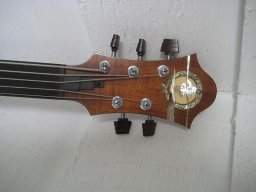
I've never seen a fretless Toro before. My gas is now officially out of control.
I've wanted an El Toro for years. If I had known they made them fretless I would have wanted that even more.
…and now I do.
 
I've never seen a fretless Toro before. My gas is now officially out of control.
I've wanted an El Toro for years. If I had known they made them fretless I would have wanted that even more.
…and now I do.
G&L has offered fretless basses from 1980 onward. Until 2016, every G&L (aside from demo models and special editions) was made only as ordered by the retailer or the consumer, so there are many variations out there. I've seen probably a half dozen fretless El Toros in my 37 years of following the G&L brand closely.

It was a very smart business practice, as it significantly increased manufacturing efficiency, allowing the managers to plan production very precisely and try to avoid expenditures that did not lead directly to profit.

The practice was discontinued in 2016. Nine years later, the company went under, horribly in debt to creditors and vendors.
 
G&L has offered fretless basses from 1980 onward. Until 2016, every G&L (aside from demo models and special editions) was made only as ordered by the retailer or the consumer, so there are many variations out there. I've seen probably a half dozen fretless El Toros in my 37 years of following the G&L brand closely.

It was a very smart business practice, as it significantly increased manufacturing efficiency, allowing the managers to plan production very precisely and try to avoid expenditures that did not lead directly to profit.

The practice was discontinued in 2016. Nine years later, the company went under, horribly in debt to creditors and vendors.

There are several fretless Toros listed on the Registry. My 1980 L1K.

L1K fl 1980 a.jpg
 
G&L has offered fretless basses from 1980 onward.
I've seen many fretless L2000 and L1000 basses (my '85 L2K is fretless and, aside from being much, much heavier than my other two '80s L2Ks, it's a joy to play) but I never saw a fretless El Toro until seeing that posted photo earlier. I have never followed G&L all that closely and never knew that their entire output was, essentially, custom ordered for so many years. Very interesting to learn!
 
Thanks for all the responses. After looking at the schematic, doing a quick verification under the hood, reading this thread, and playing both Toros for a bit I concluded that they are functioning exactly as intended. The blue Toro has moved on to a new home, in transit as we speak. I suspect I will regret selling it.
 
  • Like
Reactions: sunbeast