Until he has to share his toys....."Daddy, you mean I have to give up Binky!!!!"
And "You stole my Mommy!"


TalkBass has been independent since 1998. Add your voice.
Create a free account to reply to discussions, view embedded media, and browse with fewer display ads.
Join free Log in
Want zero display ads or expanded classifieds tools? Compare plans.
Until he has to share his toys....."Daddy, you mean I have to give up Binky!!!!
 He wants to be a guitarist, though, so you guys pray that I can straighten him about before he ruins his life!

Oh, any Nashville area cats who want to hear this stuff live, I'm playing at Past Perfect juts off Broadway at 10pm this Saturday, 2/09/2008. Artist is Brian James. He's a smoking guitarist, too, so it'll be fun to listen to even if I suck, lol ...
Cheers
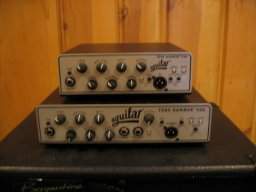
I have a question about the power of the Shuttle 6.0 .
How could it be, that the amp takes 400 Watts (max. average power consumption) and gives 600 Watts to the speakers? Thank you for your help.
Invalid Link Removed
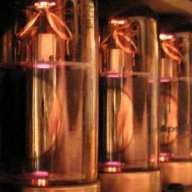
that's what an internal power supply does. Power transformers in "traditional" amps.....switch mode power supply in this amp.
Any further info than that and I'd be making it up ...as I'm not an engineer. Perhaps agedhorse will come along and add further info.

I'm not sure that 400W of electrical energy is the same as 600W of sound energy...

that's what an internal power supply does. Power transformers in "traditional" amps.....switch mode power supply in this amp.

NO!!! You can't get more power out than you put in! Power supplies trade around voltage for current, but power is always conserved (minus any inefficiency in the circuit design).
This was explained in a thread that I posted about a Carvin B800 input power rating.
Energy has to be conserved. If there is 600W of power going to the speakers, then the amplifier has to be drawing AT LEAST 600W from the wall. Otherwise you're more energy out than you put in, which is impossible, as others have said.
The disconnect is as KJung said: The input power rating on the back is an average of some sort, for typical operating conditions. My guess is it's for a 4 ohm load, with typical signal input.
Asad
The input power reflects duty cycle, a form of averaging that in our case reflects the worst maximum power the amp will consume when operating with approximately a 6dB crest factor. It works out to the amp's draw when operating at between an AVERAGE of between 1/3 and 1/4 rated CONTINUOUS power. The power supply serves to average out the current draw. A 300 watt amp typically delivers about 100 watts AVERAGE but uses the entire 300 watts to handle peaks in the output signal.
Another example is pro audio PA amps, the standard specification is to reflect the 1/8 of continuous power level, and that's what testing labs use for most of the safety and EMI tests. Because bass amps are typically used at higher duty cycle, we increase the numerical rating to reflect this real life fact.
If you look at say the QSC or Crown specs, they gice the current draw for their amps at various drive levels and duty cycles but typically use the 1/8-power current draw (or power consumed) on the backs of their amps.

you told me it was the awesomeizer circuit.
)
you told me it was the awesomeizer circuit.

The input power reflects duty cycle, a form of averaging that in our case reflects the worst maximum power the amp will consume when operating with approximately a 6dB crest factor. It works out to the amp's draw when operating at between an AVERAGE of between 1/3 and 1/4 rated CONTINUOUS power. The power supply serves to average out the current draw. A 300 watt amp typically delivers about 100 watts AVERAGE but uses the entire 300 watts to handle peaks in the output signal.
Another example is pro audio PA amps, the standard specification is to reflect the 1/8 of continuous power level, and that's what testing labs use for most of the safety and EMI tests. Because bass amps are typically used at higher duty cycle, we increase the numerical rating to reflect this real life fact.
If you look at say the QSC or Crown specs, they gice the current draw for their amps at various drive levels and duty cycles but typically use the 1/8-power current draw (or power consumed) on the backs of their amps.