
Blues Monday.
I’ve been trimming Noel, the indoor christmas tree.
I’ve been trimming Noel, the indoor christmas tree.

TalkBass has been independent since 1998. Add your voice.
Create a free account to reply to discussions, view embedded media, and browse with fewer display ads.
Join free Log in
Want zero display ads or expanded classifieds tools? Compare plans.
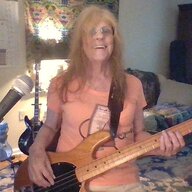
Who knew how much there is to be conscious of?
 Time turned the mutes into little petrified nubs. A few months ago I found some foam I thought would do. Cut four foam bits, and now the mutes work again. But not all that useful as each one needs to be engaged with a thumb screw. It's not a mid-set option that I can go back to for the next song.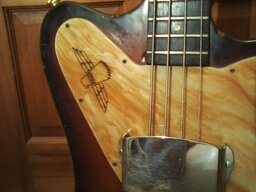
We used to be guitar, drums, bass, singer. I used a Boss octaver(1 octave down)to 'fatten' behind guitar solos. I'd play the bass line up and let the octaver cover down. In our current line-up(2G, D, B), I use an EHX Micro POG( dry, 1 down, 1 up), I use dry/1 up during guitar solos[or mine]if we go out as a trio. Don't need it if we're 4.I played a lot of years in the 70's into the 80's with a successful trio. Guitar, bass and drums. Over those years I developed my own style of 'octave playing' to help fill the holes when the guitarist took off on a solo. I still use that occasionally when appropriate, and it sounds really nice when used appropriately.
I'll never forget when we got called into our agent's office. He said, "boys, you've done a great job as a trio. But I want you to get a female singer/guitarist. We were living in Seattle and thankfully there were a lot of ladies to audition. We found an excellent lady singer/guitarist. She was one of the guys and easy to work with. We never had time to resent her addition because our worth went up immediately and we started playing much nicer rooms like hotels with nice lounges and restaurants. Fun times.
It’s an interesting instrument. The octaves add a fuller sound, almost like a rhythm guitar. As Will said, it fills in a guitar sound. I was looking at how he was plucking the strings. It appears that he was pulling pairs in unison as opposed to strumming them up or down. But it was fast.
Tom Petersson of Cheap Trick plays a 12 string bass. Four bass strings, each with a pair of octave strings. He uses a bass amp and a guitar amp. The sound is full, like the combination of a guitar and a bass. Often the lead guitar player stops playing and you hear what sounds like a guitar in the background. People accuse them of playing to pre-recorded tracks, but it’s all from the bass. It must be hard to play well.

I generally don't go 'wandering' on TB. I spend too much time in the clubs I'm in as is. My main bass(1967 THUNDERBIRD NR)has a hand rest over the neck pup and I play mostly fingers just behind it or sometimes in front for a bassier tone.
View attachment 3745460
My 66 EB-3 had a lever operated felt mute. The 67 THUNDERBIRD had a piece of some kinda damping material on a spring 'thingy'*. The material rotted/hardened a loooong time ago. I have a piece of foam lightly resting on the strings under the bridge cover(also on my Squier VM Jaguar SS).That’s so true. For me it isn’t by design, it’s just the way I naturally play. I think that some of it comes from also playing guitar where strumming is done all over the the place to change the tone. It can be near the bridge, the neck, or even further up over the fingerboard. So I naturally do the same with bass, resting on whatever feels right.
My most usual hand position is slight palm muting over the bridge. James Jamerson used piece of foam at the bridge so he was always muting. Fender used to supply the block of foam with the PBass stuck under the bridge cover. Rickenbacker and Gretsch introduced built in adjustable foam mutes. Many other companies copied them in one form or another.

Still a 'thing' these days, too.Arguably all haircuts in the 70s were bad haircuts.
Yeah, the first real bass I played/learned on was an EB-3 w/ bridge cover so I naturally played somewhere in front of it.(It was Navy issue. Removing the cover wasn't an option so I never considered it)Roger that. I don't do clubs here, although I do drop in on some manufacturer threads related to various friends in the industry pretty regularly.
Ashtray covers make no sense at all to me, that would be exactly where I'd want to be picking a substantial amount of the time. I use a floating thumb most of the time, or anchor on a pickup occasionally. So again, a ramp wouldn't work at all for you unless you felt motivated to radically change things up. I tried it and liked it until I didn't, and trying it again at some point would be trivially easy since I already have the ramps built and they just use double stick tape for mounting. But as always, vive la difference! View attachment 3745637
That’s so true. For me it isn’t by design, it’s just the way I naturally play. I think that some of it comes from also playing guitar where strumming is done all over the the place to change the tone.
There used to be a lot of crossover between my bass and guitar picking technique. That kind of lead to a liitle too strong an attack on guitar and a little too light on bass. To this day, if I use a pick on bass I tend to want to go into shred mode. Fender picks would barely make it through one tune back when I was gigging on guitar in a rock context. Many of those gigs were in duo format and although I had and used plenty of pitch shifting widgets, I always loved the effect of just changing instruments mid-song and leaving whatever voids that created. Having a drummer that people actually enjoyed hearing solo a lot was key though. And of course wanting people to sit down and shut up rather than dance helped a lot as well...View attachment 3745706
Arguably all haircuts in the 70s were bad haircuts.
I did use looping avidly for a while too. Unfortunately it has become very cliched in our local area due to the heavy usage in jam bands, although one friend of mine has been making a decent living for years playing in a solo format where he typically plays at least four or five instruments per song.I see people in a live performance recording a bass with a looper, then moving to different instruments. Loopers are quite neat to use when you have a duo and need more hands like in the video below.
I never did looping as a solo performer but bought midi tracks then customized them. I stripped most of the instruments off and that made the songs sound more organic. I moonlighted as a musician while I was a computer contractor in Lincoln City Oregon. I felt better about using my own edited midi backing tracks than buying karaoke files, which were very overproduced.
I could never warm up to looping because unless you spent many hours creating tracks, it was hard to do a complete song (at least for me) and I found the midi editing was quicker and more efficient. To me the continuously looping feature became tedious and repetitious for entertainment performance.
Well this morning I'm at work at the City of Sitka government but everyone is encouraged to semi isolate themselves if possible. Today I'll do most of my work over remote connections to the users.
I wouldn't mind getting a little looped today with all the fear going on! LOLSo now you can loop back and forth on the phone. Have some isopropyl alcohol (70% or more) on hand to debug the computers.
I see buskers using a looper but most often midi or simply tapes and a mixer.


So now you can loop back and forth on the phone. Have some isopropyl alcohol (70% or more) on hand to debug the computers.
I see buskers using a looper but most often midi or simply tapes and a mixer.
I see buskers using a looper but most often midi or simply tapes and a mixer.


