Happy Soulful Sunday...

TalkBass has been independent since 1998. Add your voice.
Create a free account to reply to discussions, view embedded media, and browse with fewer display ads.
Join free Log in
Want zero display ads or expanded classifieds tools? Compare plans.

Thanks for another good one. That’s what you call mood music. It’s specially good when you consider that the soul ballad was recorded in 1962, predating so many standards. An evolution from slow doo-wap.
Otis toured on the southern chitlin’ circuit. In the days of segregation, black performers couldn’t perform in clubs for whites. These clubs provided venues. Pay was low in the early 60’s, it was based on the gate. Typically a 60/40 split in favour of the artists on each $0.50-$0.75 ticket. They were lucky if they broke even. But it helped support the records. A lot of great songs were written on the road in seedy motel rooms. Loneliness was a common theme.
This was Otis’ first Stax single. There was a lot riding on it and it did very well, initially selling 800,000 copies. The lyrics connected with many.
“These Arms Of Mine"
These arms of mine
They are lonely
Lonely and feeling blue
These arms of mine
They are yearning
Yearning from wanting you
And if you
Would let them
Hold you Oh how grateful I will be
These arms of mine
They are burning
Burning from wanting you
These arms of mine
They are wanting
Wanting to hold you
And if you
Would let them hold you
Ohh how grateful I will be
Come on, come on baby
Just be my little woman (yeah)
Just be my lover I need somebody,
(Somebody) To treat me right
(Ohh) I need your warm loving arms to hold me tight
And I need your tender lips too
Hold me, hold me.
 .
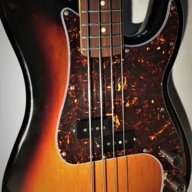
.My first really good bass was a '63 Hofner Beatle bass. Dead flats, uprightish tone. Tiny neck, strong pickups, neck dive....A short scale bass allows you to play songs easier. I use a Cort and Hofner 500/1 for that. Sometimes you want a classic PBass tone, I use a ‘57 reissue Precision for that. The neck is massive and it is heavy. For a narrower neck like a Jazz bass, I use a Rickenbacker 4003.
None of my basses have active electronics. I find that because of their wider bandwidth, they are harder to fit into a mix...
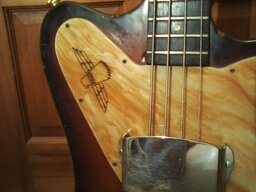
Hmm. Who knew?Being left handed, I’m so glad that I learnt to play right handed.
Some nice lefty instruments to peruse.
Link Removed
How about a road trip to Texas.
South Paw Guitars

Just curious...how many paying gigs do y’all play (average) a month?

Happy Soulful Sunday...

My first really good bass was a '63 Hofner Beatle bass. Dead flats, uprightish tone. Tiny neck, strong pickups, neck dive.
I sold that and picked up a '64 Fender Jazz. Smooth and fast neck. 1.5" at the nut. Not too heavy. Great tone, always sat in the mix well.

Thank you Mr. @beans-on-toast . I already see a few I'm drooling over!Being left handed, I’m so glad that I learnt to play right handed.
Some nice lefty instruments to peruse.
Link Removed
How about a road trip to Texas.
South Paw Guitars


Just curious...how many paying gigs do y’all play (average) a month? I’m hovering 8-10 on either bass or 6 string, sometimes significantly more, occasionally much less..
I’ve seen a lot of vintage Hofner Beatle basses with neck joint issues. I played one in the 60’s that came with a flat carpenter’s pencil shimming it to obtain a playable angle.
When I was buying my current one, I went to a local store that kept pulling them out from the back room. There must have been a dozen. I finally found a good one and it’s stood up well for over 35 years. Most were separating at the neck. Today I would try to reset the neck but back then I was too worried about undertaking it.
Gotta wonder how long the original was 'fore they cut it for 'air play'. Also, how long live? I can see the dancers lovin' every minute of it.

I picture the dancers at a live show just kinda holding on and swaying-and getting 'warm'.The Stax label release was 2:35. When the recording left the studio, it went to Atlantic. Often there were various stems, or submixes. Nothing was done live on TV. So there was often an instrument track that the artists sung over. They would ride the vocal to balance it.
When I started out, our band visited a hits AM station. They played mono 45’s. If you wanted to be played, the song had to fit on a 45, max was five minutes, but optimal mastering was three minutes or under.
The DJ was literally in a closet, standing room only, no chair. They added compression and a touch reverb to give songs more intensity. Commercials and intros were on tape.
If you wanted to get in the air, the studio had to meet radio’s requirements. They did what they had to do to get airplay.
Like you said, live they might milk the song. The Youngbloods could play Get Together for a half an hour.

Heh. The Hofner rep in TO is a good friend of mine. A few years ago at NAMM we were discussing my preamp designs and he pitched me really hard on taking a new Chinese Beatle Bass and filling is up with electronics a la the pre-Alembic Guild basses that Phil Lesh and Jack Casady played. Tempting in many ways, but I just don't do short scale basses. But never say never!
Short scale shouldn’t scare anyone away.
I have a high frequency amp waiting in the queue.
Ever try a low temp solder product such as Chip Quik for reworking surface mount parts?
Invalid Link Removed
Looks interesting. Demos on youtube.
http://www.chipquik.com
Happy Soulful Sunday...
Thanks for another good one. That’s what you call mood music. It’s specially good when you consider that the soul ballad was recorded in 1962, predating so many standards. An evolution from slow doo-wap.
Otis toured on the southern chitlin’ circuit. In the days of segregation, black performers couldn’t perform in clubs for whites. These clubs provided venues. Pay was low in the early 60’s, it was based on the gate. Typically a 60/40 split in favour of the artists on each $0.50-$0.75 ticket. They were lucky if they broke even. But it helped support the records. A lot of great songs were written on the road in seedy motel rooms. Loneliness was a common theme.
This was Otis’ first Stax single. There was a lot riding on it and it did very well, initially selling 800,000 copies. The lyrics connected with many.
“These Arms Of Mine"
These arms of mine
They are lonely
Lonely and feeling blue
These arms of mine
They are yearning
Yearning from wanting you
And if you
Would let them
Hold you Oh how grateful I will be
These arms of mine
They are burning
Burning from wanting you
These arms of mine
They are wanting
Wanting to hold you
And if you
Would let them hold you
Ohh how grateful I will be
Come on, come on baby
Just be my little woman (yeah)
Just be my lover I need somebody,
(Somebody) To treat me right
(Ohh) I need your warm loving arms to hold me tight
And I need your tender lips too
Hold me, hold me.
Thanks @SoulReflection for the great song and thanks to @beans-on-toast for the background. Great Soulful Sunday listening! We were watching a special about US in the 40's and it was sad that Hattie McDaniel (Mammy) was sitting next to the kitchen because of her color when called up to receive her Academy Award. We are a lot further along than we were back then.
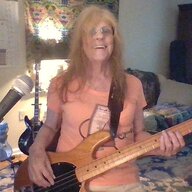

Del Ramos of The Association was playing an Ibanez Mikro when I saw them last year. I got to talk to him and he said that he liked it, so there is a place for short scale basses.If you've never tried a short-scale ....
Seconding (or thirding) the recommendation as the short scale neck will need far fewer truss rod adjustments than your average Kodiak bear. Short scale is also a lot of fun to play and this is coming from the same one who at 20-something says aww I don't need short scale. I was so rong I didn't even know how rong I was....
Lots of leftie offerings from Eastwood. No personal experience with one but they get lots of views from me. Cool old designs. Poking around TB it looks like the general agreement is the quality is fine, the looks are great.


