• TalkBass has been independent since 1998. Add your voice.
    Create a free account to reply to discussions, view embedded media, and browse with fewer display ads.
    Join freeLog in
    Want zero display ads or expanded classifieds tools? Compare plans.

Getting a "bowed" upright tone on fretless electric

My current ear-training regime involves playing a fretless to the Suzuki Method bass recordings, which are all "arco" (bowed) on a double bass. Naturally this has me trying to fake a bowed tone fingerstyle, because that makes it easier to match the recording. Most of the time that people look for an "upright" tone, they're looking for a plucked tone rather than bowed--at least, that's all I could find by searching. I know that ebows exist but I don't think that's going to work with fast runs over 3 strings, and it's a weird technique that doesn't really move me forward in bass playing.

At the moment I'm cranking treble and high mids, but it's not really satisfactory. Some things I can't possibly fake (long sustained notes, the sort of "sticky" quality of bow on string with subsonic pops) but I'm curious if anyone has suggestions for getting closer. Open to pedals, technique, EQ, whatever.

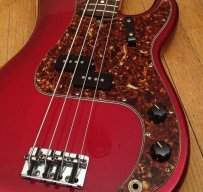
(Fretless MIM Jazz into Bassman 115 combo, usually with bridge pickup soloed, tone dimed).

 
To get a "bowed" sound without bowing, my technique involves changing the attack of the volume to emulate how a bowed bass might sound. I do this by turning down both pick ups and sounding the note and turning up the volume so as to soften the attack. Another way is to use a volume pedal.

The only thing this does, though, is change the attack of the note. That is only part of what makes a bowed upright sound the way it does. I've yet to find a way to emulate that beautiful coarse sound of the bow on the string that you hear on faster bowed passages, though I imagine there may be some creative combination of effects pedals that can get you there.

But this isn't the effects forum and I'm already probably going to get in trouble for mentioning the volume pedal. :ninja:

Go Broncos.
 
  • Like
Reactions: thabassmon
But this isn't the effects forum and I'm already probably going to get in trouble for mentioning the volume pedal. :ninja:

I don't think this is a bad place to mention a volume pedal as it takes a lot of practice to develop the technique to get the pseudo-bowed sound with one. It's arguably the most effective way of subduing the initial plucked attack of the note to give you that arco kinda thang.
 
The reason pro bows cost as much as pro basses is because they are instruments in their own right. I play violin in addition to fretless bass, and I can't think of any way to do this that doesn't involve a bow. And I think trying to play an electric fretless with a bow is going to be pretty frustrating.

ETA: well, works pretty ok on the E and G strings, can't do anything with the A and D. Worth the price of a cheap bow, I suppose.
 
What about EQ? Any ideas what the harmonic content of bowed vs plucked is?

I don't really need a bowed tone for performance or recording. Someday (someday!) I'll have an upright and lessons to cover that. It's just challenging learning bowed pieces by ear.
 
I use an ebow, but be forewarned, it is not easy, at least it wasn't for me. I spent a full year practicing at home before I was willing to use it on a gig. Just like with a real bow, it is easy to get unintended squeaks and squawks. The ebow is designed for guitar string spacing, so you have to develop the technique to keep it just in the sweet spot, both along the length of the string (usually very near the end of the fingerboard) as well as centering on the axis of the string. I do not use the ebow right over the pickup as suggested in the manual. Nearer the neck allows for a warmer more 'up-rightish' sound. I generally use just the neck pickup, if a dual pickup bass. I anticipate the desired note by a fraction, kind of like a grace note, to hammer on the note to start the string vibrating. The greater mass of bass strings requires a bit of help to start. Cross string skipping is also a skill that needs practice. I actually found first practicing to get the strings vibrating correctly acoustically i.e. without amplification, helped me develop the proper technique. I glue strips of felt over the groove guides on the ebow. It helps keep extraneous string noise down. Even though it is a challenge, I have gotten good results when needing to cover arco parts in musical scores in pits where, generally for space limitations, I'm only playing electric. I've had musical directors specifically request the 'bow thing.' It can add a desirable bit of string color when used with discretion.

Cheers,
Dennis
 
good luck with that ... a real bow can mimick singer ... so you can play many notes in one "breath", things not normally possible with a plucking instrument like guitar, piano and bass.

You can use a real bow on the E and G strings with they are flatwound ... but it isn't really efficient.

ebow sounds nothing like a real bow

a guitar slide pretty much like the ebow sounds nothing like a bow but at least like the ebow it gives a weird sustain
 
Watch this space.

I'm going to record a clip. You can tell me if it sounds appropriately bowed or not. And then I'm going to let you guess how I did it and when I post the video clip it will blow your minds!

I'm all talk right now, it's true. And if I don't deliver, shame on me. But I think I know a way. I just need to patent this first... Give me 48 hours...
 
  • Like
Reactions: vin97
Watch this space.

I'm going to record a clip. You can tell me if it sounds appropriately bowed or not. And then I'm going to let you guess how I did it and when I post the video clip it will blow your minds!

I'm all talk right now, it's true. And if I don't deliver, shame on me. But I think I know a way. I just need to patent this first... Give me 48 hours...
Subbed.
 
There's a good chance this doesn't work. But I've had some success with this method before.

In all honesty, I don't think it is anything I could patent. I'm re-purposing existing technology. Hmmm.

47 hours.
 
What about EQ? Any ideas what the harmonic content of bowed vs plucked is?
you're thinking in the wrong "dimension"! it's not EQ, it's envelope. i.e., not frequencies, but time.

the plucked note starts off loud then dies down, while the bowed note starts off less loud but keeps its volume or even gets louder for the whole duration of the note. no EQ'ing will affect that.

you can sort of fake a bowed sound by firing up some mild overdrive with a lot of sustain, rolling the bass volume all the way off, then hammering the note with the left hand while rolling up the volume knob with the right. richie blackmore famously used this technique to make his strat sound like a cello.

all this has zero use with any kind of instruction methods, it's just a fun trick. i suppose you could dial up a very compressed sound and pluck super lightly so that the notes seem to sustain longer, but that's still kind of a distraction from just working on the material itself.
 
Last edited:
I failed, obviously.

But I'm going to continue working on my idea. Nothing will sound like a bowed tone. My aim on the electric is to match the attack and sustain.

Actually just got a double bass after years without. It is humbling to play and even more so to bow, which I never truly mastered.
 
This is a constant and near fruitless venture. I play music theater pits and every now and then there is a show that needs this, so, on electric bass I do the following: (note the the music has me as a part of a larger group and in the middle of the texture of sound)
Go from bass to EHX Freeze pedal. This allows a note to be sustained for as long as you have your foot on the button.
From Freeze to the Amp.
From FX out to pedal board. (useful pedals are Chorus, Flange, Octaver)
IF your FX loop is wired in parallel, then you can put a volume pedal between the board and amp.
For shorter notes, just use chorus with volume pedal wide open.
For longer notes (and this is where the system shines) you attack the note, engage the Freeze, and the add in the FX with the pedal for that swell or bloom that you hear with acoustic bass.
Yea, it's a bit of pain and takes some practice, but the effect is worth it.

As far as having to play bass in a very exposed setting and trying to emulate the acoustic, that's a fool's errand and you're better off passing off the gig to some who can do acoustic.
As often as this question is asked on TB, to the best of my memory, I've never seen anyone ask how they can make their bass sound like a Flute, Clarinet, Trumpet or Michael Buble.
As Ed Fuqau said, "Acoustic and electric basses are different instruments joined by a common job".
 
  • Like
Reactions: IamGroot