

Hey Good Folks of the TB:
I am hearing a lot these days about "Ghost Builders" many times world class luthiers, who build top of the line guitars for the stars - yet use the original Fender, Gibson or whatever logo they are replicating - on the headstock. I am hearing that the artists claim that they just couldn't get the quality or the features from the production guitar company custom shop. Or it could be as simple as an electronics or pickup set-up the artist wants - that the original manufacturer refuses to provide. So many times, the star commissions an outside luthier to replicate the guitars of their dreams. Then they get permission to throw the logo of the original guitar company on the headstock.
The subject has been tackled peripherally on TB with many of you considering this to be blasphemy and condemning this process on almost every level. You don't want to know that the real stars in many cases are not playing Fenders, Gibsons or _________ at all, but are playing world class replicas of those guitars or basses. I personally find it fascinating, and I am hoping that some of you might as well. Like most things, everything you hear comes from the web and could be suspect, so the question is - what is the truth about "Ghost Builders?"
First of all - to state the obvious - you are Gibson or Fender for a moment. The Rock Star artist plays your guitars - but wants a guitar with this or that - special features or a craftsmanship quality that is over and above your normal offerings, even in your custom shop. You make a couple and he or she isn't happy. You haven't nailed it for whatever reason. Now what?
The world class artist has a choice, should he or she decide to commission the build elsewhere. They can have a pretty exact replica built and put on a bogus or no-name headstock decal on it. Or, they can sanction the project covertly through the guitar maker to allow their headstock decal - even though they had nothing to do with building that particular guitar. So, as a business person - I see this as a win-win-win. The guitar company has the advantage of the public thinking the artist is playing their guitars. The artist gets the guitar he wants, hand-crafted exactly to his or her specs - and the builder stays busy with some cool world-class projects. Of course, it's covert, deceptive and wrong - but if you think the guitar company doesn't want that decal on the headstock, you are sorely mistaken. This is especially true if the guitar turns out to be the #1 or if the guitar turns up in his or her stage rotation on a regular basis.
It's a no-brainer from a marketing point of view to me. Thousands of guitars have been sold by the major companies over the years - with players purchasing guitars that they thought were the same model played by their heroes. Yes it's deceptive practices 101 actually - of course, the consumer wasn't getting that model at all - because their heroes are playing a replica made in a world class luthier shop somewhere.
My guess is that it happens much more than we realize. Even if it's a simpler matter of changing out the pickups, certain manufacturers have deals with certain pickup companies. Putting anything else in their production models could leave them vulnerable to a lawsuit - due to the violation of their sometimes exclusive pickup contracts. It's a complex subject, so I thought it might be fun to explore it here. It's even rumored that sometimes money even changes hands from one side or the other, depending on the star power and the arrangement. I might point out that I have ZERO intimate first-hand knowledge of any of this, and I am not presenting anything here that isn't readily available on the interwebs. I am simply providing it in one place, so if you are up for it, the discussion can take place here.
I was pretty amazed to find that Jimmy Page's number three Les Paul, six of Pete Townsends's Tele's - along with the Eric Clapton's "Blackie's" - were actually built by Roger Giffin, not Gibson or Fender. Giffin also built basses for the likes of Sting, Paul McCartney, John Entwhistle, Mike Rutherford and Bill Wyman, to name a few. Here is a partial client list:
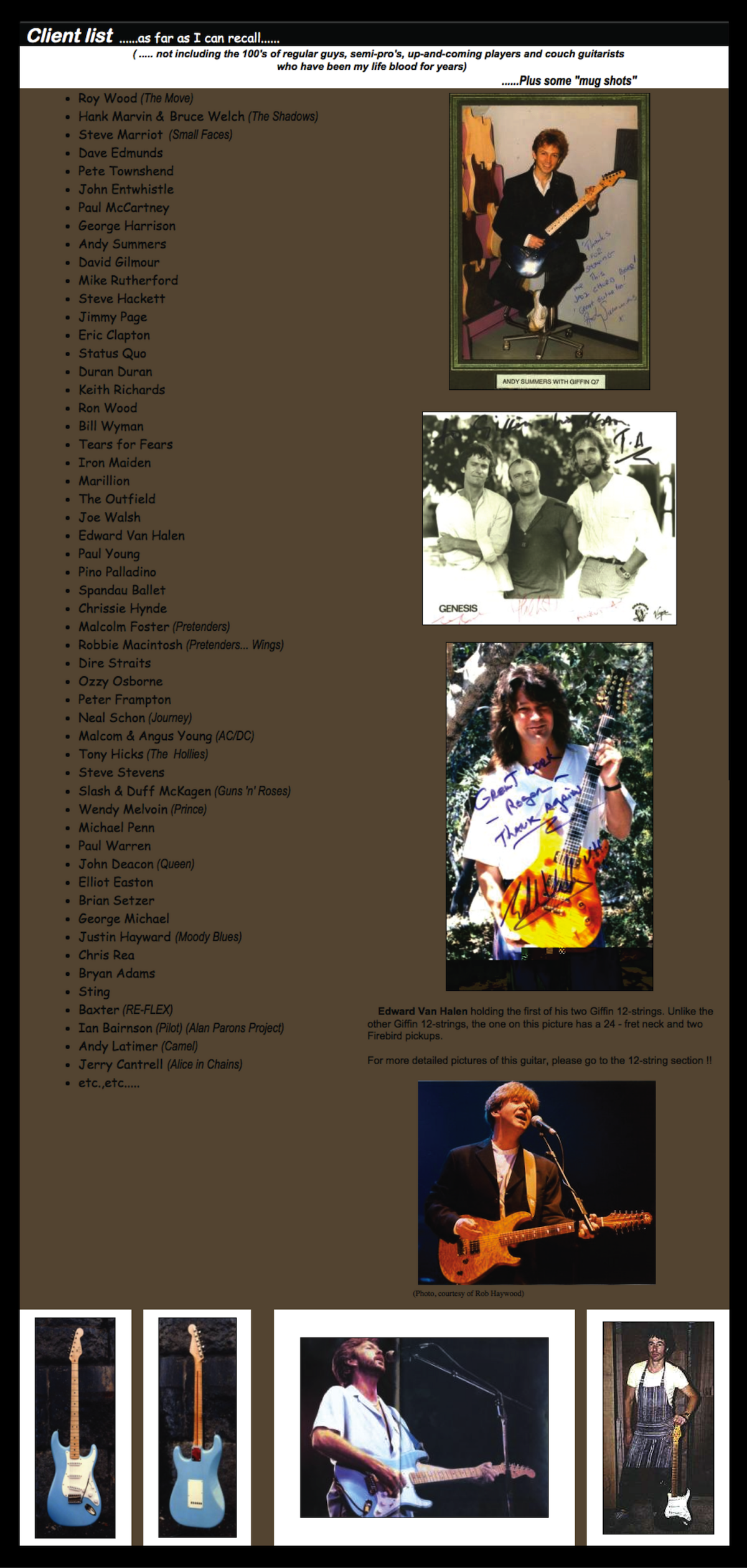
Here is more on Roger from Guitar Aficionado:

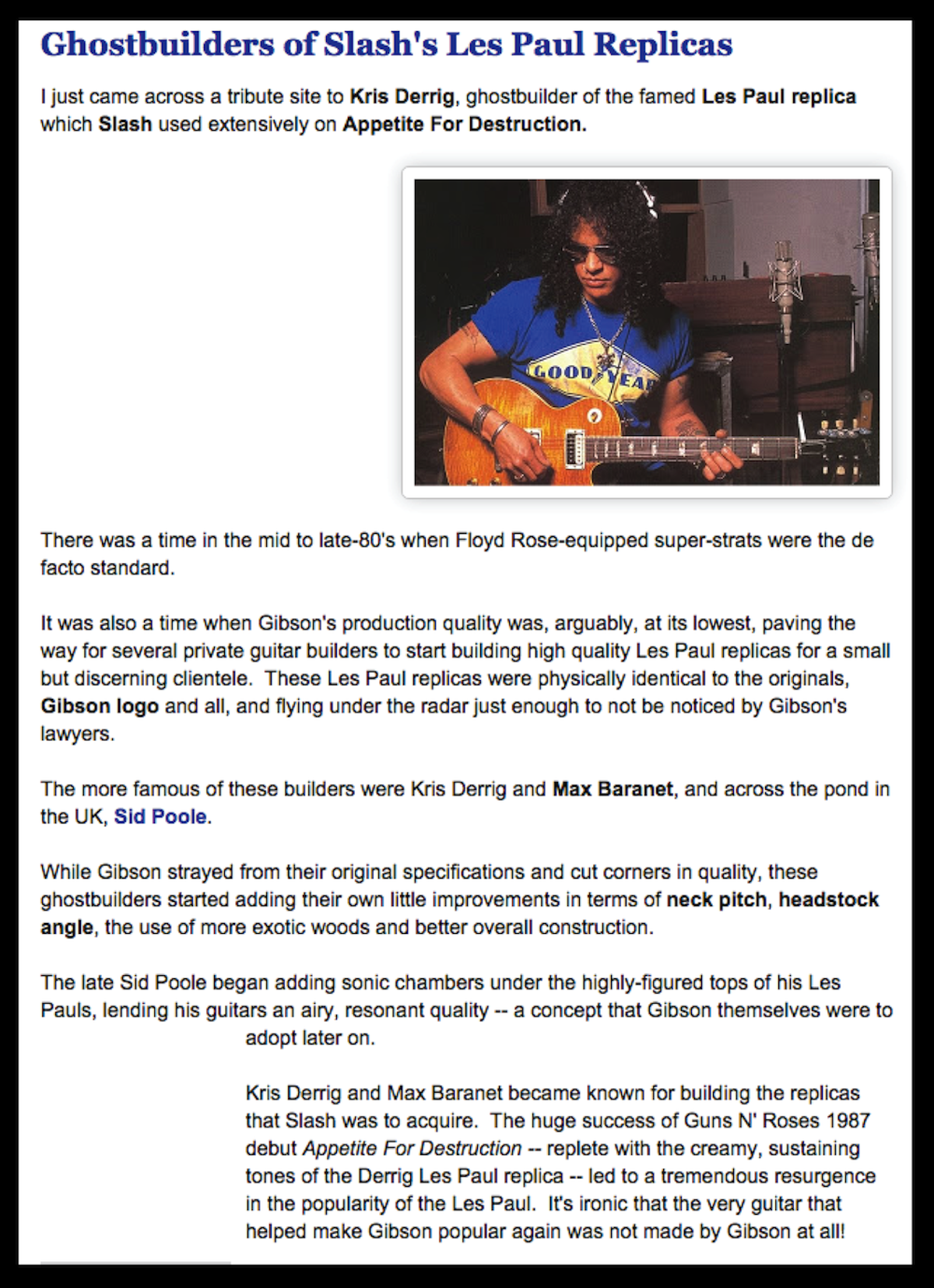
Slash's killer Les Paul used on "Appetite" was apparently actually built by Kris Derrig, NOT by Gibson and it is apparently still the guitar he uses in the studio:
There doesn't seem to be a great love or even respect for the late Ed Roman on the board, but I considered him a friend - even though we never did any real business together. I showed Ed the first PRS he ever saw, in 1977 which was my first PRS bass, #7. I always giggled when I got that annual call from Ed trying to coerce me into selling it to him. And yes, he was offering REAL money, even back then. Ed was a loud-mouthed, self-serving madman: coarse, crude, rude - a highly opinionated "know it all" - and that is exactly what I loved about him. Does that completely kill his credibility? Perhaps.
Ed had a pretty notorious reputation as a "ghost builder" for many different companies, including Gibson, Kramer, Steinberger and a laundry list of others. He had a true disdain for most of the big guitar companies and I think he got a vicarious thrill out of duplicating their instruments. He also pulled back the curtain and exposed many others doing the same thing. It's a pretty long read to post the entire Roman Ghost Building "rant" here, but it's worth checking out if the subject is of interest. It used to be almost twice as long, but over the years he had so many lawsuits threatened that he had to take parts of it down. It shrunk accordingly.
Rants - Ghost Builders - Ed Roman Guitars
My attitude is - the truth is the truth is the truth - and the more we know about Ghost Builders and the truth, the more we can keep our eyes wide open when buying any instrument. For example, how do we really know that those two old Sting Fender P's weren't actually built by Roger? Or perhaps he built the jazz bass we saw McCartney playing? I would bet there is an awful lot of "covert" information floating around in Roger's head. Maybe he will spill all the beans someday in an interview or perhaps a book. I, for one, certainly hope so.
Comment if you see fit, and if you have any additional information on the subject please feel free to post it here. But watch your back - the guitar companies don't like this information floating around.
I am hearing a lot these days about "Ghost Builders" many times world class luthiers, who build top of the line guitars for the stars - yet use the original Fender, Gibson or whatever logo they are replicating - on the headstock. I am hearing that the artists claim that they just couldn't get the quality or the features from the production guitar company custom shop. Or it could be as simple as an electronics or pickup set-up the artist wants - that the original manufacturer refuses to provide. So many times, the star commissions an outside luthier to replicate the guitars of their dreams. Then they get permission to throw the logo of the original guitar company on the headstock.
The subject has been tackled peripherally on TB with many of you considering this to be blasphemy and condemning this process on almost every level. You don't want to know that the real stars in many cases are not playing Fenders, Gibsons or _________ at all, but are playing world class replicas of those guitars or basses. I personally find it fascinating, and I am hoping that some of you might as well. Like most things, everything you hear comes from the web and could be suspect, so the question is - what is the truth about "Ghost Builders?"
First of all - to state the obvious - you are Gibson or Fender for a moment. The Rock Star artist plays your guitars - but wants a guitar with this or that - special features or a craftsmanship quality that is over and above your normal offerings, even in your custom shop. You make a couple and he or she isn't happy. You haven't nailed it for whatever reason. Now what?
The world class artist has a choice, should he or she decide to commission the build elsewhere. They can have a pretty exact replica built and put on a bogus or no-name headstock decal on it. Or, they can sanction the project covertly through the guitar maker to allow their headstock decal - even though they had nothing to do with building that particular guitar. So, as a business person - I see this as a win-win-win. The guitar company has the advantage of the public thinking the artist is playing their guitars. The artist gets the guitar he wants, hand-crafted exactly to his or her specs - and the builder stays busy with some cool world-class projects. Of course, it's covert, deceptive and wrong - but if you think the guitar company doesn't want that decal on the headstock, you are sorely mistaken. This is especially true if the guitar turns out to be the #1 or if the guitar turns up in his or her stage rotation on a regular basis.
It's a no-brainer from a marketing point of view to me. Thousands of guitars have been sold by the major companies over the years - with players purchasing guitars that they thought were the same model played by their heroes. Yes it's deceptive practices 101 actually - of course, the consumer wasn't getting that model at all - because their heroes are playing a replica made in a world class luthier shop somewhere.
My guess is that it happens much more than we realize. Even if it's a simpler matter of changing out the pickups, certain manufacturers have deals with certain pickup companies. Putting anything else in their production models could leave them vulnerable to a lawsuit - due to the violation of their sometimes exclusive pickup contracts. It's a complex subject, so I thought it might be fun to explore it here. It's even rumored that sometimes money even changes hands from one side or the other, depending on the star power and the arrangement. I might point out that I have ZERO intimate first-hand knowledge of any of this, and I am not presenting anything here that isn't readily available on the interwebs. I am simply providing it in one place, so if you are up for it, the discussion can take place here.
I was pretty amazed to find that Jimmy Page's number three Les Paul, six of Pete Townsends's Tele's - along with the Eric Clapton's "Blackie's" - were actually built by Roger Giffin, not Gibson or Fender. Giffin also built basses for the likes of Sting, Paul McCartney, John Entwhistle, Mike Rutherford and Bill Wyman, to name a few. Here is a partial client list:
Here is more on Roger from Guitar Aficionado:
Slash's killer Les Paul used on "Appetite" was apparently actually built by Kris Derrig, NOT by Gibson and it is apparently still the guitar he uses in the studio:
There doesn't seem to be a great love or even respect for the late Ed Roman on the board, but I considered him a friend - even though we never did any real business together. I showed Ed the first PRS he ever saw, in 1977 which was my first PRS bass, #7. I always giggled when I got that annual call from Ed trying to coerce me into selling it to him. And yes, he was offering REAL money, even back then. Ed was a loud-mouthed, self-serving madman: coarse, crude, rude - a highly opinionated "know it all" - and that is exactly what I loved about him. Does that completely kill his credibility? Perhaps.
Ed had a pretty notorious reputation as a "ghost builder" for many different companies, including Gibson, Kramer, Steinberger and a laundry list of others. He had a true disdain for most of the big guitar companies and I think he got a vicarious thrill out of duplicating their instruments. He also pulled back the curtain and exposed many others doing the same thing. It's a pretty long read to post the entire Roman Ghost Building "rant" here, but it's worth checking out if the subject is of interest. It used to be almost twice as long, but over the years he had so many lawsuits threatened that he had to take parts of it down. It shrunk accordingly.
Rants - Ghost Builders - Ed Roman Guitars
My attitude is - the truth is the truth is the truth - and the more we know about Ghost Builders and the truth, the more we can keep our eyes wide open when buying any instrument. For example, how do we really know that those two old Sting Fender P's weren't actually built by Roger? Or perhaps he built the jazz bass we saw McCartney playing? I would bet there is an awful lot of "covert" information floating around in Roger's head. Maybe he will spill all the beans someday in an interview or perhaps a book. I, for one, certainly hope so.
Comment if you see fit, and if you have any additional information on the subject please feel free to post it here. But watch your back - the guitar companies don't like this information floating around.
Last edited:










 I always wondered how much was fact and how much was Ed's self promotion.


