

Enjoy the benefits of a premium membership!
Upgrade Account
-
TalkBass has been independent since 1998. Add your voice.
Create a free account to reply to discussions, view embedded media, and browse with fewer display ads.
Join free Log in
Want zero display ads or expanded classifieds tools? Compare plans.
You are using an out of date browser. It may not display this or other websites correctly.
You should upgrade or use an alternative browser.
You should upgrade or use an alternative browser.
Ghosts (Real or Bull)
- Thread starter manicmicky
- Start date
More options
Who Replied?
Complete & utter bull.
If all additional circumstances are considered, it is clear that there is a rational explanation for *almost* everything.
The guy seeing an apparition in his room - waking up from a deep sleep & the combination of lighting & surfaces pretty much explains this one. (which the poster explained).
Seeing Selena's image in the door - There was probably not too much else that SelenaBassGirl thought about while staying at that hotel, so it makes sense that she would see the image. Would anyone else (even those who learned about the murder) have seen the image? Not likely.
It requires as much faith as belief in deities does. I don't buy any of it.
ian
If all additional circumstances are considered, it is clear that there is a rational explanation for *almost* everything.
The guy seeing an apparition in his room - waking up from a deep sleep & the combination of lighting & surfaces pretty much explains this one. (which the poster explained).
Seeing Selena's image in the door - There was probably not too much else that SelenaBassGirl thought about while staying at that hotel, so it makes sense that she would see the image. Would anyone else (even those who learned about the murder) have seen the image? Not likely.
It requires as much faith as belief in deities does. I don't buy any of it.
ian
I think Feynman estimated 90% of "scientific" research was bunk. I think that's conservative.
where's the quote from? also, what journals do you read?
Most experimental research and/or the interpretation of its resulting data are flawed, even when the research is conducted in open good faith, which it usually isn't.
Doing pure, disinterested, valid scientific research is incredibly expensive in terms of time and money and resources.
The prime effort in research is therefore securing funding, and the source of clean disinterested funding is very limited.
When you see some news article that says, "scientists at UCLA have discovered..." people ignorantly assume that this research was done in an ivory tower funded by the university and by extension the taxpayers. It rarely is. It's almost always funded by a corporate third party with a deep financial interest in the outcome, and if your conclusions don't come out the way they want them to, you won't receive funding from them next time around. Find the "right" results and you'll see more money.
well, in physics, most (almost all) research is supported by the national science foundation or the department of energy, both government agencies.
Find the right result and their publicists will see that "news" of your discovery will get in the media and you'll other career-enhancing benefits. Who funded the "study" will rarely be honestly revealed.
...at the end of every article. ("This study was funded by Grant XXXXXX by the National Science Foundation" or what have you.)
And that's the short explanation.
It's a system so full of corruption, conflict of interest and effective non-disclosure that it wouldn't be tolerated even in politics. Never mind the professional rivalries, nest-feathering, empire-building, intellectual dishonesties, insecurities and consuming ego of the scientists themselves before the bagman even arrives.
it's certainly a human enterprise, but cases of scientific fraud are taken quite seriously. there's a professor at harvard whose work in primate behavioral research has come into question. you can check that out to see how investigations are handled.
http://www.policymed.com/2010/08/ha...dulent-nih-primate-research-immoral-mind.html
Scientific research -- which occasionally does produce scraps of wonderful advances in human knowledge -- is predominantly a system of prostitution.
A simple example -- I have tendinosis, a condition for which there's little medical treatment. A friend of mine suggested I take lots of gelatin. I said that as far as I knew, this wouldn't work due to the way the body supposedly deals with ingested scleroprotein, but he said, no, "research" had shown it worked to strengthen connective tissue and repair injuries to it.
Being curious, I eventually found the fairly obscure study from a fairly minor university. It was funded by (wait for it!) the parent corporation then owning Knox gelatin, who then saw much expensive general publicity for the results in popular sports medicine media. The impression was that there was more funding in publicizing the results than doing the research.
Does this mean that the results were necessarily false or deceptive? No, but it shows that the integrity of the research is hopelessly tainted.
This is the rule rather than the exception.
Another disgraceful example is the current public and professional advocacy of (immensely profitable) psychiatric drugs by those in the medical and academic research communities, each of whom are receiving money or other benefits from the companies making the drugs. Never mind that there is no clean research showing them to be safe or effective, or even good scientific evidence for the hypothesis upon which psychiatric drugs have accomplished their staggeringly profitable dominance in the treatment of mental illness. [vide Whitaker]
There are immense ethical problems in current scientific research.
a great resource in health-related research is the blog "science-based medicine." it's a bit too thorough for casual reading, but if you have something specific to look up, it's perfect. of course, it doesn't cover the entirety of the field, as it is written by volunteer doctors and researchers. but, at least, it's an example of science-done-right.
As an Amazon Associate, TalkBass may receive commissions from qualifying purchases made via links on this site.
Quoted for truth....There are immense ethical problems in current scientific research...

I'm more of a " Why believe it until they prove it's real?" kinda guy.
Most people that feel this way wouldn't beleive until something happened to them persoanlly. I have had experiences in my life that strongly suggest at a minimum a plane of existence that is not normally perceptible, but me telling you about it probably won't "make you believe" even though it is indeed proof.
And no - never used any hallucinogens

If all additional circumstances are considered, it is clear that there is a rational explanation for *almost* everything.
The guy seeing an apparition in his room - waking up from a deep sleep & the combination of lighting & surfaces pretty much explains this one. (which the poster explained).
Seeing Selena's image in the door - There was probably not too much else that SelenaBassGirl thought about while staying at that hotel, so it makes sense that she would see the image. Would anyone else (even those who learned about the murder) have seen the image? Not likely.
It requires as much faith as belief in deities does. I don't buy any of it.
ian
Why is a "supernatural" explanation automatically irrational? I'm a scientist by trade and absolutely accept the possibility that things exist that are not curently understood. The world was flat once, right?

I didn't until I went to Corpus Christi, TX. It was my second venture there-and the first week we stayed in a condo, and the last two nights at the hotel next to the room where Selena was shot at. Those of you who don't know who Selena was, she was a beautiful Tejano singer, who was making it as a singer. She was shot on April 30th, 1995, by her fan club president and manager of her clothing boutique. The lady was scamming money from her. Selena went to the hotel room where the lady (Yolanda Saldivar) was staying at, to get some tax papers-after firing her. Selena was walking out the door when Yolanda pulled out a .38 and shot her in the back-spattering blood on the door, carpet and sidewalk.. Selena then ran to the lobby where she collapsed, but after saying the name of the person who shot her. She died enroute to the hospital.
They changed the room numbers to prevent fans from graffiti the door etc. but us fans all know which room it was.
The second day we were at the hotel, I took a picture of my daughter outside our room. It was later when I got home, I noticed the faces in the door. One looked like Selena, how she looked when she won her Grammy.
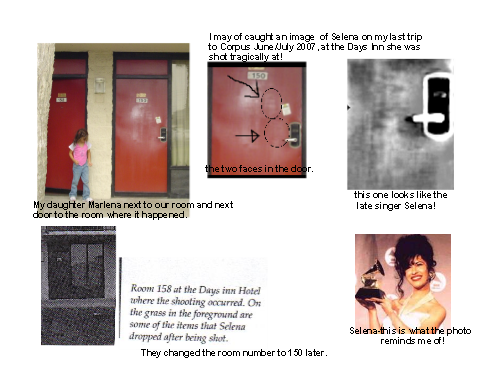
actually there is one BIG face in the door and two smaller ones. the one near the door handle looks like Selena. I darkened and made the picture bigger to see it better.
Am I the only one who doesn't see the face at all?

Am I the only one who doesn't see the face at all?
No.
Although something kind of looks like a nondescript face. Without delving deeper, Selena wouldn't have endorsed such a sighting, either.
Now that is just downright hilarious, LOL


I've had some really, really bizarre stuff happen that I've witnessed. I don't believe in ghosts or life on other planets - BUT I do believe both are possible. Thinking something is possible is not the same as believing in them.
EDIT: also ghost adventures is a crappy show with overacting juveniles running it. Ghost Hunters is far better IMHO
I don't believe in ghosts,ETs,god etc. but I believe anything is possible.
Also ETs have a bigger possibility of being than ghosts I believe. And if I recall correctly,there was a mathematical equation/theory that says there's life out there.

Am I the only one who doesn't see the face at all?
I certainly didn't!

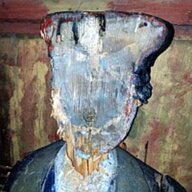
I'm just now reading Visions, Apparitions, Alien Visitors: A Comparative Study of the Entity Enigma by Hilary Evans. Despite the unwieldy title it's quite the best-written summing up of these problematic phenomena I've come across. Evans finds much to support the hypothesis that there is an unrecognized faculty (which he calls the 'producer') within the human psyche that stages such displays so skilfully that they seem entirely convincing. Yet they are not conventionally real, but are rather somehow superimposed on and integrated with perceptual reality, and the power of the mind is such that even physical effects can be produced and other people affected as if by induction.

Why is a "supernatural" explanation automatically irrational? I'm a scientist by trade and absolutely accept the possibility that things exist that are not curently understood. The world was flat once, right?
Which branch of science?
The world has always been round, save possibly for a period when a chunk got knocked out, that's now the moon. The ancient Greeks debated the circumference of the earth.
I'm a scientist too, and I accept that things exist which are not currently understood, because they are staring us in the face. We don't fully understand gravity, or Alzheimer's disease.
I personally think it's irrational for a scientist to suppose a breakdown of naturalism when presented with claims of phenomena that are unsupported by robust evidence.
Which branch of science?
The world has always been round, save possibly for a period when a chunk got knocked out, that's now the moon. The ancient Greeks debated the circumference of the earth.
I'm a scientist too, and I accept that things exist which are not currently understood, because they are staring us in the face. We don't fully understand gravity, or Alzheimer's disease.
I personally think it's irrational for a scientist to suppose a breakdown of naturalism when presented with claims of phenomena that are unsupported by robust evidence.
I work in molecular bio/pharmacology. I agree with you completely and bolded the section that I really like, a better choice of words than I made; by "supernatural", I was referring to something that just isn't currently understood - thus, the quotation marks. The assertion that a phenomena is unexplainable because the knowledge to understand it is not currently available is a bit absurd
No matter how mundane, even significant research within so-called "pure science" is subject to deforming pressures, if nothing worse than wishful thinking, flawed protocol or misinterpretation of resulting data.
It's extraordinarily hard, unglamorous, tedious and stressful to do really clean science, and science has to be really clean to be valid at all. It takes tremendous attention, dedication and courage to do it -- never mind strenuous self-honesty. That was Feynman's point, and it should be obvious.
I don't think it's really all that hard.
Of course I acknowledge that there is an issue with science research influenced by corporate sponsors such as drug companies and the coal industry. But I also think that accusing science of widespread fraud is inflammatory and unsupportable. Most of science is just too mundane to be worth faking.
Personally, I think that the safety and efficacy of drugs is more about technology than science, not that I consider that to be an excuse.
Now it's interesting that we're talking about science. Of all the fields of study, why was science even mentioned in this thread? Don't we have people in other fields, such as theology, to whom we can turn for guidance on the existence of ghosts? The Catholic Church has an entire department devoted to determining the veracity of miracles, and trains Bishops in the detection of demons.
The only reason why it's even meaningful to talk about the integrity of science in this context, is that science has integrity worth defending. Indeed, science is one of three fields that I know of, that even have a standard of truth. The others are math and accounting. Imagine accusing a politician or a holy man of selectively presenting evidence that is favorable to his sponsors. You'd be greeted with a yawn. On the other hand, there was a meta-analysis strongly suggesting such a bias in prestigious medical journals, and it was greeted with outrage.
Disclaimer: I design scientific instruments for a living. My training is in physics, but today I am as much of a technologist as a scientist.
Quoted for truth.
whooooooaaah! i didn't say that at all. so "
 " for putting words in my mouth, unless you are being intentionally unethical for irony's sake. (then "")
I work in molecular bio/pharmacology. I agree with you completely and bolded the section that I really like, a better choice of words than I made; by "supernatural", I was referring to something that just isn't currently understood - thus, the quotation marks. The assertion that a phenomena is unexplainable because the knowledge to understand it is not currently available is a bit absurd
following this tangent a little further, sean carroll of caltech had a good blog post about what he thinks "supernatural" even means, as far as scientific investigation goes.
Link Removed
Dangit! Nope, that was my bad. Forgot to pull your name from the code. Fixed now. Sorry dude!whooooooaaah! i didn't say that at all. so "


I think ghosts are a manifestation of the human mind. A non physical 'being' cannot do physical things! Period.


