• TalkBass has been independent since 1998. Add your voice.
    Create a free account to reply to discussions, view embedded media, and browse with fewer display ads.
    Join freeLog in
    Want zero display ads or expanded classifieds tools? Compare plans.

Gibson Ripper Club!

How good is the Ripper?


  • Total voters
    121
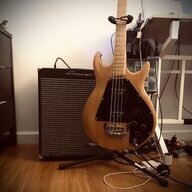
Here's my '77. First and only bass I ever bought new - from Kalamazoo!
Bought to replace a stolen '68 EB-3.
Still play it daily. A hefty axe. ;) :bassist: :hyper:

View attachment 4859027

A lotta laquer worn off the back of the neck

View attachment 4859038

Wicked cool axes! When you had gotten it back in 77, did it take a while to get comfortable with the ripper as a whole (tone & size) vs your 68 EB-3?

 
Wicked cool axes! When you had gotten it back in 77, did it take a while to get comfortable with the ripper as a whole (tone & size) vs your 68 EB-3?

Oh yah it did! The fingerboard was a lot longer and it weighed a ton more than the little mahogany EB.

Can't remember the tone variations from the chickenhead tone selector of the EB.
On the Ripper I'm usually tone selected on 3 mostly or 2 a lot. I like bottom with a lot of attack.
1 is very bassy and poofy meaning I have to roll off a lot of bass on the tone knob and amp EQ (I think this was Gibson's stap at a P bass)
4 is very thin and trebly which means I have to add a lot of bass EQ at least on the bass tone knob. (I think this was Gibson's stab at the Ric*O*Sound).
 
Last edited:
Picked up this '75 Ripper back in January. Has been my go-to ever since for pick playing.
IMG_5447.jpeg
 
5049-1389538723-9fec201145b2b62ed744e3a7bd2ee34d.jpg
petercetera.jpg


Peter Cetera of Chicago also used a Gibson Ripper Bass, which he started using sometime around 1976. Although he did use the Ripper in the studio it is unknown what records he played it on, but something tells me he probably used it on Chicago X and Chicago XI.

Other than that, not much is known on Peter Cetera's Ripper or what happened to it after he left Chicago.
 
It’s almost impossible to date Rippers in the using just a serial number because the first digit in the serial number was used in multiple years. See here for more: Gibson Serial Numbers Legenda
The best way to day a Ripper is by reading the pot codes. That said, the original fat horn body shape was used in ‘73 and ‘74, so that can be a clue.
73/73 fat horn on the left, ‘75 or later thin horn on the right.

IMG_0025.jpeg


Most of the Rippers described as ‘74s by whoever is selling it actually aren’t, because they have thin body horns. The mistake is made because the seller picks the earliest possible year of the several that could be possibly correct by the using the serial number range.

See here for more. Please help me date my Ripper?

Yours is weird because six digit serial numbers in the 900000 range were used from 1970-1972. Mass Ripper production began in 1974 (there were a couple of dozen in late ‘73) so…a mystery! Post a pic!
 
Last edited:
My Ripper shows serial # 966999 Made in USA.
Is this a 1974 model? Thanks
The fact that is has a 6 digit serial number means it should be pre-'77, and like Daniel said if it's not the rounder shape then it has to be either 75-77. From there, I would weigh it. from 75 to late 76 they made the bodies out of alder which tend to weigh around the 8-9lbs mark, where a maple body would weigh on average closer from 9.5-10.5lbs.

Obviously this is all if you don't want to open it up and check the pot codes yourself. From experience, the wiring Gibson used in the 70s was garbage and super thin so be careful because they could snap off relatively easily. Had to take mine in twice to get re-souldered.

Hope this helps!
 
The fact that is has a 6 digit serial number means it should be pre-'77, and like Daniel said if it's not the rounder shape then it has to be either 75-77. From there, I would weigh it. from 75 to late 76 they made the bodies out of alder which tend to weigh around the 8-9lbs mark, where a maple body would weigh on average closer from 9.5-10.5lbs.

Obviously this is all if you don't want to open it up and check the pot codes yourself. From experience, the wiring Gibson used in the 70s was garbage and super thin so be careful because they could snap off relatively easily. Had to take mine in twice to get re-souldered.

Hope this helps!
Also forgot to mention that in 76 they started using metal for the string ferules on the back of the body!
 
I know refinishes are blasphemous, but the refin on this helped me score a 1975 Ripper for a decent price in this hot used guitar market!

Also, I’ve always been a sucker for walnut…so this just felt right. Hopefully it’ll be here by Tuesday!

I’m part of the club now, boys!

:bassist:

That's gotta be one of the nicest looking Rippers I've ever seen!
 
I’ve recently joined the Ripper Owners Club, although I may be an outcast because mine is one of the 350 from the 2009 reissue series. I bought the bass used, and love the feel of the neck but I’m feeling like the pickups are pretty low output and I’ve not gotten the string height to a comfortable spot because mine still has the 3 point bridge where I can’t lower or higher the individual string. I’m hoping to get the bridge replaced in the coming months and then can get a proper setup on it.

IMG_4938.jpeg
 
I’ve recently joined the Ripper Owners Club, although I may be an outcast because mine is one of the 350 from the 2009 reissue series. I bought the bass used, and love the feel of the neck but I’m feeling like the pickups are pretty low output and I’ve not gotten the string height to a comfortable spot because mine still has the 3 point bridge where I can’t lower or higher the individual string. I’m hoping to get the bridge replaced in the coming months and then can get a proper setup on it.

View attachment 5105549
I've always been curious how these sounded in comparison. They're pretty rare so still a super cool addition to your collection!
 
  • Like
Reactions: quilanthegreat

Latest posts