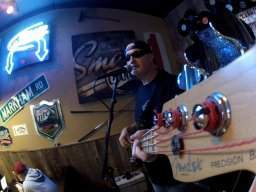
Great idea for a thread! There are a lot of boards online that would be pretty unrealistic to gig with. I gig a lot & here is my much used board. I found my sweet spot & have not changed anything in quit awhile.

TalkBass has been independent since 1998. Add your voice.
Create a free account to reply to discussions, view embedded media, and browse with fewer display ads.
Join free Log in
Want zero display ads or expanded classifieds tools? Compare plans.
Have you been to the breeder threadGigging is the main reason to have a pedalboard. For home playing and recording, there's not as much need to have a single thing to plug in that only takes a few seconds to unpack/pack up.


Yeah, I use my tuner as a mute, too. It's at the beginning of my chain, though, whereas I see a lot of dudes here with it at what looks like the last position on the board.

Nah, it makes sense with like 16 effects to turn off and on. I only have five, so it wouldn't make as much sense.It's my control panel for everything. It's an extremely powerful switching unit with flip-flop capabilities, blending, switchable buffers, etc. I needed a switching unit as we use a fair amount of effects and I sucked at tap dancing. But the main reason I got the Pedal Palette two years ago was that I needed an easy solution to a problem I encountered using the EHX B9/c9/key9 series. What I wanted to do was give those pedals a clean, uncompressed, no-always on overdrive signal while still using my standard "clean tone" for the bass line. The best sounds I have gotten from the series is when I send the keys signal to the PA and keep my normal bass signal going to my amp/cab. When I switched on the keys sound, I wanted my basic sound out of my cab to not change while the PA got a nice keys signal. But at the same time, I didn't want the EHX pedals to receive a colored signal as they sounded best first in line.
So I set my Pedal Palette up like this:
loop 1 - Always on - e.g. Cali comp, Valvecaster
Loop 2 - dirt (irrelevant for this example)
Loop 3 - keys / organ - e.g. EHX Series into the Strymon Lex straight to the board
loop 4 - other (irrelevant for this example)
And my first preset is just loop 1. Preset 2 is my keys loop and the following happens:
The Pedal Palette flips the order of the loops (1,2,3,4 becomes 3,4,1,2) so Loop 3 sees a clean signal and sends it straight to the board/PA. Then Loop 1 in parallel is engaged with all my normal always on stuff and that goes to the amp. Since Loop 1 is in parallel, it sees a clean signal as though it was first in line and doesn't care that the Keys loop is ahead of it.
I use this setup often with the Ravish as well. Similarly useful if you want to do lines on Ravish that track your bass lines and have them coming from 2 separate speakers.
These days I think the Boss ES-5 / ES-8 series probably trump the Pedal Palette. But I am not sure. The ES-5 is longer but less deep. Costs pretty close to the same amount. I find they work great - perfectly quiet switching, easy to program, easy to switch between presets and manual mode. Just a great unit. Hasn't given me anything but help.
Sorry for the long explanation
I don't have enough pedals to be on there.Have you been to the breeder thread
Yeah, mine is first just because it seemed to make sense. I don't know if there's a technical reason for putting it there, or anywhere else.I use mine as a mute as well. It's third from the end in the always in line stuff. It's there because it fits well there and no other reason.
Nah, it makes sense with like 16 effects to turn off and on. I only have five, so it wouldn't make as much sense.
I don't have enough pedals to be on there.
Yeah, mine is first just because it seemed to make sense. I don't know if there's a technical reason for putting it there, or anywhere else.


It's my control panel for everything. It's an extremely powerful switching unit with flip-flop capabilities, blending, switchable buffers, etc. I needed a switching unit as we use a fair amount of effects and I sucked at tap dancing. But the main reason I got the Pedal Palette two years ago was that I needed an easy solution to a problem I encountered using the EHX B9/c9/key9 series. What I wanted to do was give those pedals a clean, uncompressed, no-always on overdrive signal while still using my standard "clean tone" for the bass line. The best sounds I have gotten from the series is when I send the keys signal to the PA and keep my normal bass signal going to my amp/cab. When I switched on the keys sound, I wanted my basic sound out of my cab to not change while the PA got a nice keys signal. But at the same time, I didn't want the EHX pedals to receive a colored signal as they sounded best first in line.
So I set my Pedal Palette up like this:
loop 1 - Always on - e.g. Cali comp, Valvecaster
Loop 2 - dirt (irrelevant for this example)
Loop 3 - keys / organ - e.g. EHX Series into the Strymon Lex straight to the board
loop 4 - other (irrelevant for this example)
And my first preset is just loop 1. Preset 2 is my keys loop and the following happens:
The Pedal Palette flips the order of the loops (1,2,3,4 becomes 3,4,1,2) so Loop 3 sees a clean signal and sends it straight to the board/PA. Then Loop 1 in parallel is engaged with all my normal always on stuff and that goes to the amp. Since Loop 1 is in parallel, it sees a clean signal as though it was first in line and doesn't care that the Keys loop is ahead of it.
I use this setup often with the Ravish as well. Similarly useful if you want to do lines on Ravish that track your bass lines and have them coming from 2 separate speakers.
These days I think the Boss ES-5 / ES-8 series probably trump the Pedal Palette. But I am not sure. The ES-5 is longer but less deep. Costs pretty close to the same amount. I find they work great - perfectly quiet switching, easy to program, easy to switch between presets and manual mode. Just a great unit. Hasn't given me anything but help.
Sorry for the long explanation


I've got a request....
Being a complete pedal newb, is there any chance that you guys posting your boards could say what it is that's on them...and why?......Loving the pics....pretty....but I have no clue as to what's what....


Yeah, I use my tuner as a mute, too. It's at the beginning of my chain, though, whereas I see a lot of dudes here with it at what looks like the last position on the board.
Yeah....Even I could grasp that.....Thanks.....Sure - in the pic above yours, there's a distortion and a fuzz.

My setup: Picture in Post 81
Bass>Pitchfork-01> Badger Schism>Pitchblack Tuner>MXR Bass Compressor>Sansamp BDDI>PRO-DI/Amp
Schism Loop 01: Pitchfork-02>MS60b-01>MS60B-02> Modded Boss ODB-3
Schism Loop 02: JamMan SoloXT
I never turn off the MXR Compressor or the Sansamp BDDI
The Schism is a dry blend (for those who don't know) Main use of Pitchfork-01 to drop tune everything a whole step, hence it being in front. Pitchfork-02 I use for octave below or above (above most) depending on the song.
The MS60B's both have the same set of patches. Having it this way gives me a ridiculous amount of options depending on how I stack them. One example is MS60b-01 with a patch that is "Slow Attack" & "Flanger" pushing MS60B-02 with a patch that is reverb & a touch of delay pushing the ODB-3 for dirt. This gives me a surprisingly convincing smooth synth sound to play on slow songs. If I need it to be more aggressive I push it all with Pitchfork-02 set to upper octave.
I have multiple Filter patches & boost for solos ... and more
The JamMan I use to play Keyboard intros that I recorded at home ... it works very well for this.
The small 2 channel looper turns the MS60B's on & off
I play in a traditional 3 piece cover rock band with a non playing front man. We play weddings & corporate events more than anything else.




You should get one!Now I want a switcher.
I've got a request....
Being a complete pedal newb, is there any chance that you guys posting your boards could say what it is that's on them...and why?......Loving the pics....pretty....but I have no clue as to what's what....