Darn tootin. Properly cooked and seasoned snake meat can be delicious. The bones are annoying, but it's some tasty stuff.
Did/will you eat it?
tastes like chicken

TalkBass has been independent since 1998. Add your voice.
Create a free account to reply to discussions, view embedded media, and browse with fewer display ads.
Join free Log in
Want zero display ads or expanded classifieds tools? Compare plans.
Darn tootin. Properly cooked and seasoned snake meat can be delicious. The bones are annoying, but it's some tasty stuff.
Did/will you eat it?

Similar but with a distinctive flavor that's unique to all cold blooded animals. Kinda hard to describe. The flavor also fades quickly since there's barely any fat on the meat.tastes like chicken

Similar but with a distinctive flavor that's unique to all ectothermic animals. Kinda hard to describe. The flavor also fades quickly since there's barely any fat on the meat.
"Cold blooded" is a commonly accepted colloquial term for ectothermic, so you didn't quite fix anything, but thank you anyway.there Fixed it for you
"Cold blooded" is a commonly accepted colloquial term for ectothermic, so you didn't quite fix anything, but thank you anyway.

Believe me, I'm all about precision of language. I'm the guy that chimes in on a "Squire" thread only to correct the spelling.meh it's a bit like saying snakes are poisonous....peeve of mine
Gorns are slow. The snake has a good shot at victory.Snakeman vs Lizard Man
Awesome.
Believe me, I'm all about precision of language. I'm the guy that chimes in on a "Squire" thread only to correct the spelling.
It would indeed be incorrect to say "snakes are poisonous" without using the word "some." But "cold blooded" is still an acceptable colloquial version of "endothermic."
It's a stupid term though. Because of it, too many people think endotherm blood is actually cold.
Dear boys and girls of talk bass:
Crotalus adamanteus is the heaviest (though not longest) venomous snake in the Americas and the largest rattlesnake species.
The largest recorded rattlesnake was an eastern diamondback, killed in Carteret County, North Carolina, in 1959. This monster was eight feet long weighed approx. 34lbs., and is mounted in the North Carolina Museum of Natural History in Raleigh.
Second Largest ever recorded was 7 feet 8 inches in 1946
there has long been a hefty reward offered for specimens over 8 feet it has NEVER been collected!
specimens over 7 feet are very rare
there was however a report in 2009 of a 7.3 in eastern diamondback caught in St Augustine. that was originally reported at 15 feet
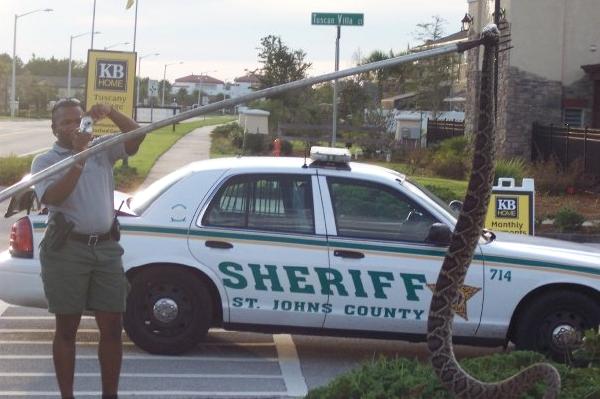
The Eastern diamondback averages about 5.5 feet in length with most commonly reaching 3.5 feet
the op's picture as well as the one above are very fine examples of forced perspective
Not trying to stir anything, but the Army Aviation museum at Ft. Rucker had a (mounted) 13 foot eastern diamondback on display. It's been more than 30 years since I've been there and they've moved into a nice big new facility so I don't know if it's still on display, but it was killed on one of the stage fields there back in the 50's if memory serves.
Also, my dad has a skin from an eastern diamondback that came from a snake laying across his driveway with it's head and tail in the bushes on either side. He got out of his truck to open the gate to his place one morning and it was laying right along side the gate. He shot it with a little .25 and I skinned and stretched it. It was just over 11 feet before we skinned it out. I have also seen several examples of eastern diamondbacks in the 10 foot range. Southeast Alabama, southwest Georgia, and northwest Florida are known for producing big eastern diamondbacks, but apparently not reporting them to record keepers. As far as that goes, I've killed a couple of velvet tails on my back porch up here in north central Alabama that were just over 7 feet, and have heard stories about some big eastern diamondbacks up here as well, though the biggest I've ever seen around my place was just over 6 feet long.
I grew up in East Texas, and have worked with reptiles my entire life....and I have personally never seen a rattler over 6 feet in length
you hear these stories all the time....I suppose it's possible, but science says they top out at the 8 foot mark! I shall have to research the Ft. Rucker snake......but as far as documented scientific evidence goes the largest ON RECORD is 96 inches!

I've read that too but it's quite debatable. The argument is that humans will kill rattlesnakes, and rattlesnakes that rattle are more likely to be noticed, and therefore killed, than snakes that are less likely to rattle--thereby leaving the non-rattling versions as the survivors which will then breed. However, there is absolutely zero evidence that this is actually occurring. Without any studies to show this effect happening, it's just an interesting hypothesis.
Believe me, I'm all about precision of language. I'm the guy that chimes in on a "Squire" thread only to correct the spelling.
It would indeed be incorrect to say "snakes are poisonous" without using the word "some." But "cold blooded" is still an acceptable colloquial version of "endothermic."
It's a stupid term though. Because of it, too many people think endotherm blood is actually cold.
Interesting. I never thought of it that way, but that makes good sense. Thanks!The terms poison and venom are often used interchangeably, but they actually have very different meanings. It is the delivery method that distinguishes one from the other.
Poison is absorbed or ingested; a poisonous animal can only deliver toxic chemicals if another animal touches or eats it. Venom, on the other hand, is always injected. Every venomous animal has a mechanism (e.g., stingers, fangs, etc.) to inject toxins directly into another animal. It is for these reasons that some species of frogs are poisonous to touch or eat, while snakes are venomous when they use their fangs to bite.


