• TalkBass has been independent since 1998. Add your voice.
    Create a free account to reply to discussions, view embedded media, and browse with fewer display ads.
    Join freeLog in
    Want zero display ads or expanded classifieds tools? Compare plans.

Graphite necks vs. headstock tuners?

After 35 years, I'm playing again, and bought a headstock tuner. Every few days, I put it on and notice the entire bass is a little off -- either all sharp or all flat. Now I know why folks cared so much that graphite necks on boutique basses hold tune so much better -- I never knew that wood necks drifted so much so easily.

Started thinking I should get a graphite neck. Then realized I could save thousands of bucks simply by using the tuner more often.

Then wondered "Is that the only advantage of a graphite neck -- holding tune?"

Would anybody mind giving a clue to an old newbie? Thanx everybody.
 
Last edited:
35 years ago was the start of the graphite craze according to my memory. Stability was the main reasons I would hear for it. Some would say it gets rid of dead spots but the science behind that claim was a little funky, at least in the ads.

Now that it's 35 years later I've seen so many bad graphite necks that have slowly moved or had glue and plastics break down I've lost interest in them. I love the high tech aspect of them but don't think it's a great material considering the cost and difficulty to make. As a gear head I would still want one but as a "musician" not so much.
 
Then wondered "Is that the only advantage of a graphite neck -- holding tune?"

Based on my experience -- I currently own three graphite-necked basses, two of which I've owned for over 35 years -- the #1 advantage of a graphite neck is consistent, uniform tone over the entire range of the instrument. Every note on the fingerboard speaks with the same clarity, authority, attack, and timbre.
 
Tuning stability comes down to the quality of the tuners, how accurately the nut is cut, how stable the bridge saddles are, the quality of the strings and most importantly how well you've wound the strings on the tuning pegs. Stretching the slack out of a string by tuning to pitch, pulling it up and away from the pickups and tuning up again will always help. Repeat this step until you stop pulling them flat.
All my guitars including a Steinberger and a Parker drift slowly out of tune over time.
 
If you don't check if your bass is in tune every time you go to play as part of your practice routine, are you even a bass player?

Jokes aside, if you really want to go down the graphite path, check out Status Graphite necks. I hear they're some of the best out there.
 
  • Like
Reactions: imabuddha
Another big selling point of graphite necks was that they wouldn't twist and warp like wood necks do when seasons change and weather fluctuates. A graphite neck, therefore, sounds great if you tour often or live in a place like New Jersey where we get crazy weather fluctuations. It's not unheard of to have spring days that are 37 degrees in the morning and 73 in the afternoon.

The counter to that was the bass community often describing the sound of graphite necked instruments as "sterile." And I recall Modulus had several models where the necks had a graphite core for stability, but wrapped wood around it and used wood fingerboards as a "best of both worlds" thing.

But it's still a case-by-case basis. Like others have said, they've seen wood necks that hold their tuning and stability no matter what (my old Warwick Corvette Standard with a 3-piece wenge neck was fantastic that way) while others have seen graphite necks flop (I recall that Moses graphite necks were notorious for QC issues).
 
I have a couple of Geoff Goulds (carbon necks), one for a number of years and was my main gigging bass. I always need to tune a bit as steel/metal strings are affected by temperature with some string types exhibiting more sensitivity to temperature than others. As others mentioned there are also some mechanical variations possible. I play the GG because it sounds great.

The bass I need to tune the least has a wood neck. What I have found, at least in casual observation, I said casual, don't jump me, that the head stock tuners have not been consistent and sometimes show different tuning even five minutes later. YMMV. That said I use a hard wired tuner most times.
 
  • Like
Reactions: Saetia
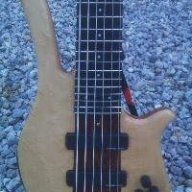
When I built my 6 string bass, I did a graphite neck. The only time it goes out of tune is if I bump a tuner. The graphite neck also has unlimited sustain and clear harmonics. I like it.
IMG_3408 (2).JPG
 
If you don't check if your bass is in tune every time you go to play as part of your practice routine, are you even a bass player?

Jokes aside, if you really want to go down the graphite path, check out Status Graphite necks. I hear they're some of the best out there.

I give a run up and down the neck everytime I pick it up and have, definitely don't have perfect pitch but with over 20 years playing
If you don't check if your bass is in tune every time you go to play as part of your practice routine, are you even a bass player?

Jokes aside, if you really want to go down the graphite path, check out Status Graphite necks. I hear they're some of the best out there.

Checking your tuning and having to tune are two different things :)

I wish I could validate the Status aspect as I have wanted one for quite some time. Actually almost sold my Modulus when Brexit happened as to take advantage of the amazing exchange rate at the time. Hopefully one day I will be able to comment. I have however played a Zon that was pretty wonderful.